
The Mechanism of the Effect of Benevolent Messages on the Attitude toward Foreign Immigrants in Korea

Copyright ⓒ 2026 by the Korean Society for Journalism and Communication Studies
Abstract
The current study explores the psychological mechanisms through which benevolent messages influence attitudes toward foreign immigrants. Intergroup threat, negative stereotypes and emotions toward foreign immigrants were suggested as mechanisms of the negative effect. Contrary to expectations, it was found that benevolent message had a positive effect on the attitude toward foreign immigrants. Threat perception has been shown to play a significant role in this effect. Benevolent message reduced threat perception, which in turn led to increase the positive attitude. Also, the effect occurs via sequential mediators: The benevolent message reduces threat perception, which in turn reduces negative emotions, which increase favorable attitudes. The effect of threat messages was found to be mediated only through emotions and was different from the mechanism of benevolent messages. Finally, stereotypes about foreign immigrants did not appear to mediate the effects of benevolent messages. The implications of the unexpected results were discussed.
Keywords:
benevolent message, intergroup threat, group emotions, foreign immigrants, psychological mechanismSince the 1990s, South Korea has begun to admit foreign workers to address its labor shortage. For the first time in its history, Korea began to receive large numbers of immigrants from diverse racial backgrounds. The number of incoming foreign workers has increased annually. According to Statistics Korea, the number of foreign immigrants residing in Korea surpassed 2.6 million in 2024, accounting for approximately 5% of the total population. As the birth rate in Korea continues to decline, the inflow of foreign labor is expected to increase further. Consequently, Korea is undergoing a transition into a multicultural society, making the integration of foreign immigrants and the establishment of harmonious relationships between immigrants and Koreans important societal issues.
Although the number of foreign immigrants has increased, many Koreans still lack direct contact with them. The main reason is that immigrant workers are more likely to be employed in specific labor-intensive fields, such as construction and agricultural day labor, or reside in concentrated geographic areas (Park, 2023). As a result, most Koreans come into contact with foreign immigrants indirectly, namely through the media. This raises important questions about how foreign immigrants are portrayed in the media and how such portrayals shape relationships between Koreans and foreign immigrants.
Prior studies have found that media coverage of foreign immigrants in Korea generally conveys two types of messages: threat messages and benevolent messages (Im, 2018; K. Kim, 2009). A threat message refers to a message suggesting that foreign immigrants undermine the goal attainment or well-being of Koreans (C. Kim & Koh, 2019; Riek et al., 2006). For instance, news reports claiming that foreign workers are taking construction day-labor jobs, which in turn leaves domestic workers unable to find work, constitute a typical threat message. A benevolent message portrays foreign immigrants as a marginalized group facing difficult circumstances and in need of assistance (K. Kim, 2009). Such messages mostly emphasize that shortcomings or discriminatory aspects of Korean policies place foreign immigrants in hardship. For example, news reports describing foreign migrant workers as suffering workplace injuries without receiving industrial accident compensation, or as living in substandard facilities such as plastic greenhouses, convey prototypical benevolent messages (see Appendix).1 Many studies have reported that a significant portion of news about foreign immigrants contains benevolent messages (e.g., Lee & Choi, 2016). Nonetheless, the influence of benevolent messages remains underexplored, whereas the effects of threat messages on intergroup relations have been widely studied. Because many studies have shown that how the media depict outgroups can influence attitudes toward the outgroup, examining the impact of benevolent messages on relations between Koreans and foreign immigrants is important. A recent study reported that benevolent messages had negative effects on intergroup attitudes through negative emotions (e.g., contempt), similar to threat messages (C. Kim, 2019). This finding is notable given its counterintuitive nature. However, this effect has been tested only once, and the psychological mechanism underlying the emotional response remains insufficiently explained—specifically, why benevolent messages evoke negative emotions instead of help-oriented intergroup emotions such as compassion or guilt. Benevolent messages can be understood as media reports that may support social integration by directing public attention to the hardships of disadvantaged minority groups. If so, it is necessary to understand why these messages can lead to negative effects. To understand outgroup-harm narratives and identify strategies to reduce their impact, it is essential to examine the psychological processes through which media messages foster a desire to harm the outgroup.
Therefore, the present study aims to reassess the impact of benevolent messages on attitudes toward foreign immigrants and to explore the psychological processes that drive these effects. To this end, the current study focuses on intergroup threat, a core construct in intergroup conflict research, to examine the role it may have played in producing the previously observed negative effects of benevolent messages. Furthermore, drawing on Intergroup Emotion Theory and the Stereotype Content Model, this study will investigate whether intergroup threat influences attitudes toward foreign immigrants through the mediation of intergroup emotions and/or stereotypes. It is expected that this study will contribute to a clearer understanding of the psychological mechanisms underlying the effects of benevolent messages and offer foundational insights for improving future media-based social integration strategies.
Threat and Benevolent Message
A substantial body of research has shown that the media often use biased language when reporting on racial minority groups. These groups are frequently depicted through negative stereotypes. For example, in U.S. mass media, Blacks are often portrayed as lazy, untrustworthy, unintelligent, and uneducated compared to Whites (Dixon & Linz, 2000; Mastro & Behm-Morawitz, 2005; Tukachinsky et al., 2015). Also, media tend to depict minority racial groups as a threat. Numerous studies have shown that U.S. media overrepresent African Americans as criminals, Latinos as undocumented immigrants, and Muslims as terrorists (Dixon & Linz, 2000; Dixon & Williams, 2015).
The Korean media are not fundamentally different. Foreign immigrants are often portrayed as a group that takes over Koreans’ jobs or commits violent crimes. For example, Park and Park (2016) found that violent crimes committed by foreign immigrants were overrepresented in Korean media; such crimes were reported more frequently than they occurred in reality. C. Kim and Koh (2019) analyzed major domestic television news programs and found that approximately 30% of coverage involving foreign immigrants included threat-related content.
Another dominant theme in Korean media coverage of foreign immigrants is the benevolent message. K. Kim (2009) found that approximately 80% of television news stories in Korea depicted foreign immigrants as a marginalized group in need of assistance due to difficult living conditions in Korean society. A similar trend was observed in print media. Lee and Choi (2016) reported that about 60% of Korean newspapers included benevolent messages in their coverage of foreign immigrants. Benevolent portrayals of immigrants are not unique to Korea. Research has shown that political elites in the United States also frequently employ benevolent rhetoric in discussions of immigration-related issues (Menjívar & Kil, 2002).
The Effect of Benevolent Messages
It is well established that threat messages have a detrimental impact on intergroup relations. Threat messages evoke negative emotions toward outgroups, worsen attitudes, and lead to opposition to policies that benefit outgroups (Gilmore et al., 2013; Seate & Mastro, 2015). For example, Stephan et al. (2005) found that when participants were exposed to messages suggesting that a hypothetical immigrant group would increase the state’s tax burden, their attitudes toward the group worsened. Moreover, threat messages can provoke more serious consequences, such as hatred toward outgroup (Hewstone et al., 2002). Kim et al. (2018) demonstrated that exposure to threat messages elicits derogatory responses toward outgroups via feelings of anger and contempt.
What effect, then, do benevolent messages have on relations with foreign immigrants? A body of research in persuasive communication has suggested that messages conveying the suffering of others can evoke prosocial emotions, including guilt and sympathy, which may subsequently facilitate helping-oriented responses and increase the likelihood of engaging in supportive behaviors (Lindsey, 2005; Lindsey et al., 2007; Sohn & Lee, 2016). For instance, Lindsey (2005) showed that exposure to messages emphasizing the severity of blood disorders such as leukemia and lymphoma—and urging bone marrow transplant and donor registration—elicited anticipated guilt among experimental participants, which in turn increased their likelihood of engaging in bone marrow donor behaviors. Additionally, Sohn and Lee (2016) found that exposure to messages portraying children suffering from hunger increased participants’ intentions to engage in helping behaviors, and that this effect was mediated by compassion and sympathy. Taken together, although these studies did not directly test benevolent messages, the findings indicate that such messages can elicit favorable reactions—such as positive attitudes and helping behaviors—toward foreign immigrants.
However, in an experiment, C. Kim (2019) directly tested the effect of benevolent messages and found that participants exposed to benevolent messages exhibited greater hatred toward foreign immigrants than those in a control group, producing effects similar to those of threat messages. Also, this study found that feelings of contempt mediated the effect of benevolent messages, yet it did not sufficiently explain why benevolent messages provoked such contempt.
It is plausible to speculate that the negative effects of benevolent messages are related to intergroup threat and stereotypes. Several theoretical frameworks support this assumption. For example, Realistic Group Conflict Theory posits that competition between groups over limited resources increases perceived threat and thereby worsens intergroup relations (Sherif, 1958). Similarly, the Instrumental Model of Group Conflict suggests that resource stress leads to perceived group competition and intergroup threat (Esses et al., 2012). In this model, resource stress refers to the perception that access to desired resources, such as jobs or money, is limited. The theory explains that when groups are perceived as competing for these resources, resource stress increases, and negative attitudes are likely to emerge as a response to this competition.
Benevolent messages depict foreign immigrants as living in poverty and in need of help. However, the messages may be perceived as a threat to Koreans’ well-being if Koreans perceive the plight of immigrants as a drain on national resources, thereby increasing competition for access to desired resources. In such cases, benevolent messages could be interpreted similarly to threat messages and may negatively influence attitudes toward foreign immigrants. Conversely, when individuals become aware of the hardships faced by foreign immigrants through benevolent messaging and feel prosocial emotions such as guilt or compassion, positive attitudinal and behavioral reactions toward foreign immigrants may also emerge. Because both positive and negative responses can emerge depending on how benevolent messages are interpreted, the current study poses the following research question and hypothesis.
- RQ1. What effect do benevolent messages have on attitudes toward foreign immigrants?
- H1. The effect of benevolent messages on attitudes toward foreign immigrants will be mediated by perceived threat.
- H2. The effect of benevolent messages on attitudes toward foreign immigrants will be mediated by guilt or compassion.
Perceived intergroup threat can also influence attitudes toward foreign immigrants through negative emotional responses. One theory linking threat and emotion is intergroup emotion theory (IET) (Mackie et al., 2000; Smith, 1993). According to IET, people define themselves as group members and experience emotions at the group level. These group emotions are important predictors of attitudes toward outgroups (Mackie et al., 2004). IET proposes that group emotions are shaped through a cognitive appraisal process, wherein individuals assess events based on their relevance to the group’s goals and well-being (Lazarus, 1991; Smith, 1993). Various appraisal dimensions have been suggested. For instance, Lazarus (1991) identified six appraisal dimensions: goal relevance, goal congruence, type of ego-identity, coping potential, blame or credit, and future expectation. Smith (1993) suggested five dimensions relevant to intergroup context: perceived obstacle, certainty, responsibility, legitimacy, and control. Among these, the perceived obstacle (analogous to goal congruence in Lazarus’ framework) refers to appraisal of whether an event is beneficial or not, which is assessment whether an event poses a threat to the ingroup. Perceive obstacle dimension is considered a primary appraisal, as it determines the valence of the emotional response. If ingroup members appraise a situation as harmful to their group goals, negative emotions such as anger or fear are likely to arise. Conversely, when a situation is appraised as beneficial, positive emotions are elicited. After the valence of emotion is determined, discrete emotions are crystallized by other appraisal components.
Based on IET, if Koreans perceive the benevolent message as a threat to their goal, then negative emotions will be elicited. Also, if Koreans perceive a harmful situation described in a benevolent message as unfair but believe they are capable of coping with it, emotions such as anger, rage, or contempt may arise. Alternatively, if they feel powerless to address the situation, they may experience fear or anxiety. Ultimately, these negative emotions will lead to unfavorable attitudes toward foreign immigrants.
- H3. The effect of benevolent messages on attitudes toward foreign immigrants will be mediated by negative emotions such as anger, contempt, and fear.
- H4. The effect of benevolent messages on attitudes toward foreign immigrants will be mediated sequentially through perceived threat and negative emotions such as anger, contempt, and fear.
Finally, benevolent messages may influence intergroup relations by shaping or activating stereotypes of foreign immigrants. Of course, theoretical perspectives differ in how easily stereotypes can change, and this debate is closely related to how stereotypes are stored and processed in memory (Hilton & von Hippel, 1996; Mastro & Tukachinsky, 2011). The conversion model suggests that stereotype change can occur rapidly when exposure to counter-stereotypical messages reaches a critical threshold. In contrast, the bookkeeping and exemplar-based models both posit that stereotypes are updated incrementally through the accumulation of counter-stereotypical information or specific individual exemplars, with judgments depending on the information that is most accessible at the time of evaluation. By comparison, the subtyping model argues that counter-stereotypical information is categorized into a separate subgroup rather than integrated into the existing stereotype, leaving the overall group stereotype largely unchanged. Empirical research in the communication field suggests that stereotype change following message exposure is more commonly observed than non-change. Although a small number of studies report that counter-stereotypical message exposure did not alter existing stereotypes (e.g., Bodenhausen et al., 1995), a larger body of evidence shows that even a single exposure can lead to stereotype modification (e.g., Mastro & Tukachinsky, 2011; Ramasubramanian, 2015; Ramasubramanian & Oliver, 2007). Based on this literature, the present study was based on the assumption that exposure to benevolent messages may influence Koreans’ stereotypes of foreign immigrants.
The Stereotype Content Model (SCM) is a theoretical framework that links perceived intergroup threat to stereotypes. SCM proposed that people perceive stereotypes of social groups along two dimensions: warmth and competence (Fiske et al., 2002). Interestingly, threat perception toward an outgroup determines stereotypes about that group. According to SCM, competence stems from appraisals of whether outgroups may be capable to harm (or benefit) the in-group or its goals. When a particular group is perceived as having the ability to harm ingroup, people judge that group as competent. Warmth is assessments of whether outgroups may intend to harm (or benefit) the ingroup. Thus, if a particular group is perceived as having intentions to harm ingroup, people perceive that group as cold.
Combinations of warmth and competence dimensions decide emotional and behavioral responses toward outgroups (Cuddy et al., 2007, 2008). For example, out-groups that are rated high on competence and warmth are the targets of positive emotions such as pride and admiration. Outgroups rated low on competence and warmth become targets of negative emotions. Research based on this theory found that in the U.S., immigrants are viewed as not competent and not warm (Cuddy et al., 2007). Similar findings have been reported in Korea (D. Kim et al., 2011; H. Kim, 2017). Therefore, it seems that foreign immigrants are not fundamentally viewed favorably in Korea.
It is difficult to expect that benevolent messages will influence warmth stereotypes, as messages emphasizing immigrants’ hardships is unlikely to change perceptions of their intentions to harm Korean society. However, benevolent messages may influence competence stereotypes, because individuals may interpret immigrants’ competence differently depending on which elements of the message they focus on. For instance, some participants may interpret immigrants’ hardships as indicating a limited capacity to harm the ingroup, which could lower perceived competence. According to the Stereotype Content Model, outgroups perceived as low in both warmth and competence are likely to become targets of negative emotions such as contempt and anger. Conversely, if benevolent messages are interpreted as signaling that immigrants can gain social support or resources, this may increase perceived competence, which could elicit emotions such as envy or jealousy, consistent with SCM predictions. Because competence appraisals may be high or low depending on how individuals interpret the message, the present study proposes the following competing hypotheses.
- H5-1. Participants exposed to benevolent messages will perceive foreign immigrants as having higher competence stereotypes compared to the control group.
- H5-2. Participants exposed to benevolent messages will perceive foreign immigrants as having lower competence stereotypes compared to the control group.
- H6. There will be no significant difference in evaluations of warmth stereotypes toward foreign immigrants between participants exposed to benevolent messages and those in the control group.
- H7-1. The effect of benevolent messages on attitudes toward foreign immigrants will be sequentially mediated through heightened competence stereotypes and subsequent emotions of envy and jealousy.
- H7-2. The effect of benevolent messages on attitudes toward foreign immigrants will be sequentially mediated through reduced competence stereotypes and subsequent emotions of anger and contempt.
METHOD
Participants
The hypotheses were tested with an online experiment. Upon approval from Hannam University’s Institutional Review Board (IRB), a total of 252 participants were recruited through a research company in Korea. Participants who failed attention check questions (N = 42) were excluded. Thus, 210 cases were used for data analysis. The sample was 53.8% male. Participants were distributed across age groups as follows: 15.2% were in their 20s, 17.1% were in their 30s, 19.0% in their 40s, 22.4% were in their 50s, 26.2% were aged 6o or older. This gender and age distribution closely reflect the demographics of the general Korea populations. Political ideology was not skewed (Liberal: 29.0%, Moderate: 47.1%, Conservative: 23.8%). Also, there was no difference in prior stereotypes about foreign immigrants across experimental conditions (Warmth: F (2, 209) = .38, p = .67; Competence: F (2, 209) = .48, p = .61).
Procedure and Materials
Participants first answered demographic questions and rated their stereotypes concerning toward foreign immigrants. Then, they were randomly assigned to one of three conditions: benevolent message, threat message, or control. In the benevolent and threat message condition, participants read an experimental stimulus, then were asked to answer questions measuring variables of interest such as emotions, perceived threat, and attitude toward foreign immigrants. In the control condition, participants assessed these variables without exposure to any stimulus. Participants were debriefed after completing all these processes.
In the benevolent message condition, participants read a newspaper article about the financial difficulties foreign immigrants face due to Korea’s national health insurance system. The article emphasized that immigrants are required to pay premiums disproportionate to their income. In the threat condition, participants read a different article describing how foreign immigrants contribute to deficits in the national health insurance system by bringing their families to Korea to receive costly medical treatment and then returning to their home countries without paying the required premiums. These articles were adopted from real newspaper articles to enhance ecological validity and minimize artificiality. The word counts (1879 vs. 1769 letters) for both messages were controlled to be approximately equal.
Measures
A social distance measure was combined with a feeling thermometer scale in order to measure attitude toward foreign immigrant (C. Kim, 2019). Five items measured social distance (e.g., How willing are you not to have a foreign immigrant as a neighbor? How willing are you not to date a foreign immigrant?) (Struch & Schwartz, 1989). Each item was measured on a 7-point Likert scale, from 1 (not at all) to 7 (very much), and the scores was reversed by multiplying by −1: higher scores indicate a greater desire to be close (α = .95, M = 4.67, SD = 1.38). Also, on a feeling thermometer scale, participants provided a number between 0° and 100° that best represented their overall attitude toward foreign immigrants (0° = extremely cold; 50° = neither cold nor warm; 100° = extremely warm) (M = 60.35, SD = 17.42). Because the two measurements used different scales, they were converted to z scores and averaged (α = .94).
Emotions were measured with nine individual emotion items (Cuddy et al., 2007; Smith, 1993). Respondents rated how much they feel anger, contempt, jealousy, fear, pity, admire, guilt, gratitude, and anxiety when they think of foreign immigrants on 7-point scales, from 0 (not at all) to 6 (very much) (anger: M = 3.09, SD = 1.53; contempt: M = 2.94, SD = 1.54; jealousy: M = 2.80, SD = 1.46; fear: M = 3.40, SD = 1.46; compassion: M = 3.61, SD = 1.44; admiration: M = 3.10, SD = 1.33; guilt: M = 2.87, SD = 1.38; gratitude: M = 3.34, SD = 1.29; anxiety: M = 3.61, SD = 1.47).
Threat perception was measured using five items adapted from the intergroup threat scale (Stephan et al., 1999). Participants answered five items for concerning how much they perceived threats to Korean’s power and material resources by foreign immigrants (e.g., Foreign immigrants will get ahead economically at the expense of Koreans; Foreign immigrants will displace Korean workers from their job). Items were rated on a 7-point Likert type scale ranging from 1 (strongly disagree) to 7 (strongly agree) (α = .71, M = 4.38, SD = .86).
Based on the SCM, competence and warmth stereotypes were measured (Fiske et al., 2002). Stereotypes were measured twice: before and after exposure to the experimental stimuli. Measurements taken prior to exposure were intended to ensure that participants were evenly distributed across experimental conditions. Five items measured competence stereotype. Respondents were asked to answer how intelligent, competent, confident, knowledgeable, and capable when they thought foreign immigrants were on 7-point scales, from 1 (not at all) to 7 (very much) (α = .88, M = 3.83, SD = 0.91). Warmth stereotype were measured in the same way using kind, friendly, sincere, nice, and helpful evaluations (α = .91, M = 4.04, SD = 0.93).
RESULTS
Research Question 1 examined the effects of benevolent messages on attitudes toward foreign immigrants. To test this, a one-way ANOVA was conducted. The results showed that the three groups differed in their level of attitude toward foreign immigrants, F (2, 209) = 4.55, p = .012, η² = .04. Tukey pairwise comparisons indicated that participants in the benevolent message reported more positive attitude toward foreign immigrants than participants in the threat message and the control condition. Threat message and control condition did not differ statistically (see Table 1). This result contradicts a prior study (Kim, 2019), which found that benevolent messages have a negative effect on attitudes toward foreign immigrants.

Attitude toward Foreign Immigrants of Three Conditions
The first and second hypotheses were competing hypotheses, predicting that the effect of benevolent messages on attitudes toward foreign immigrants would be mediated by perceived threat and by guilt or compassion, respectively. To test the hypotheses, Hayes’ (2013) PROCESS macro (Model 4) was employed. Using bootstrapping procedures, PROCESS estimates 95% confidence intervals for indirect effects. If the confidence interval does not include zero, then the effect is statistically significant.
Result showed that the indirect path mediated by perceived threat was statistically significant (95% CI for mediation [.011, .231]). Thus, H1 was supported by data. However, the mechanism was opposite to what was expected. As can be seen in Figure 1, participants exposed to the benevolent message are less likely to have threat perception toward foreign immigrants (b = -.31, SE = .13, p < .05) than are participants not exposed to any message. Also, the less participants have threat perception, the more they show positive attitude (b = -.32, SE = .08, p < .01). Meanwhile, a mediated path from threat message to attitude toward foreign immigrants via threat perception was not significant (95% CI for mediation [-.024, .256]).
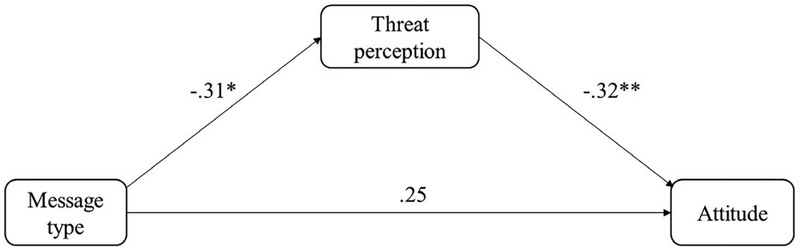
Indirect Effect of the Benevolent Message through Threat PerceptionNote. All path coefficients are unstandardized. Message type is coded (0 = control, 1 = Benevolent message).* p < .05, ** p < .01.
In contrast, the indirect effects via guilt and compassion were not statistically significant (95% CI for the indirect effect: guilt [-.117, .053]; compassion [-.065, .038]). Participants exposed to the benevolent message reported higher levels of guilt toward foreign immigrants (b = .58, SE = .21, p < .05) than participants in the control condition; however, guilt did not significantly predict attitudes toward foreign immigrants (b = -.02, SE = .05, p > .05). In the case of compassion, benevolent messages did not significantly predict compassion, nor did compassion predict attitudes toward foreign immigrants. Thus, H2 was not supported.
The third hypothesis predicted that the effect of the benevolent message would be mediated by negative emotions such as anger, contempt and fear. The fourth hypothesis predicted sequential mediated pathways from benevolent message, through threat perception and emotions, to attitude toward foreign immigrants. To examine these hypothesis, Hayes’ (2013) PROCESS macro (Model 6) was used.
Result showed that all simple mediation models from benevolent messages to attitudes toward foreign immigrants through negative emotions were not statistically significant. On the other hand, results of the sequential indirect effects through threat perception and anger, contempt, jealousy, fear, and anxiety were statistically significant (see Table 2). Thus, H4 was supported. Figure 2 showed how the mechanism works. For instance, participants exposed to the benevolent message have less threat perception (b = -.31, SE = .13, p < .05) than are participants in the control condition. Also, the less participants have threat perception, the less they show anger (b = .37, SE = .13, p < .01). Finally, lower anger leads to positive attitude toward foreign immigrants (b = -.33, SE = .04, p < .01). Other emotions work in the same way (see Figure 2).
Bootstrap Estimates of 95% Confidence Intervals for the Sequential Indirect Effects
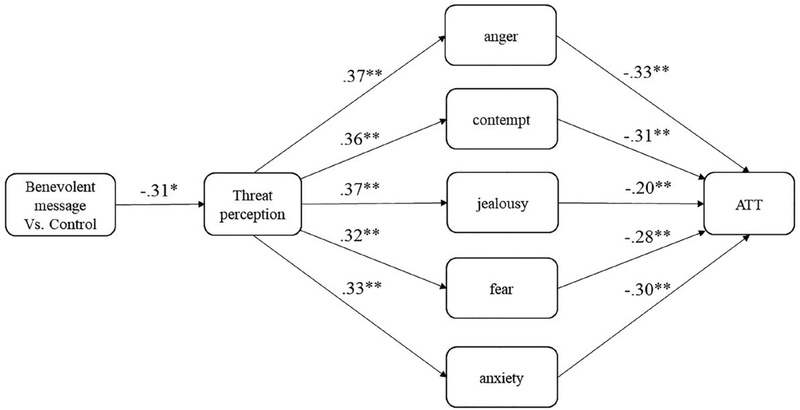
Sequential Indirect Effects through Threat Perception and EmotionsNote. All path coefficients are unstandardized. ATT: attitude toward foreign immigrants. * p < .05, ** p < .01.
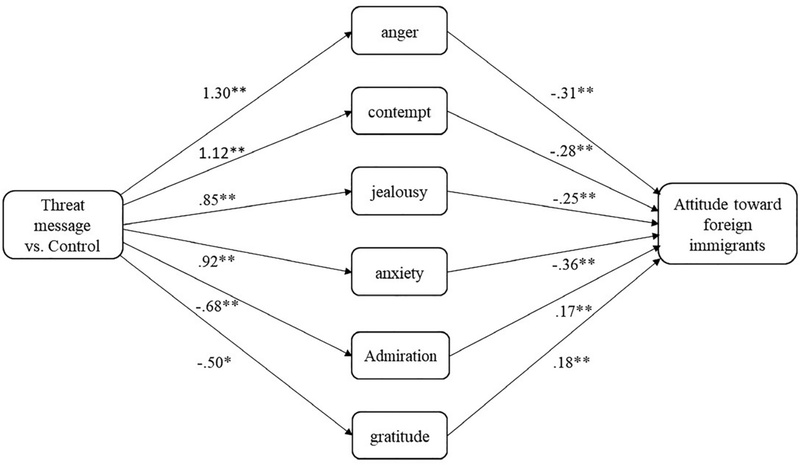
Indirect Effects of the Threat Message through EmotionsNote. All path coefficients are unstandardized. * p < .05, ** p < .01.
Regardless of the hypothesis, the role of emotions through which threat messages influence attitudes toward foreign immigrants were tested. Results showed that the effect of threat message on attitude toward foreign immigrants was mediated by emotions (see Figure 3). As seen in Figure 3, participants exposed to the threat message have more negative emotions such as anger, contempt, and fear (or have less positive emotions such as admiration and gratitude), which in turn increase unfavorable attitude toward foreign immigrants. However, all of sequential mediated pathways from threat message, through threat perception and emotions, to attitude toward foreign immigrants were not significant.
Hypothesis 5 was formulated as a competing hypothesis, predicting that exposure to benevolent messages would either increase or decrease perceived competence stereotypes toward foreign immigrants compared to the control group. Hypothesis 6 predicted a null effect, such that exposure to benevolent messages would not produce changes in warmth stereotypes toward foreign immigrants. Finally, Hypotheses 7 proposed competing sequential mediation pathways through which benevolent messages may influence attitudes toward foreign immigrants. Specifically, benevolent messages are expected to affect perceived competence stereotypes, which in turn elicit distinct intergroup emotions (envy/ jealousy or anger/contempt), ultimately shaping attitudes toward foreign immigrants. To test these two hypotheses, Hayes’ (2013) PROCESS macro (Model 4 and 6) was run.
The results showed that neither competence nor warmth stereotypes mediated the relationship between benevolent messages and attitudes toward foreign immigrants (95% CI: warmth stereotype [-.085, .038]; competence stereotype [-.152, .066]). In addition, all sequential mediation pathways from benevolent messages through competence stereotypes and emotions to attitudes toward foreign immigrants were not statistically significant. Also, these results were the same for the threat message.
To further investigate why stereotypes failed to function as mediators, additional analyses were conducted. A one-way ANOVA showed that there were no significant differences in competence stereotypes across experimental conditions (competence stereotype: F (2, 209) = 0.88, p = .413, η² = .01; benevolent M = 3.82, control M = 3.94), nor were there significant differences in warmth stereotypes (warmth stereotype: F (2, 209) = 2.69, p = .070, η² = .02; benevolent M = 3.98, control M = 4.25). This pattern was also observed in the pre–post comparison analyses of stereotypes. For example, in the benevolent message condition, there were no significant differences in either competence or warmth stereotypes between pre- and post-message exposure (competence stereotype: t (69) = 0.81, p > .05, pre M = 3.88, post M = 3.82; warmth stereotype: t (69) = 2.00, p > .05, pre M = 4.12, post M = 3.98). These additional analyses indicate that stereotypes did not serve as mediators because there were no significant changes in stereotype perceptions.
DISCUSSION
The current study aimed to investigate the effects of benevolent messages on attitudes toward foreign immigrants and to explore the underlying mechanisms. Intergroup threat, negative stereotypes and emotions were suggested as mechanisms of the effect. While prior research suggested that benevolent messages may produce negative outcomes similar to threat messages, the findings of the current study revealed the opposite: benevolent messages led to more positive attitudes toward foreign immigrants. Threat perception has been shown to play a significant role in this effect. Benevolent message reduced threat perception, which in turn led to increase the positive attitude. Also, it has been shown that the effect occurs via sequential mediators: the benevolent message reduces threat perception, which in turn reduces negative emotions, which ultimately predicts positive attitudes. Although the effect was not statistically significant, the threat message did, as expected, worsen attitudes toward foreign immigrants, and the effect was mediated by increasing negative emotions or decreasing positive emotions. Finally, it was found that stereotypes of foreign immigrants do not work as a mediator. There is no difference between experimental groups in stereotypes, and as a result it could not mediate attitude change.
Then, why did benevolent messages produce positive effects on attitudes toward immigrants, contrary to prior findings? Although further empirical evidence is needed to substantiate this explanation, one plausible account lies in differences in message design. While the present study, like the previous research, used health-insurance-related news as experimental stimuli, the portrayal of immigrants may have differed in meaningful ways. Specifically, the stimuli in the current study may have placed greater emphasis on the severity and urgency of immigrants’ hardships, thereby strengthening perceptions that immigrants deserve help rather than pose a threat to Korean society. This interpretation is consistent with the Stereotype Content Model, which predicts that groups portrayed as vulnerable and dependent—rather than competitive—are more likely to elicit prosocial emotions, leading to more favorable attitudes. Indeed, in the present study, exposure to benevolent messages increased feelings of guilt, although guilt was not significantly associated with attitudes toward foreign immigrants.
Additionally, the observed attitude change may reflect a potential confound introduced by differences in responsibility attribution cues in the stimuli, rather than the independent effects of the benevolent message per se. According to the Intergroup Emotion Theory (e.g., Smith, 1993), emotions toward an outgroup arise from group-level cognitive appraisals, among which responsibility appraisal concerns judgments about who caused or is accountable for an outgroup’s hardship. When outgroup difficulties are attributed to external or system-level causes, more prosocial intergroup emotions are likely to emerge, which in turn may relate to more positive attitudes and helping intentions. Thus, if the benevolent message in this study unintentionally included strong attributional cues emphasizing institutional responsibility (e.g., that limitations in Korea’s systems contribute to immigrants’ hardship), or if participants allocated greater cognitive attention to these attributional elements, the positive attitude change found in this study may be linked to this attributional component rather than the independent effect of benevolence itself. This may help explain why the current study yielded more positive attitudinal change compared to C. Kim (2019). A possible explanation for the divergence from C. Kim (2019) may lie in differences in attributional cues embedded in the stimuli. While both studies employed benevolent messages, Kim’s stimuli may have allowed for interpretations that immigrants’ hardships stem from their own choices or behaviors, whereas the present study more clearly framed these hardships as resulting from external, structural constraints, thereby encouraging more favorable responses. This interpretation suggests that future studies should separately manipulate responsibility attribution (external vs. internal) and message tone to more clearly identify their independent effects.
Another possibility is that public’s prior stereotypes and attitudes toward foreign immigrants in Korea have become more favorable over time. Given that this study was conducted more than five years after the previous study (C. Kim, 2019), it is plausible that increased direct and indirect contact with immigrants has led to more favorable baseline attitudes among the Koreans. According to the contact hypothesis (Harwood, 2010), contact with outgroup members reduces prejudice. If Koreans are now more familiar with immigrants through media or daily interactions, their interpretations of benevolent messages may have become more positive.
Although the details of the findings were unexpected, the current study has theoretical and practical implications. Theoretically, this study revealed the mechanism underlying the effect of benevolent messages. Although benevolent messages constitute a substantial portion of news coverage about foreign immigrants in Korea, research on such messages has remained insufficient. To understand and mitigate intergroup conflict through messaging, it is essential to identify the process by which messages are translated into either a desire to harm or a willingness to embrace the outgroup. In this regard, elucidating the mechanisms of benevolent messages represents an important research topic. This study suggests that threat perception needs to be central to such discussions. The analysis indicates that reduced threat perception improves intergroup relations both directly and indirectly through emotions. These results support the core proposition of intergroup emotion theory that intergroup threat is a direct determinant of intergroup emotions, which in turn shape prejudice (e.g., Smith, 1993).
While group emotions play a central role in shaping attitudes, stereotypes—although proposed as a key mediator alongside threat perception—did not function as a mechanism of attitude change in this study. The analysis suggests that the main reason is that stereotype levels did not show statistically meaningful change. Contrary to expectations, competence stereotypes (as well as warmth stereotypes) did not differ significantly between the benevolent message and control condition, nor did they show significant change from pre- to post-message exposure. These results are inconsistent with prior findings suggesting that even brief message exposure can produce stereotype change (e.g., Ramasubramanian, 2015).
The results may reflect deeply entrenched stereotypes toward foreign immigrants among Koreans, implying that a single short-term exposure to benevolent messages may not have been sufficient to shift evaluations of immigrants’ competence or warmth. The SCM posits that competence stereotypes are formed based on perceived ability to harm the ingroup, which is inferred from the social status of the outgroup. Messages emphasizing immigrants’ hardships and need for help may not have meaningfully shifted Koreans’ preexisting judgments of outgroup ability, which likely reflect relatively stable beliefs formed prior to message exposure. In other words, competence evaluations of foreign immigrants may already be strongly established, and a single exposure to benevolent messages—which could be interpreted either as highlighting immigrants’ lack of competence or as suggesting that their competence could improve with institutional support—did not influence competence judgments in this study. Prior evidence also suggests that mere exposure to messages is often insufficient to change deeply ingrained stereotypes (e.g., Bodenhausen et al., 1995). However, this explanation remains speculative, and future research should examine stereotype change under more controlled or repeated exposure conditions.
Finally, the present study demonstrates that benevolent and threat messages engage distinct psychological pathways in shaping attitudes toward foreign immigrants. Threat messages influenced attitudes by directly triggering emotional reactions, whereas benevolent messages exerted their effects through a sequential process in which threat perception was activated first and subsequently shaped emotional responses. These results align with longstanding debates on whether emotions arise independently of cognition or are preceded by cognitive appraisals (Lazarus, 1991; Zajonc, 1980). From the perspective of affective primacy proposed by Zajonc (1980), affect does not invariably require prior cognitive inference and can be elicited automatically, particularly when stimuli are simple, evolutionarily salient, or processed outside conscious awareness. When the messages used in the present study are examined through the lens of this perspective, threat messages may have activated rapid and relatively automatic emotional reactions due to their association with survival-relevant cues, potentially allowing them to influence attitudes through a more direct affective pathway. In contrast, benevolent messages typically lack immediate threat cues and may therefore require greater cognitive appraisal and meaning construction, through which emotional responses could subsequently be generated and translated into attitudinal judgments. Taken together, these findings tentatively suggest that message effects may depend not only on message content (benevolence vs. threat) but also on the type of psychological processing that the message is likely to promote (automatic affect vs. cognitive appraisal). Because the present study did not directly manipulate or measure these underlying processes, future research should more explicitly test these proposed mechanisms by independently manipulating appraisal cues and threat salience.
From a practical perspective, the findings offer insights for media professionals and policymakers. Benevolent messages can be seen as reporting that can contribute to social integration by raising awareness of the difficulties faced by socially disadvantaged minority groups and helping to improve them. Nonetheless, prior research cautioned against benevolent messages due to their potential to provoke negative effect or another forms of prejudice (Esposito & Romano, 2014). However, the present study suggests that carefully designed benevolent messages may foster more inclusive attitudes toward foreign immigrants. This work shows that benevolent messages reduce the likelihood of threat perception and resulting negative emotions, suggesting that messages that minimize threat perception while highlighting systemic injustices may be a more effective strategy for promoting social integration. While the present findings demonstrate that benevolent messages alone can effectively reduce threat perception, it remains an open empirical question whether combining benevolent and non-threat messages could produce additive effects beyond those observed here. For example, media portrayals that include non-threat messages (i.e., messages emphasizing the economic or cultural contributions of immigrants) could theoretically be added to benevolent messages to further reduce threat perception (e.g., Seate & Mastro, 2015). Additionally, it is theoretically possible that benevolent messages could further enhance their positive influence if they clearly indicate that responsibility for foreign immigrants’ hardship lies with external or systemic factors, which may in turn elicit prosocial emotions. While the current study did not directly measure or manipulate these attributional cues, future research could experimentally test whether explicitly highlighting external responsibility strengthens the attitudinal effects of benevolent messages, providing a more precise understanding of the mechanisms through which such messages influence intergroup attitudes.
This study has several limitations that should be acknowledged, most of which relate to the experimental design. First, the study relied on a single message as the experimental stimulus. Although the selected news story contained a prototypical portrayal of foreign immigrants, using only one message limits the generalizability of the findings to other message contexts (Jackson & Jacobs, 1983). In particular, the effects observed in this study may not extend to other topical domains, such as labor market inequality, housing conditions, or access to education. Therefore, caution is required when interpreting the results beyond the health insurance context.
Second, the artificiality of the experimental treatment is one of the limitations. In real-world contexts, benevolent and threat messages may overlap, and individuals often encounter messages containing elements of both. The isolated presentation of message types in this study may therefore limit the ecological and external validity of the findings. Future research should examine intergroup message environments in which benevolent and threat messages coexist to better reflect real-world communication.
Third, potential confounding variables were not fully accounted for. For example, political ideology has been identified as an important predictor of attitudes toward immigrants in prior research. Although it did not show a significant effect in the current sample, this null result may reflect sample-specific characteristics or contextual factors. Further research is warranted to examine its role under different conditions.
Fourth, differences in responsibility attribution cues across messages may have introduced a potential confound. Benevolent messages may have unintentionally emphasized external, system-level responsibility for immigrants’ hardships. As a result, it is unclear whether the observed positive attitude change reflects the independent effect of benevolence or participants’ responses to these attributional cues. Future studies should independently manipulate message tone and responsibility attribution (external vs. internal) to clarify their separate contributions to intergroup attitudes.
Fifth, no manipulation checks were conducted, making it difficult to ascertain whether participants interpreted the messages as intended. The study did not include a manipulation check because asking participants to evaluate the stimuli (e.g., rating the messages as benevolent or threatening) prior to the main measures could have influenced responses to subsequent questions—such as perceived threat, intergroup emotions, and attitudes—through question-order effects and measurement reactivity. Nonetheless, the absence of manipulation checks limits stimulus validation and the interpretability of the findings.
Finally, this study employed a brief, one-time exposure to short newspaper articles, which may have limited the strength of the experimental manipulation. Research suggests that repeated or long-term exposure to media content can enhance psychological responses (e.g., Cohen, 2001). Notably, the study did not detect changes in stereotypes; therefore, incorporating prolonged or repeated exposure to experimental stimuli in future research may produce stronger effects, allowing for the detection of meaningful stereotype changes. In addition, the current study did not include baseline measures of attitudes, making it difficult to assess pre-existing differences across conditions, and relied solely on immediate post-test measures, providing no information on the persistence of the observed effects. Future studies should consider including both pre- and post-measures as well as follow-up assessments to more rigorously examine how benevolent messages influence intergroup attitudes over time. Taken together, these limitations point to several important directions for future research. Future research should address several directions suggested by the present study. First, more rigorous experimental designs, including manipulation checks and separate manipulations of message tone and responsibility attribution, are needed to clarify underlying mechanisms. Second, longitudinal or repeated-exposure designs should be employed to examine the persistence of effects and the possibility of stereotype change over time. Finally, future studies should test whether these findings generalize across different issue domains and media formats.
Disclosure Statement
No potential conflict of interest was reported by the author
Acknowledgment
This work was supported by 2024 Hannam University Research Fund.
Notes
References
-
Bodenhausen, G. V., Schwarz, N., Bless, H., & Wänke, M. (1995). Effects of atypical exemplars on racial beliefs: Enlightened racism or generalized appraisals. Journal of Experimental Social Psychology, 31(1), 48–63.
[https://doi.org/10.1006/jesp.1995.1003]

-
Cohen, J. (2001). Defining identification: A theoretical look at the identification of audiences with media characters. Mass Communication & Society, 4, 245–264.
[https://doi.org/10.1207/S15327825MCS0403_01]
-
Cuddy, A. J., Fiske, S. T., & Glick, P. (2007). The BIAS map: Behaviors from intergroup affect and stereotypes. Journal of Personality and Social Psychology, 92, 631–648.
[https://doi.org/10.1037/0022-3514.92.4.631]
-
Cuddy, A. J., Fiske, S. T., & Glick, P. (2008). Warmth and competence as universal dimensions of social perception: The stereotype content model and the BIAS map. Advances in Experimental Social Psychology, 40, 61–150.
[https://doi.org/10.1016/S0065-2601(07)00002-0]
-
Dixon, T. L., & Linz, D. (2000). Overrepresentation and underrepresentation of African Americans and Latinos as lawbreakers on television news. Journal of Communication, 50, 131–154.
[https://doi.org/10.1111/j.1460-2466.2000.tb02845.x]
-
Dixon, T. L., & Williams, C. L. (2015). The changing misrepresentation of race and crime on network and cable news. Journal of Communication, 65, 24–39.
[https://doi.org/10.1111/jcom.12133]
- Esposito, L., & Romano, V. (2014). Benevolent racism: Upholding racial inequality in the name of black empowerment. Western Journal of Black Studies, 38(2), 69–83.
-
Esses, V. M., Brochu, P. M., & Dickson, K. R. (2012). Economic costs, economic benefits, and attitudes toward immigrants and immigration. Analyses of Social Issues and Public Policy, 12, 133–137.
[https://doi.org/10.1111/j.1530-2415.2011.01269.x]
-
Fiske, S. T., Cuddy, A. J., Glick, P., & Xu, J. (2002). A model of (often mixed) stereotype content: Competence and warmth respectively follow from perceived status and competition. Journal of Personality and Social Psychology, 82, 878–902.
[https://doi.org/10.1037/0022-3514.82.6.878]
- Gilmore, J., Meeks, L., & Domke, D. (2013). Why do (we think) they hate us: Anti-Americanism, patriotic messages, and attribution of blame. International Journal of Communication, 7, 701–721.
-
Harwood, J. (2010). The contact space: A novel framework for intergroup contact research. Journal of Language and Social Psychology, 29, 147–177.
[https://doi.org/10.1177/0261927X09359520]
- Hayes, A. F. (2013). Introduction to mediation, moderation, and conditional process analysis. The Guilford Press.
-
Hewstone, M., Rubin, M., & Willis, H. (2002). Intergroup bias. Annual Review of Psychology, 53, 575–604.
[https://doi.org/10.1146/annurev.psych.53.100901.135109]
-
Hilton, J. L., & von Hippel, W. (1996). Stereotypes. Annual Review of Psychology, 47, 237–271.
[https://doi.org/10.1146/annurev.psych.47.1.237]
-
Im, J. (2018). A study on the trends of television reporting on foreign migrant workers in Korea: Focusing on <MBC>, <KBS>, <SBS> and <YTN> news. Journal of Social Science, 57(1), 321–354.
[https://doi.org/10.22418/JSS.2018.6.57.1.321]
-
Jackson, S., & Jacobs, S. (1983). Generalizing about messages: Suggestions for design and analysis of experiments. Human Communication Research, 9, 169–191.
[https://doi.org/10.1111/j.1468-2958.1983.tb00691.x]
- Kim, C. (2019). News message’s effects on outgroup derogation toward immigrant foreigners comparison between threat message and benevolent message. Korean Journal of Broadcasting and Telecommunication Studies, 33(5), 31–60.
- Kim, C., Harwood, J., & Xiang, J. (2018). The negative and positive influences of threat and nonthreat media messages about immigrants. International Journal of Communication, 12, 950–972.
- Kim, C., & Koh, H. (2019). A study on the intergroup threat and stereotypes toward foreign immigrants: By analyzing broadcasting news programs. Broadcasting & Communication, 20(4), 51–80.
-
Kim, D., Kim, D., & Jung, T. (2011). Cognition of Korean college students for six foreigner groups. Korean Journal of Social and Personality Psychology, 25(1), 1–23.
[https://doi.org/10.21193/kjspp.2011.25.1.001]
-
Kim, H. (2017). Exploring stereotypes according to the nationality of immigrants living in Korea. Media, Gender & Culture, 32(2), 125–173.
[https://doi.org/10.38196/mgc.2017.06.32.2.125]
- Kim, K. (2009). The representation of immigrants in narratives of TV news. Korean Journal of Broadcasting and Telecommunication Studies, 23(3), 7–46.
-
Lazarus, R. S. (1991). Emotion and adaptation. Oxford University Press.
[https://doi.org/10.1093/oso/9780195069945.001.0001]
- Lee, M., & Choi, J. (2016). Analysis of immigrant’s image on Korean newspapers. Locality & Communication, 20(1), 53–77.
-
Lindsey, L. L. M. (2005). Anticipated guilt as behavioral motivation: An examination of appeals to help unknown others through bone marrow donation. Human Communication Research, 31, 453–481.
[https://doi.org/10.1093/hcr/31.4.453]
-
Lindsey, L. L. M., Yun, K. A., & Hill, J. B. (2007). Anticipated guilt as motivation to help unknown others: An examination of empathy as a moderator. Communication Research, 34(4), 468–480.
[https://doi.org/10.1177/0093650207302789]
-
Mackie, D. M., Devos, T., & Smith, E. R. (2000). Intergroup emotions: Explaining offensive action tendencies in an intergroup context. Journal of Personality and Social Psychology, 79, 602–616.
[https://doi.org/10.1037/0022-3514.79.4.602]
-
Mackie, D. M., Silver, L., & Smith, E. R. (2004). Emotion as an intergroup phenomenon. The Social Life of Emotions, 227–245.
[https://doi.org/10.1017/CBO9780511819568.013]
-
Mastro, D. E., & Behm-Morawitz, E. (2005). Latino representation on primetime television. Journalism & Mass Communication Quarterly, 82, 110–130.
[https://doi.org/10.1177/107769900508200108]
-
Mastro, D. E., & Tukachinsky, R. (2011). The influence of exemplar versus prototype-based media primes on racial/ethnic evaluations. Journal of Communication, 61, 916–937.
[https://doi.org/10.1111/j.1460-2466.2011.01587.x]
- Menjívar, C., & Kil, S. H. (2002). For their own good: Benevolent rhetoric and exclusionary language in public officials’ discourse on immigrant-related issues. Social Justice, 29, 160–176.
- Park, S. (2023). Is Korea a multicultural society?: Critical reflection on controversy related to multicultural society and search for alternatives. Journal of Educational Research, 28(2), 37–52.
-
Park, S., & Park, S. (2016). Are foreigners really crime-prone?: How crime news coverage shapes perceptions of foreign criminality in South Korea. Korean Journal of Journalism & Communication Studies, 60(3), 145–177.
[https://doi.org/10.20879/kjjcs.2016.60.3.006]
-
Ramasubramanian, S. (2015). Using celebrity news stories to effectively reduce racial/ ethnic prejudice. Journal of Social Issues, 71(1), 123–138.
[https://doi.org/10.1111/josi.12100]
-
Ramasubramanian, S., & Oliver, M. B. (2007). Activating and suppressing hostile and benevolent racism: Evidence for comparative media stereotyping. Media Psychology, 9, 623–646.
[https://doi.org/10.1080/15213260701283244]
-
Riek, B. M., Mania, E. W., & Gaertner, S. L. (2006). Intergroup threat and outgroup attitudes: A meta-analytic review. Personality and Social Psychology Review, 10, 336–353.
[https://doi.org/10.1207/s15327957pspr1004_4]
-
Seate, A. A., & Mastro, D. (2015). Media’s influence on immigration attitudes: An intergroup threat theory approach. Communication Monographs, 83, 194–213.
[https://doi.org/10.1080/03637751.2015.1068433]
-
Sherif, M. (1958). Superordinate goals in the reduction of intergroup conflicts. American Journal of Sociology, 63, 349–356.
[https://doi.org/10.1086/222258]
-
Smith, E. R. (1993). Social identity and social emotions: Toward new conceptualizations of prejudice. In D. M. Mackie & D. Hamilton (Eds.), Affect, cognition and stereotyping: Interactive processes in group perception (pp. 297–315). Academic Press.
[https://doi.org/10.1016/B978-0-08-088579-7.50017-X]
-
Sohn, M., & Lee, S. (2016). Exploratory study about the mediating factors between guilty feeling and effects of international relief messages. Journal of Communication Science 16(1), 96–122.
[https://doi.org/10.14696/jcs.2016.03.16.1.96]
-
Stephan, W. G., Renfro, C. L., Esses, V. M., Stephan, C. W., & Martin, T. (2005). The effect of feeling threatened on attitudes toward immigrants. International Journal of Intercultural Relations, 29, 1–19.
[https://doi.org/10.1016/j.ijintrel.2005.04.011]
-
Stephan, W. G., Ybarra, O., & Bachman, G. (1999). Prejudice toward immigrants. Journal of Applied Social Psychology, 29, 2221–2237.
[https://doi.org/10.1111/j.1559-1816.1999.tb00107.x]
-
Struch, N., & Schwartz, S. H. (1989). Intergroup aggression: Its predictors and distinctness from in-group bias. Journal of Personality and Social Psychology, 56(3), 364–373.
[https://doi.org/10.1037/0022-3514.56.3.364]
-
Tukachinsky, R., Mastro, D., & Yarchi, M. (2015). Documenting portrayals of race/ethnicity on primetime television over a 20-year span and their association with national-level racial/ ethnic attitudes. Journal of Social Issues, 71, 17–38.
[https://doi.org/10.1111/josi.12094]
-
Zajonc, R. B. (1980). Feeling and thinking: Preferences need no inferences. American Psychologist, 35(2), 151.
[https://doi.org/10.1037/0003-066X.35.2.151]
Appendix
1. Threat message
Foreigners “Eat and Run” on Health Insurance... Even Brought Father-in-law to Korea to Drain 100 Million Won
A Chinese man in his 30s entered South Korea in February of last year. Immediately upon arrival, he registered as a dependent of his father, who was working in a Korean company, and received a total of 42 medical treatments, including examinations for a brain tumor. The amount paid by the National Health Insurance Service (NHIS) for his treatment was 19.5 million KRW. After receiving treatment, this man returned to China three months later.
Cases of so-called “Health Insurance Eat and Run”—where family members of foreigners working in Korea register as dependents to claim expensive health insurance benefits and then return to their home countries—are on the rise. According to the Ministry of Health and Welfare on the 22nd, the number of foreigners covered by health insurance increased by 110,000 over three years, rising from 1.21 million at the end of 2019 to 1.32 million at the end of last year. In the case of foreign employee subscribers, not only their wives and children but also their parents, siblings, and parents-in-law can be registered as dependents. These dependents receive the same health insurance benefits as Korean nationals without restrictions such as a minimum stay period or permanent residency. Foreigners are lining up to exploit these regulations by receiving “intensive treatment” in Korea for a short period and then leaving the country.
A Vietnamese man in his 50s entered Korea in May of last year. On the day of his arrival, he signed up for health insurance as a dependent of his son-in-law. He immediately received six treatments for conditions including cerebral infarction and returned to Vietnam a month later. The amount borne by the NHIS was 13.1 million KRW.
On various foreign internet communities, it is easy to find posts like “How to utilize Korean Health Insurance,” which dig into the loopholes of Korea’s system. One site featured a post titled “Sharing how to link family to (Korean) Health Insurance.” The post contained information such as “If just one family member pays the insurance premium, the whole family can share the benefits” and “You can save at least several million won a year.”
In fact, there was a case where a Chinese national used nearly 100 million KRW of health insurance funds. According to the Ministry of Health and Welfare, a Chinese man in his 50s entered the country in April 2020 and signed up for health insurance as a dependent of his son-in-law. After receiving treatment for liver disease, he returned to China early the following year. The amount paid by the Corporation was approximately 90 million KRW. As of last year, Chinese nationals accounted for the largest portion of foreign health insurance subscribers at 660,000, or 53% of the total. The health insurance deficit regarding Chinese nationals over the past three years amounts to 133.5 billion KRW. A high-ranking government official previously stated, “There are cases among foreign employee subscribers where one person has registered 7 to 10 dependents. There is a Chinese national who received health insurance benefits amounting to 3.3 billion KRW as a dependent,” adding that they intend to fix this. Additionally, a Canadian man in his 60s entered the country in October of last year, registered as a dependent, received treatment for cardiac arrhythmia, and left the country after three months. The NHIS paid 17.2 million KRW. An American man in his 80s who entered Korea in May of last year registered as a dependent of his daughter-in-law, received treatment for chronic kidney disease (NHIS cost: 4.2 million KRW), and left the country after one month.
There are no exact statistics on the scale of “health insurance eat and run” by some foreign dependents. An official from the Ministry of Health and Welfare stated, “Over the past three years, the average amount of health insurance funds used by foreign dependents within six months of entering Korea is about 5.7 billion KRW.” While it cannot be said that all of this money was abused, it can be estimated that a significant amount of the approximately 10 billion KRW in annual health insurance funds is leaking. To prevent this, the National Assembly proposed an amendment to the National Health Insurance Act last year, requiring foreign dependents to stay in Korea for at least six months to be eligible for health insurance benefits. The Ministry of Health and Welfare persuaded the ruling and opposition parties to process the bill, but it has not yet been properly discussed in the National Assembly. If this law passes, the criteria for health insurance benefits for some 9,800 foreign dependents per year will be strengthened. A Ministry official noted, “The health insurance finance for foreigners as a whole is in surplus,” but added, “Some dependents are the problem.”
2. Benevolent message
“Burdensome Procedures and Costs”: Serious Discrimination in Foreigner Health Insurance Enrollment
Mr. A (31), a migrant worker from Cambodia, recently heard the news that all foreigners residing in Korea for more than six months must subscribe to the National Health Insurance. He searched for ways to register his five-year-old daughter as a subscriber. He learned through help from those around him that he could register his child as a dependent. He also barely managed to find out that he needed family relationship verification documents issued by his home country to do so. It took Mr. A several months to obtain a confirmation letter written in Korean, attached to an English family relations certificate, through the Korean Embassy in Cambodia. He then submitted these to the National Health Insurance Service (NHIS). However, the reply from the NHIS was a demand to submit the confirmation letter again after getting it notarized.
Pastor Ahn Dae-hwan of the Korea Migrant Workers Foundation, who helped Mr. A’s family with the health insurance enrollment, pointed out, “It is a confirmation letter issued by the Korean Embassy representing our country abroad. Demanding to have it notarized again is a waste of administrative resources.” Mr. A’s case, where he could eventually register his child as a dependent and receive health insurance benefits after going through cumbersome procedures, is actually one of the better ones.
Mr. B, a Koryo-in (ethnic Korean) with Ukrainian nationality, said, “Birth certificates issued in Central Asian countries like Russia, Uzbekistan, and Kazakhstan do not record the parents’ dates of birth, so document formats differ by country.” He added, “Despite this, the NHIS demands the exact same documents unconditionally, leaving us frustrated and helpless.” Pastor Ahn explained, “Foreigners are very anxious because of stories that health insurance enrollment and premium payments can affect visa extensions.”
About three months have passed since the mandatory health insurance enrollment system for foreigners and overseas Koreans was implemented, but voices calling for system improvements continue to come from foreigners in Korea and related organizations.
In addition to the cumbersome enrollment procedures, the limited scope of dependents for foreign subscribers is pointed out as a major problem, as it forces them to pay much higher premiums than Korean families. Currently, Korean health insurance subscribers can register direct lineal ascendants and descendants, spouses, and the spouse’s lineal ascendants as dependents if they have no income. However, foreigners can only register their spouse and minor children as dependents if they are recognized as members of the same household.
Because of this, foreigners living with parents or adult children are in a situation where everyone must sign up for health insurance individually. Consequently, the burden of premiums for foreign regional subscribers is increasing every year, dealing a severe blow that threatens the survival of low-income foreign workers.
Mr. C (20), a Chinese national, works alone and lives with his mother, who suffers from a cerebral infarction, and his elderly grandmother. Mr. C was working at a job where workplace health insurance was not available, so he was subscribed to regional health insurance. However, starting this year, his mother and grandmother could no longer be registered as one household. As a result, three separate health insurance bills of 113,050 won each began to arrive for the three family members. Kim Se-young, head of the Goyang Immigrant Integration Center, conveyed, “Foreign families consisting of adults must all sign up for health insurance individually even if they have no income, so many foreigners find the cost burdensome.” Furthermore, if foreign migrant workers fall into arrears on their premiums, insurance benefits are suspended until payment is made in full, which can threaten their right to health.
In the case of Korean regional subscribers, even if they are in arrears, they can receive insurance benefits if the number of missed payments is less than six or if they pay the overdue premiums at least once through installment payments.
Center Head Kim argued, “For our citizens facing financial difficulties, premiums are reduced, and minors whose income and property do not meet certain standards are exempted from payment. However, for migrants, such premium reduction and exemption criteria are not applied at all.” In this regard, experts point out, “Discrimination in the application of the health insurance system can result in threatening the health, livelihood, and even residency of migrants, who are a medically vulnerable class.” They added, “We must enhance the rationality and acceptability of the foreigner health insurance system by relaxing discriminatory conditions against foreigners.”