
Roles of Perceived Message Ethicality and the Persuasion Ethics Schema in Predicting Intended and Unintended Anti-Drug Campaign Consequences
 ; Thomas Hove
Copyright ⓒ 2026 by the Korean Society for Journalism and Communication Studies
Abstract
This study examines the roles of ethical perceptions in determining health campaign message effectiveness. Integrating findings from commercial communication studies with emerging health communication ethics research, it investigates how perceived message ethicality and the persuasion ethics schema (PES) lead to both intended and unintended consequences of an anti-drug campaign. An online cross-sectional survey was conducted in South Korea among 1,500 adults aged 19 and older. Fitting PROCESS Macro models 4 and 8 yielded the following results. First, perceived message ethicality was found to be negatively related to psychological reactance and positively related to intention to comply with the campaign message (ICC). Second, psychological reactance served as a significantly negative predictor of ICC, and it partially mediated the relationship between perceived ethicality and ICC. Third, PES was positively related to reactance and negatively related to ICC. Fourth, PES significantly moderated the relationship between perceived message ethicality and ICC, but not the relationship between perceived ethicality and reactance. In aggregate, our results provide empirical support for health communication ethicists’ recommendations to consider audience ethical perceptions in campaign planning.
Keywords:
anti-drug campaign, perceived message ethicality, persuasion ethics schema, psychological reactance, campaign effectivenessTo cope with constant exposure to persuasive media messages, people have become increasingly sensitive to manipulation, coercion, and other ethically questionable influence techniques. In the field of health communication, there have been repeated recommendations to improve understanding of people’s ethical reactions to the techniques used in health campaigns (Guttman, 2017; Guttman & Ressler, 2001; Guttman & Salmon, 2004; S. T. Lee & Cheng, 2010; Witte, 1994b). A pragmatic justification for doing so is that these reactions may play a role in determining a campaign’s effectiveness. However, this conjecture needs empirical testing.
In the commercial contexts of marketing, advertising, and branding, several studies have examined the relationship between people’s ethical perceptions of companies and their willingness to trust or accept those companies’ influence (see Geetha et al., 2024). To operationalize those ethical perceptions, a concept that has frequently been used is “consumer perceived ethicality” (Brunk, 2012). “Ethicality” refers to the normative status of being morally good or bad, right or wrong, appropriate or inappropriate, acceptable or unacceptable, responsible or irresponsible, and so on. In marketing and business ethics, perceived ethicality has been studied as a dimension of consumers’ evaluations of companies and brands, and it has been found to affect such entities’ reputation and competitiveness.
We adapt this concept to the context of health communication for two reasons. First, although health campaigns differ from commercial persuasion in that they pursue prosocial rather than self-interested goals, they are not immune from ethical evaluation. Health campaigns are attempts to influence and change people’s thoughts and behaviors, and as such they can be experienced as controlling, paternalistic, or autonomy-threatening regardless of their intent. Critical health communication scholars have long recognized that even well-intentioned campaigns can raise ethical concerns about coercive framing, stigmatization, or the manipulation of risk perceptions (Guttman & Ressler, 2001; Guttman & Salmon, 2004; Rossi & Yudell, 2012; Witte, 1994b). The key parallel between commercial and health communication contexts is not the nature of the persuader’s interests but rather the role that audiences’ ethical evaluations play in shaping their responses to influence attempts. Second, just as consumers’ ethical perceptions of companies affect their trust and behavioral responses in commercial contexts, we propose that campaign audiences’ ethical evaluations of health messages may shape their compliance intentions—with psychological reactance as a key intervening mechanism. To capture these evaluations, we adapt the concept of consumer perceived ethicality to the health communication context, defining perceived message ethicality as people’s overall normative impressions of a health campaign message. This is an empirical issue that has not been tested much in the health communication literature, and the current study aims to fill in this gap.
Alongside perceived message ethicality, we incorporate a related variable that is likely to play a role in the persuasion process—the persuasion ethics schema (PES). PES refers to people’s preexisting beliefs and expectations about the ethical intent and appropriateness of public service advertisements (Paek & Hove, 2018a). To test the normative recommendations of health communication ethicists, we investigate whether perceived message ethicality and PES may either individually or jointly lead to intended or unintended campaign effects.
The context for this study is anti-drug campaigns in South Korea, and it was chosen for the following reasons. First, illegal drug use among South Koreans has skyrocketed in recent years and become a serious health issue. Second, the coercive and emotionally charged message appeals that are typically used in anti-drug campaigns may be counterproductive because they have been found to lead to psychological reactance (Reynolds-Tylus, 2019). A possible contributor to this reactance is people’s negative ethical perceptions of health messages that use emotionally manipulative or coercive techniques, for example those that make excessive use of fear, threats, blame, and shame (Guttman & Salmon, 2004). By investigating the possible roles of perceived ethicality and the persuasion ethics schema in the persuasion process, this study provides theoretical and practical insights for designing ethically sound and effective anti-drug campaigns in particular and public health campaigns in general.
Anti-Drug Campaigns in South Korea and Potential Boomerang Effects
Although illegal drug use in South Korea has traditionally been low, the country now faces a rapidly escalating drug crisis. Recent government data estimate that in 2024 the number of people who had used drugs was over 400,000, which is equivalent to the population of a major city and represents a 22.5% increase from the previous year (C. W. Lee, 2024). While Korea’s overall prevalence of drug use (about 0.5% of the population) remains lower than the global average, the pace of growth and changing normative attitudes toward drug use have raised official concerns. According to some reports, the ease of access to drug-related information online has desensitized people to the dangers of drugs and made them more likely to perceive drug use either as mere deviant behavior or as a source of entertainment (Ahn, 2024).
In 2023 the government declared a “war on drugs,” which involved initiatives carried out by a variety of government agencies. One type of initiative was communication campaigns promoting drug use prevention. For example, the recently launched “No Exit” campaign is a social media relay initiative jointly organized by the National Police Agency and the Anti-Drug Movement Headquarters. Its purpose is to raise awareness about the severity of drug abuse with the message, “Drugs are a maze without an exit. Don’t ever start using them.” Previous anti-drug campaigns conveyed similar types of threat messages such as “Illegal drugs—once you start, your life is over” and “Drugs ruin not only your life but also your family’s.” A common rationale for using such emotionally aggressive messaging is to catch young people’s attention. However, this approach also carries the risk of backlash and boomerang effects.
To date, only a few empirical studies have analyzed the effectiveness of anti-drug campaigns in South Korea (e.g., Paek & Go, 2024; Paek et al., 2024). In the U.S., such studies have been conducted for several decades, and the findings have generally been disappointing (e.g., Fishbein et al., 2002). One such finding is that campaigns relying heavily on negative emotions such as fear, shame, and blame may backfire by alienating their intended audiences or reinforcing social stigmas (Hastings et al., 2004; Hornik et al., 2008). The current study examines these potential negative consequences as indicators of campaign effectiveness. In addition to analyzing the relationship between the effectiveness of anti-drug campaigns and audience perceptions of their ethicality, we investigate the relationship between these ethical perceptions and unintended consequences such as psychological reactance.
Perceived Ethicality and Campaign Effectiveness
Over two decades of research have addressed the issue of audience and consumer skepticism toward influence attempts, most notably in the fields of advertising and marketing (e.g., Obermiller & Spangenberg, 1998). To overcome this skepticism, marketers have tried to persuade consumers about the ethically admirable aspects of their companies or brands, for example through messages that call attention to corporate social responsibility practices. Perceived ethicality, also known as consumer perceived ethicality, is defined as people’s overall impression of the morality of a company, brand, product, or service (Brunk, 2012). Several studies have shown that perceived ethicality influences people’s responses to corporate and organizational communication. For example, a recent meta-analysis of 31 articles found that perceived ethicality positively influences attitudes toward brands (Geetha et al., 2023). Perceived ethicality has also been found to be related to consumer trust, brand and firm loyalty, and purchase intentions (Budi Riharjo et al., 2025; Oh et al., 2023; Singh et al., 2012).
We adapt this concept to the context of health communication to investigate whether it plays a similar role in mitigating people’s skepticism and resistance toward attempts to influence their health behaviors. Although commercial and health communication differ, in both contexts audiences’ ethical evaluations may shape how they react to influence attempts. In health communication, previous research has examined how skepticism and lack of trust affect people’s responses to campaign messages (e.g., BelhadjYoussef & Besbes Sahli, 2025; Ryu & Jun, 2019). However, few studies have investigated how skepticism and reactance relate to audience perceptions of messages’ ethical appropriateness. As critical commentaries have warned, several of the persuasion techniques used in health campaigns may have negative ethical consequences (e.g., Guttman & Ressler, 2001; Guttman & Salmon, 2004; National Research Council, 1989; Rossi & Yudell, 2012; Witte, 1994b). For example, campaigns about specific health issues such as smoking, obesity, excessive drinking, and illegal drug use may be perceived as unethical when they use threat-based persuasion techniques. Such campaigns may also unfairly stigmatize people and make them feel guilty for harming themselves and others. In some cases, they end up placing most of the stigma and blame not on the corporations that aggressively market unhealthy products, nor on the social systems that fail to provide suitable conditions and resources for healthy behaviors, but rather on individuals who have supposedly made irresponsible choices.
If health communication messages trigger negative ethical impressions, they might hamper intended campaign goals. Such impressions may coincide with psychological reactance, the motivational state that occurs when people perceive their freedom of choice to be threatened or restricted (Brehm, 1966). Also known as a type of boomerang effect, reactance has been found to be generated by message characteristics that are common in anti-drug and other health messages, such as controlling and coercive language, threat-based persuasion, and manipulative intent (Dillard & Shen, 2005; Quick & Stephenson, 2008; Rains, 2013; Shen, 2014; Sivakumaran et al., 2023; Xu, 2015). According to a meta-analysis of reactance research, when campaigns about health behaviors such as smoking and drinking used controlling language, an unintended consequence was increased engagement in the targeted risky behaviors (Rains, 2013).
It is important to note that perceived message ethicality is conceptually distinct from these reactance-related appraisals, such as perceived manipulation or threat to freedom. Whereas the latter are specific psychological appraisals of a message’s tactics, perceived message ethicality is a broader, holistic normative appraisal of a message with respect to its being morally acceptable, socially responsible, and respectful of ethical norms. People may recognize a message as manipulative or autonomy-threatening without necessarily judging it to be ethically inappropriate, and vice versa. Such holistic evaluative judgments need not require recipients to consciously identify specific message features.
Critical commentaries on health communication ethics have called for greater sensitivity about potentially unethical persuasion techniques (e.g., Guttman, 2017). However, such normative warnings have emerged primarily from critical reflection rather than systematic empirical testing. Few studies have explored the extent to which audiences’ ethical perceptions of health campaign messages either lead to intended consequences, such as eliciting the desired behavioral intention, or prevent unintended consequences, such as reactance and message rejection. Based on the findings about perceived ethicality from marketing literature, we propose the following hypothesis about the roles of perceived message ethicality in the persuasion process.
H1. Perceived ethicality of an anti-drug campaign message will be (a) negatively related to psychological reactance and (b) positively related to intention to comply with the message.
Psychological reactance has been found to have direct adverse effects on persuasion goals such as changes in attitudes and behavioral intentions (see Rains, 2013; Steindl et al., 2015). Such effects, considered together with the direct effects of perceived ethicality of the campaign message, suggest a possible mediating role of reactance between perceived message ethicality and persuasion. Similar mediation effects have been documented in previous studies, for example between message characteristics and persuasion (Dillard & Shen, 2005). Based on these findings, we propose the following hypotheses:
H2 (direct effects). Psychological reactance will be negatively related to intention to comply with the campaign message.
H3 (mediation effects). Psychological reactance will mediate the relationship between perceived ethicality and intention to comply with the campaign message.
Individual Predispositions toward Persuasive Messages: The Persuasion Ethics Schema
People’s perceptions of message ethicality may vary according to individual characteristics such as personality traits, educational level, involvement, motivation, emotions, and predispositions. Such factors shape how people interpret, accept, or resist persuasion attempts (Boerman et al., 2023; Eisend & Tarrahi, 2022; Sivakumaran et al., 2023). One variable that gauges predispositions toward persuasive media messages is the persuasion ethics schema (Paek & Hove, 2018a). In media research, schemas generally refer to people’s common-sense theories or sets of beliefs and expectations about either the characteristics of media or the influence of media on society. Examples include the sets of beliefs associated with views such as “news media are biased” or “news media are powerful” (Meirick, 2006; Price et al., 1997). The persuasion ethics schema (PES) refers to people’s preexisting beliefs and expectations about the ethical intent and appropriateness of persuasive messages, and particularly public service messages. These beliefs would include views such as “public service health messages are manipulative,” or “anti-drug campaigns are inappropriately coercive.” In the original study on PES, the items that measure the variable were formulated as people’s pre-existing negative beliefs about persuasive messages (Paek & Hove, 2018a). Higher scores for PES indicate more intensely negative orientations toward persuasive messages.
In the initial studies on PES, some findings indicate that high PES toward public service advertisements inhibits the effectiveness of anti-smoking campaign messages. While no significant main effect of PES was found, in the first study there was a significant interaction effect between PES and audience type (smoking status) on intention to comply with the campaign message (Paek & Hove, 2018a). In a follow-up experiment study, there were mixed findings on the extent to which PES interacted with audience type (smoker vs. non-smoker) and message appeal (self-harm vs. other-harm) to determine message effectiveness (Paek & Hove, 2018b). Despite the overall mixed findings, some evidence showed that people with higher levels of PES toward public service advertisements would be more likely to experience unintended effects such as psychological reactance and less likely to experience intended effects such as compliance intention. We therefore propose the following direct effects hypothesis.
H4 (direct effects). Persuasion ethics schema (PES) will be (a) positively related to psychological reactance and (b) negatively related to intention to comply with the campaign message.
In light of the mixed findings from that experiment study (Paek & Hove, 2018b), a more specific relationship to explore with respect to PES concerns how message appeal may be associated with the perceived ethicality of the message. That is, people may have viewed messages which emphasize the harms that smokers inflict on themselves and others as ethically inappropriate, and smokers may have been more likely to have that view than non-smokers. Importantly, prior findings suggest that PES does not operate as a stable main-effect predictor, but rather as a contingent factor whose influence emerges in interaction with message characteristics and audience-related variables. This pattern is consistent with broader persuasion and schema-based research, which shows that dispositional beliefs are more likely to shape message processing under conditions where evaluative judgments—such as perceived appropriateness or fairness—are salient (Fiske & Taylor, 1991; Friestad & Wright, 1994). Moreover, research on persuasion knowledge and resistance indicates that people differ in the extent to which they critically evaluate persuasive intent and message appropriateness, and that such evaluations can activate resistant responses, including psychological reactance (Campbell, 1995; Dillard & Shen, 2005; Sagarin et al., 2002).
Extending this line of research, we propose viewing PES as a dispositional sensitivity to ethical aspects of persuasion that influences the extent to which people translate ethical evaluations of messages into affective and behavioral responses. Specifically, when people perceive persuasive messages to be manipulative, coercive, or otherwise ethically inappropriate, those with higher PES are more likely to experience heightened reactance and reduced compliance intention. Conversely, when people perceive messages to be ethically appropriate, they may respond more favorably. According to this reasoning, we expect PES to amplify the effects of perceived message ethicality on both psychological reactance and compliance intention. Since this prediction has not yet been tested, we propose the following research question about moderation effects.
RQ1 (moderation effects). Will PES moderate the relationship between (a) perceived message ethicality and psychological reactance and (b) perceived message ethicality and intention to comply with the campaign message?
A related issue is possible moderated mediation effects of PES. Alongside the mediation effect in H3 and the moderation effects in RQ1, there may also be an indirect effect that would be stronger among people with higher sensitivity to persuasion ethics. Previous research has consistently shown that psychological reactance serves as a key mediating mechanism linking message characteristics to persuasion outcomes (Dillard & Shen, 2005; Rains, 2013). When this mediation framework is integrated with the conditional role of PES, it is plausible that the strength of this indirect effect varies depending on people’s ethical sensitivity to persuasion. Specifically, perceived message ethicality—conditional on PES—may reduce psychological reactance, which would in turn enhance compliance intention. But rather than assuming a uniform mediation process, we consider the possibility that the indirect pathway from perceived ethicality to compliance intention via reactance is contingent upon PES. This reasoning is supported by previous moderated mediation effect research in the context of political persuasion (Mannetti et al., 2013). Since no other studies have explored the moderated mediation effects among perceived message ethicality, PES, and psychological reactance, we raise the following research question:
RQ2 (moderated mediation effects). To what extent does PES condition the indirect effect of perceived message ethicality on compliance intention through psychological reactance?
Our research model is shown in Figure 1.
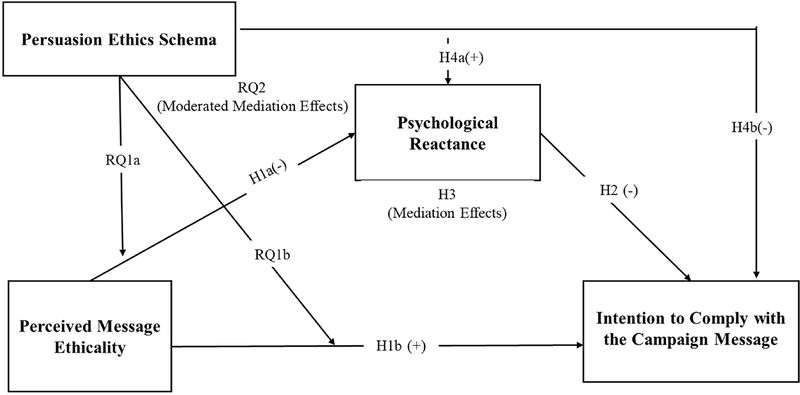
Research Model
METHODS
Data Collection
An online cross-sectional survey was conducted in South Korea during the second week of June 2024, targeting 1,500 adults aged 19 and older. The survey protocol received approval from the institutional review board at the authors’ university. Participant recruitment was managed by a leading South Korean online research firm, which maintains a panel of approximately 1.5 million people that reflects national demographics such as gender, region, and age. People volunteered for the survey in return for points redeemable for online purchases. A total of 2,245 panel members clicked a “Participate in the survey” link, and the completion rate was 86.24% (1,936 responses). According to the research firm’s data screening protocols, 436 responses were excluded either because of oversampling (326 cases) or because of incomplete, inattentive, or insincere responses flagged through attention checks and response times (110 cases), leaving a total of 1,500 responses for final analysis. This final sample was 50.9% male, and its average age was 45.47 (SD = 13.65). The average educational attainment fell between a 2- to 3-year technical college degree and a 4-year college degree (SD = 0.58). About 4.1% of the participants answered that they had experienced at least one type of the illegal drugs listed in the survey. This rate was slightly higher than that of a national survey conducted among 4,000 adults, in which 2.9% reported using illegal drugs or hallucinogenic inhalants (Kim, 2025).
Survey Procedures
Participants received information regarding the study’s ethical considerations, including its purpose statement, assurances of anonymity and confidentiality, stipulations of potential risks and benefits, and contact information for questions or concerns. After affirming consent to participate, they answered background questions about their awareness of illegal drugs, their experience of using or not using illegal substances, and their PES with respect to public service advertisements.
Next, they were randomly assigned to view one of four different anti-drug campaign messages that had recently appeared on media platforms. These messages were selected through a systematic procedure designed to enhance both ecological validity and controlled variation across stimuli. Specifically, we initially collected from YouTube a pool of anti-drug advertisements that had been publicly disseminated in South Korea. To ensure comparability across stimuli, the ads were selected based on the following criteria: (1) they were less than one minute in length and could be edited to a standardized duration; (2) they were high-quality, nationally disseminated campaigns funded by credible sources such as government agencies; (3) they targeted a general audience rather than a specific subgroup; and (4) they either lacked celebrity appearances or had appearances that could be easily removed to avoid celebrity effects.
Importantly, although all four messages addressed the common theme of drug use prevention and were comparable in format and production quality, they were intentionally heterogeneous in their persuasive message features. The messages varied in tone (e.g., reflective vs. confrontational), appeal type (e.g., self-harm vs. fear-based), framing (e.g., narrative vs. deterministic vs. preventive), and degree of directive or morally charged language. These features have been identified as theoretically relevant to perceptions of message ethicality and the elicitation of psychological reactance (Dillard & Shen, 2005; Rains, 2013). At the same time, although a one-way ANOVA indicated a statistically significant difference across message conditions in perceived ethicality (F (3, 1996) = 2.95, p = .032), the effect size was negligible (partial η² = .006), and post hoc comparisons using Scheffé tests revealed no consistent pairwise differences at the .05 level of p-value. This pattern suggests that the four messages maintained largely comparable baseline levels of perceived ethicality while varying in other persuasive features. Using such messages allowed us to focus on examining individual-level perceptions of ethicality and their associations with psychological reactance and compliance intention, and to avoid substantive confounding by differences in perceived ethicality across messages. This combination of controlled similarity (e.g., topic, length, production quality) and systematic variation (e.g., tone, appeal, and framing) allowed us to examine how perceived message ethicality and related psychological processes operate across different types of real-world campaign messages, while minimizing extraneous confounds.
After participants viewed the message, they responded to items measuring their perceptions of its ethicality, their psychological reactance, and their intention to comply with the message. Completion of the entire survey took less than 15 minutes.
Measures
Perceived message ethicality was measured with the following three items using a 7-point Likert scale (1 = “not at all”, 7 = “very much”) adapted from previous studies (Brunk, 2012; Klink & Wu, 2017; Septianto et al., 2023): “(1) This message respects moral norms; (2) This message is socially responsible; (3) This message is ethical.” Exploratory Factor Analysis (EFA) clearly indicated one factor with 76.44% of total variance explained. The three items were averaged to construct a scale in which higher scores indicated higher perceived message ethicality (M = 5.05, SD = 1.17, α = .91).
Persuasion ethics schema (PES) was measured using four items from the scale developed by Paek and Hove (2018a), which adapted Campbell’s (1995) Inferences of Manipulative Intent scale (7-point Likert scale, 1 = “not at all,” 7 = “very much”): “(1) The way in which public service advertisements try to persuade people is usually unacceptable; (2) Public service advertisements try to manipulate the public; (3) I do not like how public service advertisements try to control the audience in inappropriate ways; (4) Public service advertisements try to be persuasive by manipulating the truth.” EFA clearly indicated one factor with 68.50% of total variance explained. The four items were averaged to construct a scale in which higher scores indicated higher PES (M = 2.94, SD = 1.14, α = .88).
Psychological reactance was measured with five items derived from studies that included a psychological reactance scale (Witte, 1994a; 7-point Likert scale, 1 = “not at all” to 7 = “very much”): “The video you just watched (1) tried to pressure me; (2) tried to make a decision for me; (3) was overblown; (4) was boring; (5) was exaggerated.” EFA clearly indicated one factor with 51.67% of total variance explained. The five items were averaged to construct a scale in which higher scores indicated higher levels of psychological reactance (M = 3.30, SD = 1.16, α = .84).
Intention to comply with the campaign message (ICC) was measured with three items (7-point Likert scale, 1 = “not at all”, 7 = “very much”) adapted from previous research (Kim & Yoon, 2015; Park et al., 2021; Yu et al., 2014) and modified to fit this study: “(1) I will act according to the content of this campaign message in the future; (2) I plan to behave in line with the content of this campaign message in the future; (3) I am willing to act as suggested by this campaign message.” EFA clearly indicated one factor with 87.98% of total variance explained. The three items were averaged to construct a scale in which higher scores indicated higher levels of compliance intention (M = 5.77, SD = 1.21, α = .96).
Analytic Strategy
For hypothesis and research question testing, we used the SPSS PROCESS Macro, which enables the estimation of mediation, moderation, and moderated mediation models within a regression-based framework (Hayes & Rockwood, 2020). To test the unconditional direct and indirect relationships specified in H1–H3, we first fitted PROCESS Model 4. In models that include interaction terms, such as moderated mediation models, lower-order coefficients are conditional and cannot be interpreted as unconditional effects. Accordingly, Model 4 was employed to obtain baseline (unconditional) estimates of the direct effects of perceived message ethicality on psychological reactance and intention to comply with the campaign message (H1), as well as the direct (H2) and indirect (H3) effects of psychological reactance on compliance intention. This approach enables a more conservative and interpretable assessment of mediation effects independent of moderation.
For the remaining hypotheses and research questions, we fitted PROCESS Model 8 with perceived message ethicality as an independent variable, PES as a moderator, psychological reactance as a mediator, and intention to comply with the campaign message as a dependent variable. This model allows for the estimation of conditional direct and indirect effects across levels of the moderator. Because each participant was exposed to one of four campaign messages (i.e., a between-subjects message design), message-level variation was explicitly incorporated into the analyses. Following recommendations for studies with a small number of purposively selected stimuli (Slater et al., 2015), we treated message condition as a set of fixed effects (dummy variables) rather than as a random factor. This fixed-effects approach allows us to account for systematic between-message differences while maintaining the primary focus on individual-level relationships among perceived ethicality, psychological reactance, and compliance intention. Thus, we analyzed the data with a pooled sample (N = 1500), including ad conditions as dummy variables to account for potential differences in effects across ad conditions.
Our model also controlled for potential covariates such as the demographic variables of gender, age, education, and drug use experience. These covariates were included because they are likely to relate to the variables of interest (see Scheier et al., 2012). For continuous variables as moderators (in this study, PES), PROCESS allows researchers to use more sophisticated probes such as the Johnson-Neyman method. This method identifies the “region of significance,” the points along the continuum of a moderator where the conditional effect of X on Y transitions between statistically significant and not significant (Hayes, 2018; Jensen et al., 2018). This method can avoid any potential weaknesses of median-split methods such as losses of information and statistical power due to arbitrary categorization.
RESULTS
H1 predicted that perceived message ethicality would be (a) negatively related to psychological reactance and ( b) positively related to compliance intention. The results of fitting Model 4 showed that, the more people perceived the given anti-drug campaign message to be ethical, the less likely they experienced psychological reactance (B = -.305, SE = .024, t = -12.613, p < .001), and the more likely they intended to comply with the campaign message (B = .428, SE = .024, t = 17.896, p < .001). Thus, H1a and H1b were supported (see Table 1).

Results of PROCESS Model 4
H2 predicted that psychological reactance would be negatively related to intention to comply with the campaign message. This hypothesis was supported in that those who experienced a higher level of psychological reactance were less likely to comply with the campaign message (B = -.239, SE = .024, t = -9.834, p < .001). In addition, the mediation effect hypothesis (H3) was also statistically significant (Effect = .073, Bootstrap SE = .010, Bootstrap CI [.053, .094]): perceived ethicality was positively related to compliance intention through lowered psychological reactance.
Regarding the role of the persuasion ethics schema (PES), H4 predicted that PES would be (a) positively related to psychological reactance and (b) negatively related to intention to comply with the campaign message. This hypothesis was also strongly supported. As shown in Table 2, the results of fitting Model 8 indicate that those who had higher PES reported a higher level of psychological reactance (B = .245, SE = .090, t = 2.730, p = .006), and they were less likely to intend to comply with the campaign message (B = -.361, SE = .090, t = -3.987, p < .001).
Results of PROCESS Model 8
RQ1 asked about any moderation effects of PES on the relationship between perceived ethicality and psychological reactance, and between perceived ethicality and compliance intention. Results were mixed. While the moderation effect of PES on the relationship between perceived ethicality and psychological reactance was not statistically significant (B = .026, SE = .017, t = 1.531, p = .126), the moderation effect of PES on the relationship between perceived ethicality and compliance intention was statistically significant (B = .051, SE = .017, t = 2.938, p = .003). Using the Johnson-Neyman method, we found no statistical significance transition points within the observed range of the moderator. This means that, at all levels of PES, perceived message ethicality was positively related to intention to comply with the campaign message.
RQ2 asked the extent to which PES conditioned the indirect effect of perceived message ethicality on compliance intention through psychological reactance (moderated mediation effects). As shown in Table 3, the conditional indirect effect of perceived ethicality on compliance intention through psychological reactance demonstrated a significant positive effect at all three levels of PES. The conditional indirect effects did not have significantly different patterns across levels of PES, and index of moderated mediation for PES did not reach statistical significance (index of moderated mediation = -.005; Bootstrap SE = .005; Bootstrap CI [-.017, .004]).
Conditional Indirect Effects of PE on ICC at Each Value of PES as a Moderator (PROCESS Model 8)
DISCUSSION
This study investigated how perceived message ethicality and the persuasion ethics schema (PES) are associated with the effectiveness of anti-drug communication campaigns, particularly in relation to psychological reactance and compliance intention. While critical commentaries have warned about the ethical risks in fear-based or coercive health messaging (e.g., Guttman & Salmon, 2004), few studies have empirically tested whether audiences actually perceive such messages to be unethical, and whether those perceptions are associated with campaign effectiveness. Moreover, little is known about how these ethical perceptions interact with preexisting dispositions toward persuasive media messages. By examining the interplay of perceived message ethicality, psychological reactance, and PES, this study provides an audience-centered perspective on how, in the persuasion process, ethical considerations may play both negative and positive roles. In doing so, this study attempts to bridge the gap between normative recommendations about ethical persuasion and empirical assessments of campaign effectiveness.
First, we found consistent evidence that perceived message ethicality is strongly associated with audience responses. Messages with higher perceived ethicality were significantly associated with lower psychological reactance and higher intention to comply with the campaign message (H1a, H1b). These results are consistent with previous findings in marketing and advertising, where the perceived ethicality of a brand or company has been shown to predict positive attitudes toward brands and greater willingness to engage with them (Brunk, 2012; Geetha et al., 2024; Budi Riharjo et al., 2025). Our study extends the concept of perceived ethicality into the realm of health campaigns, demonstrating that it functions as a key heuristic in how audiences interpret not only commercial but also prosocial influence attempts.
Second, psychological reactance was negatively associated with compliance intention, and it partially mediated the relationship between perceived ethicality and compliance intention (H2, H3). This pattern suggests that ethical messaging may be linked to reduced skepticism and resistance toward a message and, in turn, greater persuasive receptivity. Both findings also align with the results of several studies on reactance theory, which found that messages perceived to be controlling, threatening, or manipulative often elicit reactance and as a result undermine the objectives of persuasive campaigns (Quick & Stephenson, 2008; Rains, 2013; Steindl et al., 2015; Xu, 2015). In particular, our findings support Dillard and Shen’s (2005) work on the role of message features in triggering reactance, with ethical perceptions emerging as a critical buffer against such resistance.
Third, PES was consistently associated with both reactance and compliance intention (H4). People with higher PES—who tend to view persuasive public service advertisements with greater cognitive and moral suspicion—were more likely to exhibit psychological reactance and less likely to intend to comply with the anti-drug message. These findings build directly on previous studies that conceptualized PES as a form of schema-based resistance which shapes how people respond to health-related PSAs (Paek & Hove, 2018a, 2018b). In other words, these findings further validate the relevance of PES as a cognitive filter that precedes message processing.
Fourth, regarding moderation (RQ1), PES significantly moderated the relationship between perceived message ethicality and compliance intention, but not the relationship between perceived ethicality and reactance. This asymmetrical pattern suggests that PES may be more relevant at later stages of message processing, such as behavioral intention formation, than at earlier affective or cognitive responses, such as reactance. One possible interpretation is that perceptions of ethicality are broadly associated with reactance across individuals, whereas the translation of these perceptions into behavioral intentions is more contingent on individual predispositions such as PES. Importantly, Johnson–Neyman analyses indicated that the positive association between perceived ethicality and compliance intention was observed across the full range of PES levels. This result suggests that perceived ethicality is robustly associated with compliance intention, even among people with higher skepticism toward persuasive messages, although the strength of this association varies.
With respect to moderated mediation (RQ2), the indirect association between perceived ethicality and compliance intention via psychological reactance was not significantly conditioned by PES. This result suggests that, while PES is associated with both reactance and compliance intention, it does not substantially alter the indirect pathway linking perceived ethicality to compliance through reactance. Taken together with the moderation results, these findings indicate that PES may operate more as a direct or conditional predictor of outcomes than as a variable that systematically reshapes the underlying mediation process.
In aggregate, our results indicate that audience ethical perceptions of a message should be considered by health campaign planners not only as a normative concern to be sensitive about but also as a key factor in message effectiveness. By integrating findings from commercial communication with the recommendations of health communication ethicists, this study offers a novel and empirically grounded framework for understanding how audience ethical impressions shape the success or failure of public health campaigns.
Limitations are as follows. First, our study context was anti-drug campaigns in South Korea, which may not be generalizable to other public health issues or to other countries. Future research should explore the effectiveness of ethical messaging about other health topics such as smoking, alcohol, obesity, and vaccination. Also, since South Korea has exceptionally strong legal and cultural strictures against drug use, the findings may not transfer to more liberal legal systems or more culturally diverse societies. Second, our cross-sectional survey method limits the feasibility of making causal inferences among the variables of interest, and we were accordingly careful to report only correlational relationships among them. A related third limitation concerns message-level variation. Although message condition was modeled as fixed effects to account for systematic differences (Slater et al., 2015), the small number of purposively selected messages (n = 4) limits generalizability beyond the stimuli used in this study. Additionally, because respondents were exposed to only one message within a survey context, the findings may reflect a combination of individual- and message-level variance that cannot be fully disentangled. Future research using larger, systematically sampled message sets and multilevel or more controlled designs would help isolate these effects and enhance generalizability. Fourth, although we employed a psychological reactance measure based on well-established scales (Witte, 1994a), our operationalization primarily captures the cognitive appraisal component of reactance (e.g., perceived pressure or manipulation) rather than its full multidimensional structure, which also includes affective responses such as anger (Dillard & Shen, 2005). While previous studies suggest that these components are closely related, future studies may benefit from incorporating both cognitive and affective indicators to provide a more comprehensive assessment of psychological reactance. Fifth, although perceived ethicality is conceptualized as a holistic, top-down moral judgment, our measure does not directly capture how specific message features (e.g., threat, stigma, coercion) translate into an overall impression. Future research should examine how such features contribute to perceived ethicality through more direct measurement or experimental manipulation. Last, while our study highlights the role of perceived ethicality in shaping campaign effectiveness, it does not isolate which specific message features drive variations in audience responses, despite using stimuli that systematically vary in persuasive characteristics. For example, ethicists have argued that guilt and fear appeals in health campaigns are potentially unethical when they provoke shame, blame, or social stigmatization (Guttman & Salmon, 2004). Future research should employ more tightly controlled experimental designs that manipulate specific message features to more precisely identify the mechanisms underlying perceived ethicality and its associations with psychological reactance and compliance intention.
Despite these limitations, this study provides empirical support for common normative recommendations about ethical persuasion. First, it integrates these recommendations with psychological reactance theory, demonstrating that audience perceptions of ethicality influence persuasion not only directly but also indirectly through reactance. Second, we extended the concept of perceived ethicality from the context of consumerism to that of health campaigns, and we provided evidence for its positive role in determining message effectiveness. Third, we found additional evidence indicating that PES is a dispositional factor that affects people’s responses to health campaign messages in both intended and unintended ways.
For practical implications, these findings underscore the importance of ethically appropriate messaging in public health campaigns. To enhance effectiveness, campaign designers should be cautious about using messages that manipulate, blame, shame, frighten, or threaten their intended audience. Such messages could trigger reactance and lead to unintended outcomes. However, those outcomes might be prevented by pretesting for message ethicality. As another step before campaign implementation, public health communicators could also assess audience predispositions such as PES. While ethical persuasion may help prevent boomerang effects in general, persuasive strategies that have been tailored to appeal to high-PES people in particular—who tend to be more skeptical of efforts to influence them—may enhance message effectiveness.
Acknowledgments
This work was supported by the research fund of Hanyang University given to the corresponding author (HY-2025-3535).
Disclosure Statement
No potential conflict of interest was reported by the authors.
Data Availability Statement
The data that support the findings of this study are available upon request.
References
-
Ahn, Y. K. (2024). International drug crime trends and a conceptual model of drug crime prevention. Korean Association of Addiction Crime Review, 14(1), 83–104.
[https://doi.org/10.26606/kaac.2024.14.1.4]

-
BelhadjYoussef, M. H., & Besbes Sahli, A. (2025). Impact of skepticism on reactions to preventive health ads: Gender difference effect. Journal of Nonprofit & Public Sector Marketing, 38(1), 1–27.
[https://doi.org/10.1080/10495142.2025.2488780]
-
Boerman, S. C., Van Reijmersdal, E. A., & Rozendaal, E. (2023). A closer investigation of dispositional persuasion knowledge of sponsored content: Exploring determinants and clusters. Journal of Marketing Communications, 30(6), 660–680.
[https://doi.org/10.1080/13527266.2023.2175893]
- Brehm, J. W. (1966). A theory of psychological reactance. Academic Press.
-
Brunk, K. H. (2012). Un/ethical company and brand perceptions: Conceptualising and operationalising consumer meanings. Journal of Business Ethics, 111(4), 551–565.
[https://doi.org/10.1007/s10551-012-1339-x]
-
Budi Riharjo, I., Efendi, D., Kurnia, K., & Respatia, W. (2025). Analysis of the perceived firm ethicality and brand loyalty through the lens of corporate social responsibility, green brand innovativeness and green marketing: Evidence from an emerging economy. International Journal of Ethics and Systems, (ahead-of-print).
[https://doi.org/10.1108/IJOES-09-2024-0284]
-
Campbell, M. (1995). When attention-getting advertising tactics elicit consumer inferences of manipulative intent: The importance of balancing benefits and investments. Journal of Consumer Psychology, 4, 225–254.
[https://doi.org/10.1207/s15327663jcp0403_02]
-
Dillard, J. P., & Shen, L. (2005). On the nature of reactance and its role in persuasive health communication. Communication Monographs, 72(2), 144–168.
[https://doi.org/10.1080/03637750500111815]
-
Eisend, M., & Tarrahi, F. (2022). Persuasion knowledge in the marketplace: A meta-analysis. Journal of Consumer Psychology, 32(1), 3–22.
[https://doi.org/10.1002/jcpy.1258]
-
Fishbein, M., Hall-Jamieson, K., Zimmer, E., von Haeften, I., & Nabi, R. (2002). Avoiding the boomerang: Testing the relative effectiveness of antidrug public service announcements before a national campaign. American Journal of Public Health, 92(2), 238–245.
[https://doi.org/10.2105/ajph.92.2.238]
- Fiske, S. T., & Taylor, S. E. (1991). Social cognition (2nd ed.). Mcgraw-Hill Book Company.
-
Friestad, M., & Wright, P. (1994). The persuasion knowledge model: How people cope with persuasion attempts. Journal of Consumer Research, 21(1), 1–31.
[https://doi.org/10.1086/209380]
-
Geetha, M., Kaushik, A. K., Abithakumari, J., & Gotmare, P. R . (2024). A meta-analysis exploring the relationship between perceived brand ethicality and consumer response. Business Ethics, the Environment and Responsibility, 33(4), 763-779.
[https://doi.org/10.1111/beer.12640]
-
Guttman, N. (2017). Ethical issues in health promotion and communication interventions. Oxford Research Encyclopedia of Communication.
[https://doi.org/10.1093/acrefore/9780190228613.013.118]
-
Guttman, N., & Ressler, W. H. (2001). On being responsible: Ethical issues in appeals to personal responsibility in health campaigns. Journal of Health Communication, 6(2), 117–136.
[https://doi.org/10.1080/10810730116864]
-
Guttman, N., & Salmon, C. T. (2004). Guilt, fear, stigma and knowledge gaps: Ethical issues in public health communication interventions. Bioethics, 18(6), 531–552.
[https://doi.org/10.1111/j.1467-8519.2004.00415.x]
-
Hastings, G., Stead, M., & Webb, J. (2004). Fear appeals in social marketing: Strategic and ethical reasons for concern. Psychology & Marketing, 21(11), 961–986.
[https://doi.org/10.1002/mar.20043]
- Hayes, A. F. (2018). Introduction to mediation, moderation, and conditional process analysis: A regression-based approach (2nd ed.). Guilford Press.
-
Hayes, A. F., & Rockwood, N. J. (2020). Conditional process analysis: Concepts, computation, and advances in the modeling of the contingencies of mechanisms. American Behavioral Scientist, 64(1), 19–54.
[https://doi.org/10.1177/0002764219859633]
-
Hornik, R., Jacobsohn, L., Orwin, R., Piesse, A., & Kalton, G. (2008). Effects of the national youth anti-drug media campaign on youths. American Journal of Public Health, 98(12), 2229–2236.
[https://doi.org/10.2105/AJPH.2007.125849]
-
Jensen, J. D., Ratcliff, C. L., Yale, R. N., Krakow, M., Scherr, C. L., & Yeo, S. K. (2018). Persuasive impact of loss and gain frames on intentions to exercise: A test of six moderators. Communication Monographs, 85(2), 245–262.
[https://doi.org/10.1080/03637751.2017.1353699]
-
Kim, M. J., & Yoon, Y. M. (2015). Effect of multiple media use and social conformity on perceived credibility and sharing intention of online rumor. PR Research, 19(2), 96–119.
[https://doi.org/10.15814/jpr.2015.19.2.96]
- Kim, N. H. (2025). Current situation and treatment plans for recent changes in drug crimes (I): Drug crime survey (KICJ Issue Paper Vol. 4). Korean Institute of Criminology and Justice.
-
Klink, R. R., & Wu, L. (2017). Creating ethical brands: The role of brand name on consumer perceived ethicality. Marketing Letters, 28(3), 411–422.
[https://doi.org/10.1007/s11002-017-9424-7]
- Lee, C. W. (2024, November 7). Drug addiction surges in South Korea. The Dong-A Ilbo. https://www.donga.com/en/article/all/20241107/5270938/1
-
Lee, S. T., & Cheng, I. H. (2010). Assessing the TARES as an ethical model for antismoking ads. Journal of Health Communication, 15(1), 55–75.
[https://doi.org/10.1080/10810730903460542]
-
Mannetti, L., Brizi, A., Giacomantonio, M., & Higgins, E. T. (2013). Framing political messages to fit the audience’s regulatory orientation: How to improve the efficacy of the same message content. PLoS One, 8(10), Article e77040.
[https://doi.org/10.1371/journal.pone.0077040]
-
Meirick, P. C. (2006). Media schemas, perceived effects, and person perceptions. Journalism & Mass Communication Quarterly, 83(3), 632–649.
[https://doi.org/10.1177/107769900608300310]
- National Research Council. (1989). Improving risk communication. National Academies Press.
-
Obermiller, C., & Spangenberg, E. R. (1998). Development of a scale to measure consumer skepticism toward advertising. Journal of Consumer Psychology, 7(2), 159–186.
[https://doi.org/10.1207/s15327663jcp0702_03]
-
Oh, H. J., Cha, Y., & Kim, J.-N. (2023). Fans, friends, critics, and foes: How CSR-based stakeholder segmentation differentiates perceived corporate ethics, trust, and perceived brand quality. Public Relations Review, 49(2), 102317.
[https://doi.org/10.1016/j.pubrev.2023.102317]
-
Paek, H.-J., & Go, H. (2024). Mechanisms of social media campaign effectiveness: Integrated model of presumed media influence and perceived social norms. Advertising Research, 140, 5–39.
[https://doi.org/10.16914/ar.2024.140.5]
-
Paek, H.-J., Go, H., & Lee, J. (2024). Mechanisms for drug prevention campaign effectiveness: Roles of perceived message sensation value and sensation seeking tendency. Journal of Public Relations, 28(1), 1–31.
[https://doi.org/10.15814/jpr.2024.28.1.1]
-
Paek, H.-J., & Hove, T. (2018a). How the media effects schema and the persuasion ethics schema affect audience responses to antismoking campaign messages. Health Communication, 33(5), 526–536.
[https://doi.org/10.1080/10410236.2017.1279003]
-
Paek, H.-J., & Hove, T. (2018b). How the persuasion ethics schema and audience type influence the persuasive effects of antismoking message appeals: A test of a moderated moderation model. PR Research, 22(1), 22–49.
[https://doi.org/10.15814/jpr.2018.22.1.22]
-
Park, S., Lee, S. E., Seo, J. H., & Oh, K. S. (2021). The influence of Veggie Day climate campaign on social media responses and pro-environmental behaviors: Based on university students in Busan. Journal of the Korea Contents Association, 21(12), 888–895.
[https://doi.org/10.5392/JKCA.2021.21.12.888]
-
Price, V., Huang, L.-N., & Tewksbury, D. (1997). Third-person effects of news coverage: Orientations toward media. Journalism & Mass Communication Quarterly, 74, 525–540.
[https://doi.org/10.1177/107769909707400307]
-
Quick, B. L., & Stephenson, M. T. (2008). Examining the role of trait reactance and sensation seeking on perceived threat, state reactance, and reactance restoration. Human Communication Research, 34(3), 448–476.
[https://doi.org/10.1111/j.1468-2958.2008.00328.x]
-
Rains, S. A. (2013). The nature of psychological reactance revisited: A meta-analytic review. Human Communication Research, 39(1), 47–73.
[https://doi.org/10.1111/j.1468-2958.2012.01443.x]
-
Reynolds-Tylus, T. (2019). Psychological r e a ct a nc e a nd pe r s uasiv e he alth communication: A review of the literature. Frontiers in Communication, 4, Article 56.
[https://doi.org/10.3389/fcomm.2019.00056]
-
Rossi, J., & Yudell, M. (2012). The use of persuasion in public health communication: An ethical critique. Public Health Ethics, 5(2), 192–205.
[https://doi.org/10.1093/phe/phs019]
-
Ryu, H., & Jun, S. (2019). Asymmetric negative influence of cynicism and skepticism: A study of preventative communication. International Journal of Advertising, 38(4), 577–602.
[https://doi.org/10.1080/02650487.2019.1596448]
-
Sagarin, B. J., Cialdini, R. B., Rice, W. E., & Serna, S. B. (2002). Dispelling the illusion of invulnerability: The motivations and mechanisms of resistance to persuasion. Journal of Personality and Social Psychology, 83(3), 526–541.
[https://doi.org/10.1037/0022-3514.83.3.526]
-
Scheier, L. M., Grenard, J. L., & Holtz, K. D. (2012). An empirical assessment of the above the influence advertising campaign. Journal of Drug Education, 41(4), 431–461.
[https://doi.org/10.2190/DE.41.4.f]
-
Septianto, F., Paramita, W., & Ye, S. (2023). What’s in a (first) name? Personized advertising messages enhance consumer perceived ethicality. Journal of Advertising, 52(2), 179–192.
[https://doi.org/10.1080/00913367.2021.1990810]
-
Shen, L. (2014). Antecedents to psychological reactance: The impact of threat, message frame, and choice. Health Communication, 30(10), 975–985.
[https://doi.org/10.1080/10410236.2014.910882]
-
Singh, J. J., Iglesias, O., & Batista-Foguet, J. M. (2012). Does having an ethical brand matter? The influence of consumer perceived ethicality on trust, affect and loyalty. Journal of Business Ethics, 111(4), 541–549.
[https://doi.org/10.1007/s10551-012-1216-7]
-
Sivakumaran, B., Harindranath, R . M., Nandakumar, N., & Srivastava, E. (2023). Public service announcements: A literature review and way forward. International Journal of Consumer Studies, 47(6), 2451–2478.
[https://doi.org/10.1111/ijcs.12942]
-
Slater, M. D., Peter, J., & Valkenburg, P. M. (2015). Message variability and heterogeneity: A core challenge for communication research. Annals of the International Communication Association, 39(1), 3–31.
[https://doi.org/10.1080/23808985.2015.11679170]
-
Steindl, C., Jonas, E., Sittenthaler, S., Traut-Mattausch, E., & Greenberg, J. (2015). Understanding psychological reactance: New developments and findings. Zeitschrift für Psychologie, 223(4), 205–214.
[https://doi.org/10.1027/2151-2604/a000222]
-
Witte, K. (1994a). Fear control and danger control: A test of the extended parallel process model (EPPM). Communication Monographs, 61(2), 113–134.
[https://doi.org/10.1080/03637759409376328]
-
Witte, K. (1994b). The manipulative nature of health communication research: Ethical issues and guidelines. American Behavioral Scientist, 38(2), 285–293.
[https://doi.org/10.1177/0002764294038002009]
-
Xu, J. (2015). Designing messages with high sensation value: When activation meets reactance. Psychology & Health, 30(4), 423–440.
[https://doi.org/10.1080/08870446.2014.977280]
-
Yu, H., Park, H., & Yang, W. (2014). Messages promoting to prevent addiction to online-games among teenagers: Applying physical-psychological appeals and positive-negative framing. The Korean Journal of Advertising, 25(1), 321–341.
[https://doi.org/10.14377/KJA.2014.1.15.321]