
Embodied Boundary Work: Materializing Identity Across Transnational K-pop Concert Spaces
 ; So Yoon Lee2
Copyright ⓒ 2026 by the Korean Society for Journalism and Communication Studies
Abstract
This study posits K-pop fandom as a site of embodied boundary work, focusing on the spatial and material dimensions of concertgoing practices. Drawing on comparative ethnographic fieldwork of a combined 18 concerts conducted by two authors in South Korea (n=11) and the United States (n=7) between 2022 and 2023, we explore how fans navigate and reconfigure individual and social boundaries through participation. We conceptualize K-pop concerts as critical episodes of interaction in the global flow of Korean cultural production. These events are not only sites of consumption, but arenas where fans co-produce meaning, identity, and place. Our analysis foregrounds material artifacts with infrastructural conditions in shaping how fans construct and navigate their fandom across different spatial contexts. Through a comparative lens, we identify three key modes of embodied boundary work that emerge in concert contexts: semiotic alignment, identity articulation, and spatial negotiation. These dynamics build upon the knowledge that K-pop fandom acts not as a monolithic community or coherent subculture. We analyze how K-pop concertgoing constitutes a key practice of fandom that is spatio-materially anchored and claims to authenticity, hierarchies of belonging, and infrastructural asymmetries are negotiated, contested, and unevenly distributed across different cultural and spatial contexts.
Keywords:
transnational fandom, ethnography, identity, materiality, boundary work, K-poptransnational popIn recent years, K-pop, or South Korean (hereafter Korea/Korean) popular music, has become not only a transnational cultural phenomenon in digital spaces but also a tangible, material force in global live music industries. In 2022, the annual physical sales for the top 400 K-pop albums hit over 70 million (Yonhap News, 2022), and by 2025, Forbes reported an “apparent shift in K-pop, transitioning from being dependent on album sales to concert-fueled growth” (Benjamin, 2025) based on international ticket sales. An increasing number of K-pop artists are now holding live concerts at various locations outside of Asia, demonstrating K-pop’s expanding reach across the globe. In fact, we are witnessing a deeper integration of K-pop into global live entertainment infrastructures, both spearheading and benefiting from the rise of music tourism, whose market size in Korea is estimated at 3226 million USD in 2026 (Grand View Research, 2026). Beyond the numbers, K-pop’s expansion into concert venues and tour stops worldwide has produced social, cultural, and material impacts that merit closer analysis.
For example, in 2019, K-pop group NCT 127 launched their first North American tour with a deliberate effort to celebrate each city on the tour separately. In a video produced by SM Entertainment before the tour launched, each group member was assigned to be a representative for each city. Then the company continued to share vlogs from each stop to the group’s YouTube channel, sending each member on small adventures in their designated city (NCT DAILY, 2019). In turn, fans supported their city’s designated member.
In the seven years since NCT’s Hit the States tour demonstrated localization practices in North America, we have seen tensions arise around the globalization of K-pop tours. For example, K-pop group Seventeen faced backlash in 2024 from their Korean fanbase over what was framed as “domestic market discrimination.” (Dee, 2024) Of the 14 concerts on their 2023 Follow tour, only two were held in Korea, while the remaining twelve took place in Japan. Korean fans questioned why they received fewer opportunities to see the group perform and called for boycotts of Seventeen’s concerts on social media. Both examples demonstrate how K-pop fandom practices are spatialized: fans’ identities, performances, and sense of belonging are not abstracted from place but made meaningful through the visible and palpable embodiment of boundaries.
Against this backdrop, this article calls for a more nuanced discussion of K-pop concertgoing practices and, by extension, issues of materiality and spatiality in K-pop fandom practices. Building on existing research that highlights the diverse array of actors partaking in K-pop fandom practices (James, 2025; Saeji, 2024) and intersectional experiences of fandom at large (De Kosnik & Carrington, 2019; Pande, 2018), we conceptualize K-pop concertgoing practices as critical episodes of interaction among diverse social groups within the global circuits of Korean popular culture, where fans not only interact with K-pop idols and their performances but also co-produce meaning, identity, and place with other fans. In particular, we build on Suk-Young Kim (2018)’s earlier study of K-pop concerts and “liveness,” in which she argues that “live K-pop concerts not only double as fan meetings but also function as fan meetings rather than music performances (p. 177).” In interrogating the puzzle of how the K-pop industry manages the “hard sell” of live performances in an era of digitalization, Suk-Young Kim offers a savvy explanation that concerns the spatial and emotional aspects of K-pop concertgoing:
“...a more ontological definition of ‘live’ in a live performance would reference a feeling of ‘aliveness.’ That feeling of rapport emerges among community members who occupy the same space with a shared purpose; hence, the double meaning of live as in ‘live performance’ and ‘feeling alive,’ which reference spatial and emotional rapport (p. 175).”
In this paper, we seek to understand how exactly such “spatial and emotional rapport” occurs across different contexts and the different tensions that such rapport entails, focusing on not just K-pop concerts but the various spaces that fans inhabit in the process of concertgoing. That is, we conceptualize and analyze spaces such as concert venues, city streets, public transportation, and pop-up stores that K-pop fans inhabit as not simply backdrops to fandom, but places that are actively produced by individuals’ material and embodied practices of fandom. In doing so, we make clear that we refer to space as the abstract, undifferentiated dimension of social life, and place as space transformed through human practice, movement, and affective investment (Tuan, 1977).
Based on such a conceptualization of the relationship between space and place in the context of K-pop concertgoing, this paper asks the following question: How do K-pop fans construct and navigate social, cultural boundaries in their concertgoing practices across different contexts? In empirically tackling this question, we draw analytical insights from Low (2017)’s framework of “spatializing culture,” which is a powerful framework that allows scholars to “produce and locate – physically, historically, affectively, and discursively – social relations, institutions, representations and practices in space (p. 7).” We put this framework in conversation with scholarship on identity work, boundary policing, and destigmatization strategies in fan practices (Korobkova & Black, 2014; Yodovich, 2016), exploring how physical and material aspects of fandom mediate identity and boundary work in different spatial contexts. Taken together, we show how K-pop fans’ concertgoing practices, as an important category of fandom practices, entail embodied boundary work—the spatially situated and materially mediated work of communicating who belongs where and on what terms.
To capture such embodied boundary work in situ, we leverage the uniqueness of our data: ethnographic observations of K-pop fans’ concertgoing practices in Korea and the United States between 2022 and 2023. While this study primarily draws from the two authors’ ethnographic data, it also draws on media and online discourse of particular K-pop concerts and their reception for argumentation when necessary. Through this study, we seek to better understand how boundary work between fans and non-fans, as well as within fandoms, is mediated through physical and material artifacts in the context of K-pop, advancing discourse on participatory fan practices and reexamining the meaning of concertgoing in the post-pandemic era.
To answer our research question, we first situate our study by describing the analytical merits of addressing issues of materiality and spatiality for studies of digital mediations in popular culture and communication scholarship. Since the approach foregrounding digital mediations has been so pronounced in fandom studies and especially in K-pop scholarship, we aim to shed light on the spatial and material aspects of fandom culture, in this case by analyzing K-pop fans’ concertgoing practices. We used a two-researcher comparative ethnography to emphasize the transcultural and transnational nature of this project, especially in light of this special issue’s theme. Our findings describe three key modes of embodied boundary work demonstrated by K-pop fans’ concertgoing practices in Korea and the US. First, fans engage in semiotic alignment using visual and material cues to signal belonging, especially given the existence of linguistic barriers. Second, fans engage in identity articulation, where their performances of fandom intersect with different facets of their identity such as race/ethnicity, linguistic identity, and nationality. Third, fans engage in spatial negotiation, where they adapt to or resist the logistical and cultural constraints of different venues. We then discuss our findings and their implications for communication and Hallyu studies scholarship. We call for a renewed examination of how we understand the relationship between fans of Korean popular culture and questions of space and place, offer our methodological approach for future application, and argue for a theoretical shift that centers the physical, embodied dimensions of fan practices in the co-production of today’s media landscape.
Analytical Framework: Space, Place, and Embodied Boundary Work
Early fan studies texts emphasized the shift from fans as consumers (Fraade-Blanar & Glazer, 2017) to prosumers (Jenkins, 2013; Scott, 2019; Toffler, 1980), that is, fans who now have a voice in the production of their object of fandom. This shift was made possible by fan practices within their own communities of production, creation, promotion, and diffusion across media platforms (Derbaix et al., 2023; Wang, 2020). Similarly, K-pop’s extraordinary global success has been attributed to the industry’s impressive digital media ecosystem and its capacity to engage a global audience (D. Kim, 2021; Lee, 2019), a dynamic that became especially pronounced during pandemic lockdown orders, when the industry saw unprecedented growth as fans found ways to participate in K-pop in digital contexts (Gibson & Herman, 2022). Scholars have also consistently highlighted the role of K-pop fans as prosumers and co-creators of content, analyzing the diverse array of fandom practices that occur in both online and offline spaces. For example, fans purchase physical merchandise to attend in-person fan events hosted by entertainment companies and by their peers, including “fan cafes”—pop-up events at bubble tea and coffee shops that have proliferated since the mid-to-late 2010s (Wu, 2024). Fans also post on social media proudly and at times sheepishly showing off their K-pop collections, and purchase items from other fan artists online (James, 2026), upholding what Otmazgin and Lyan (2019) call fan entrepreneurship—a fan economy of creators, resellers, and small-scale producers that has emerged alongside fans’ digital practices.
However, as many Hallyu scholars established early on, K-pop fandom is not a unilateral entity. Popular media and culture scholarship have long problematized the oversimplification of fandom. Morimoto and Chin (2017) contend that work in fan studies literature that overemphasizes the overcoming of difference through fandom disregards the vital disjunctures and disparities that make up global digital fandom (p. 174). Other studies on fandom, especially K-pop fandom, have argued that media convergence has exacerbated the datafication of fan labor (Caliandro et al., 2024; Q. Sun et al., 2023), with fans feeling pressure to compete against others for “streaming goals” and strategically engaging in free labor to increase views and listens on international music platforms like YouTube and Spotify as well as Korean platforms like Melon and Genie. Media convergence has also intensified intercultural frictions within K-pop fandom (D. Oh, 2017; Jin et al., 2023), with Jung (2012) documenting how nationalism and other identitarian commitments can fuel acts of othering, manifesting in cybervigilantism and the policing of fellow fans.
If this set of literature provides us with valuable insights into the diversity and heterogeneity within K-pop fandom, another set of literature sheds light on the role of information and communication infrastructure in K-pop fandom (J. Kim & Kwon, 2022). Infrastructure may take the form of physical transportation systems, concert venues, cultural norms, and information-sharing systems, all of which influence popular media and culture across contexts. For example, leveraging the global popularity of K-pop to promote Korean culture and boost inbound tourism (Y. Oh, 2018, 2023), K-pop-themed guided tours, events, and live performances have mushroomed. All of these practices support the notion that K-pop fans inhabit a hybrid space (de Souza e Silva et al., 2025), where routine interactions occur in digital and physical spaces simultaneously.
Nevertheless, while fans’ digital practices have been widely explored, research on how different identity markers and socio-cultural boundaries materialize remain scarce. This is curious given the increasing social, economic, and cultural implications of K-pop concertgoing practices as well as their potential for generating analytical insights. Even within a single concert venue, different types of fans, casual listeners, and accompanying friends and family members inhabit the same physical space, creating a complex network of social relations that makes the diversity and heterogeneity within a fandom unusually visible. Moreover, as we have argued earlier, K-pop concerts entail a set of concertgoing practices that transform not just venues but other spaces that fans inhabit into meaningful places, allowing us to observe how fan identities and socio-cultural boundaries materialize.
Accordingly, this study synthesizes existing frameworks to formulate an analytical framework that helps capture the material, spatial, and affective dimensions of fan practices. First, we draw on Setha Low’s (2017) framework of spatializing culture, which distinguishes the social production of space—the political-economic, infrastructural, and historical forces that produce the built environment—from the social construction of space—the meaning-making, narrative, and embodied practices through which people transform space into meaningful place. Low argues that ethnography is uniquely positioned to access this latter dimension, since social construction unfolds through situated, embodied interaction. Low’s framework allows us to attend to both the material and spatial dimensions of concertgoing such as venue design and transportation and the embodied practices through which fans transform these spaces into meaningful places–namely by coordinating lightstick use or dress codes.
Second, we draw on the concept of boundary work, previously used by fan studies scholars to refer to the ways fans differentiate between “true/authentic” and “fake/inauthentic” fans. Cornel Sandvoss (2005), in Fans: The Mirror of Consumption, explores how fans distinguish “true” fans from more casual or “inauthentic” participants, showing that boundary work occurs not only between fans and non-fans but also within fandoms. More recently, Suzanne Scott’s Fake Geek Girls (2019) elucidates how boundary work in fandom is often gendered: who gets recognized as a “legitimate” fan is deeply gendered, with women and socially marginalized groups frequently having to work harder to “prove” their fandom. Scott shows that boundary work within fandom is not neutral, but rather acts as a form of cultural gatekeeping that reflects broader power relations. Within K-pop fandom specifically, M. Sun (2020), in her ethnography of Chinese GOT7 fans, shows how fan labor is mobilized as boundary work, with fans drawing distinctions between more involved fans and less involved, casual fans who do not contribute to fandom or their idols’ success. Similarly, Gahler and Choi (2024) demonstrate how nationality intersects with fan identities: their survey of 555 K-pop fans from Korea and the US suggests as fanship deepened, Korean fans exhibited stronger negative attitudes toward American fans, whereas American fans showed increasingly positive attitudes toward Korean fans.
Bringing these frameworks together, we use the term embodied boundary work to refer to how fans articulate and embody their identities through bodies, senses, objects, dress, sound, and spatial positioning. We argue that K-pop fans’ concertgoing practices offer a fruitful case for understanding how boundary work is performed through spatially situated and materially mediated practices that draw on available semiotic and cultural resources.
DATA AND METHODS
To answer our research question, how do K-pop fans construct and navigate social, cultural boundaries in their concertgoing practices across different contexts, we draw from our ethnographic observations of K-pop concerts in both Korea and the United States (2021-2023). Given the transcultural nature of K-pop fan experiences, we adopt Marcus’ (1995) call to conduct ethnography by following connections, relationships, and flows that link different sites within a broader “world system”, while remaining conscious that our positionalities and logistical constraints make it impossible to represent the entire ecology of K-pop fan concertgoing practices (Adams, 2025). Instead, we base our methodology on that of recent works in Hallyu scholarship such as Liew (2025) and Lyan and Otmazgin (2025) who argued that, “By analyzing an offline event, we strive to understand the institutional role of fans in situ and in vivo” (p. 787). To do so, we leverage the unique triangulation of two distinct positionalities in the process of data collection and analysis: an American female researcher doing fieldwork in Korea, specifically Seoul, and a Korean female researcher conducting fieldwork in the United States, specifically Chicago and Los Angeles. While our distinct cultural backgrounds influenced differences at the data collection, analysis, and writing stages, we found the article’s strength was in our triangulation process throughout each stage. Our different approaches integrated the collaborative goals of a transcultural and transnational project focused on connections across boundaries. Both authors first received IRB approval from their respective institutions, then independently conducted ethnographic fieldwork, putting our data in conversation throughout the second half of data collection in our respective field sites and with our overlapping positionalities.
We attended, observed, and analyzed ethnographic data for a total of 18 concert events across both researchers. “K-pop concerts” as discrete events refer to live performances by a self-identified solo artist or group, often featuring elaborate choreography, synchronized dance routines, and fan interaction, with a strong emphasis on visual and auditory spectacle. Each concert ranged between two and five hours and followed the common K-pop concert structure. This structure included an artist performing different collections of their songs, often starting with loud and bass-heavy, then transitioning to slower, sexier songs, then ending with a fake finale followed by a now-expected encore of their most popular song. Between each of these portions of the set list, the artist interacted with the fans and changed outfits backstage while a special concert video (VCR) played for the audience. Tables 1 and 2 list the events during which the authors respectively conducted participant observation.

Events for Analysis (Author 1)
Events for Analysis (Author 2)
The majority of concerts were attended in Seoul, South Korea (n=11), then Chicagoland, Illinois, USA (n=6), and finally one in Los Angeles, California. Of note is that both researchers have been fans of K-pop for years prior to this study. While this article is confined to concerts attended during the fieldwork period, certain in-group knowledge was ascertained from years of attending concerts in locations beyond those listed in Tables 1 and 2. Concert location influenced such differences as size of venue, proximity to a major city, public transportation, attendee cultural background, and even visa availability for crew and performance team members. These limitations and affordances led to, in part, the concert variability that we describe in this article.
Many, but not all, of the concerts observed included pre-planned “dress codes” either decided by the artist’s production company or the fans themselves. In some ways, these dress codes provided the impetus for this study, as distinctions and similarities in fan dress brought to the surface introductory themes of fan symbolism and subculture. After further data collection and analysis, we deepened that thematic review to be in line with literature on space, place, and boundary work. During analysis, we paid particular attention to how fans draw on semiotic and cultural resources such as color, memes, and symbols to simultaneously express their individual identities and membership of particular fandoms. Pulling from media and communication scholarship that emphasized the importance of clothing and material artifacts in fan identity demarcation (Anderson, 2015; Chadborn et al., 2017), we traced themes of shared or distinct visual and material choices made by fans in concert contexts. After consolidating fieldnotes and comparing findings, we identified important similarities and differences in the unique ways fans demonstrated their fan identity through material practices in physical spaces.
FINDINGS AND ANALYSIS
We find that K-pop fans, in both Korea and the U.S. contexts, engage in complex, contradictory communication practices to define and assert their “place” in relation to broader socio-cultural norms. Our findings reveal how concert-going, as a key fan practice, is not just an immersive experience of music and performance but also a site of visibility and negotiation for fan legitimacy. In what follows, we provide ethnographic descriptions to first sketch out key similarities and differences in concertgoing practices that emerged when putting the two authors’ respective ethnographic data in conversation. Then, we analyze how existing socio-cultural boundaries such as race, ethnicity, and linguistic identity are articulated, complicating the construction of a unified fandom identity and highlighting the tensions between global fan practices and local cultural contexts. Finally, we discuss the coproduction and textual meanings of performing K-pop fandom across international and hybrid contexts.
Semiotic Alignment: Concertgoing in Action
K-pop concertgoing practices unfold across different spatial contexts. Drawing on our respective ethnographic observations of K-pop concerts in Korea and the United States, we argue that K-pop fans use visual and material cues to signal belonging in both explicitly fannish and non-fandom spaces. We conceptualize concertgoing not simply as an experience delimited within the performance venue, but rather a broader set of practices that include mundane and logistical choices that concern what to wear, how to travel, and when to arrive. As we illustrate below, these practices reflect and reproduce broader as well as fandom-specific norms, while also creating avenues for identity expression and fan recognition.
Fans draw on a shared set of semiotic resources, pulled from platform-mediated interactions and histories of participation, to craft their fan identity. Taken together, our fieldwork data finds that fans in Korea follow more explicit dress-codes for venues, whether fan-created or shared in advance by the production company. Their performance of those dress codes is often layered with dark jackets or outer layers above fan outfits, influenced by public cultural expectations in Seoul and transit infrastructure. In contrast, fans in the U.S. are more likely to demonstrate individualized forms of concert dress and take more risks, dressing in a way that makes them feel confident and is based less on predetermined dress codes and more on in-group jokes or references. We theorize that this distinction is possible due to car-centric venues, where fans have personal and private space before entering fandom space. Across both contexts, concertgoing is a site of identity construction and visibility politics within broader infrastructures. To start, we provide a vignette of an event observed by our author in Korea:
In the spring of 2023, I attended a 15th-anniversary event for the K-pop boy group SHINee in Seoul. A muggy, drizzly Saturday morning ensured sweaty buses and trains, especially in the express line I opted to ride to the venue. In a mint green button-down top with jeans and an umbrella, I attempted to match the long-established Shinee fanclub dress code of light blue. On the train, I recognized symbols of fandom from other people in my car. Rather than overt symbolism from outfits or labels, I saw subtle in-group references: a headphone case, a sticker, scrunchies and hair bows, and, in one case, the telltale end of a lightstick poking out from a tote bag, all in the distinct fandom color. My assumptions were proven correct when I saw many of the individuals I had presumed to be fans get off the train at the same stop as me, peeling off layers of rain jackets to reveal shirts in the assigned dress code color.
The venue, located in the Jamsil area of Seoul, was a large concrete structure with overhangs reminiscent of parking decks or overpasses. Fans crowded under the overpasses to hide from the rain, which had picked up at this point, but braved the elements to stand in long queues to pick up their will-call tickets and participate in the experiential marketing events developed by the artist’s production company. Despite the weather, fans arrived early to visit with their friends and experience the energy surrounding the venue, trading fan-made goods and sharing snacks. When the venue opened, fans lined up again, winding up the concrete ramps in the downpour. Inside the arena, we piled our umbrellas and jackets in our seats while we stood to enjoy the show.
In this example, fans attending a concert in Seoul were subject to external factors such as weather, transportation infrastructure, and venue design while navigating their way through a fandom experience. Through symbols of in-group identity, fans were able to recognize one another and engage in semiotic alignment even before removing raincoats to show explicit fandom membership. Figure 1 illustrates how these pops of blue appear in a rainy crowd.
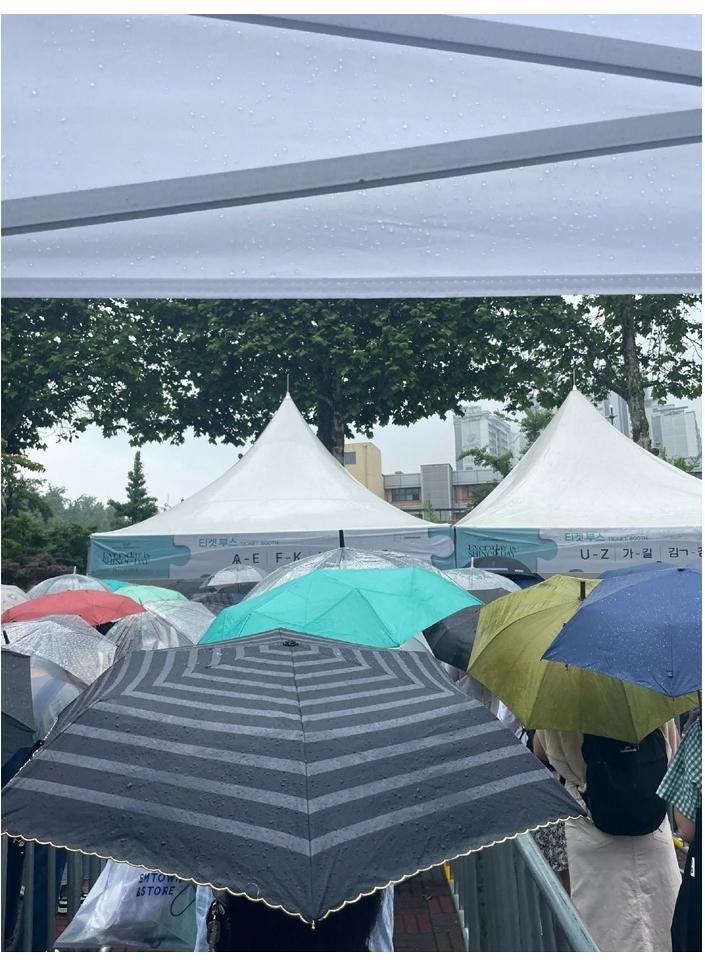
Fans with Blue Umbrellas at A Rainy Concert Venue
The regionally different performance of semiotic alignment via subtle versus overt fandom symbols acts as an important elucidating factor in the divergent relationship between spatial contexts and fandom norms. Fans in Korea, for example, stood outside in the rain for hours under blue umbrellas that they brought with them via public transportation, then kept those umbrellas with them inside the venue. Meanwhile, consider the observations of the second author, who attended BTS member SUGA’s “Suga Agust D D-Day Tour” in Rosemont, a suburb of Chicago located just minutes away from O’Hare International Airport:
It was a breezy, even slightly hot day. I managed to secure two tickets to SUGA’s concert, which took place at Allstate Arena for three days in early May of 2023. On May 5th, I decided to take public transportation. I first took the Metra up to downtown Chicago, transferred to the CTA Blue Line, and took the train all the way up to Rosemont Station. On the way, I spotted a few women who I suspected were fellow ARMYs, given their style of dress. When I got off at Rosemont Station, I saw a steady stream of Uber and Lyft cars pulling in as many fans waited for rides. The “over-representation” of purple in fans’ outfits suggested that people were dressed intentionally for the occasion. One woman had dyed parts of her hair purple, and several others were wearing purple T-shirts. I saw ARMY Bombs (BTS’ official lightstick) dangling from backpacks and handbags, some decorated with keychains and accessories that reflected individual taste. When I arrived at the arena, a long line had already formed. I was curious to see what other ARMYs had chosen to wear for a solo concert of a BTS member. My observations suggested a mix of allegiances—some fans wore SUGA-specific items, while others represented the broader BTS discography. I spotted a few sweatshirts from BTS’s 2022 Busan concert (“Yet To Come”), creating a kind of kaleidoscopic collage of fan histories within the crowd.
On May 6th, which marked the last day of Suga’s stop in Rosemont, I decided to take an Uber from Hyde Park all the way up to Allstate Arena. The weather forecast predicted rain, and when I arrived at the gate with my umbrella, a staff member informed me that umbrellas weren’t allowed inside. “Do you want to leave that in your car?” he asked. I almost replied, “I Ubered here!” For someone who grew up in Korea and did not own a car in both Chicago and Seoul, this was a reminder of how concert logistics in the U.S. often assumed car ownership. Most major venues in the Chicago area have large ground-level parking lots, while venues in Seoul tend to be built around public transportation and feature vertical, underground parking lots.
The above vignettes illustrate how K-pop fans’ concertgoing practices operate as social and semiotic practices shaped by both spatial contexts and fandom norms. Whether fans are navigating public transportation in Seoul or ride-share logistics in suburban Chicago, they actively participate in semiotic alignment that make them a part of a community through wearing color-coded outfits, displaying merchandise, and embodying shared cultural references. What to wear, how to travel, and how to display affiliation are not just practical matters, but also acts of boundary work, through which fans negotiate who belongs, who is “in the know,” and what counts as authentic participation.
Whether through subtle color-coded accessories or dramatic cosplay, fans draw on a shared set of semiotic resources to perform and perceive fandom. Our ethnographic data suggests that Korean fans tend to exhibit more coordinated and subdued expressions of fandom, partly shaped by public norms and transit infrastructure, while U.S.-based fans often engage in more theatrical, individualized forms of self-presentation, made possible by the spatial affordances of car-centric venues. Yet across both contexts, concertgoing becomes a key site for making fandom visible and socially meaningful.
Identity Articulation: Whose Consumption is Louder?
Our second theme, identity articulation, refers to moments in which fans’ performances of fandom intersect with markers of identity. Both of the authors captured moments where different facets of fans’ identities, such as gender, race, ethnicity, and language background, influenced how they navigated the cultural space they inhabited, shaping a fragmented and sometimes dissonant concert experience. As researchers with distinct positionalities, we also identified how our respective positionalities as a white American woman and a bilingual Korean woman shaped our consumption and legitimacy as fans.
Across our ethnographic data, we found K-pop concerts in the U.S. to have more diversity in terms of visible race, age, and gender performances. K-pop concerts in Korea included more diversity of languages spoken, indicating that many international fans attended shows, but less visible diversity in gender and race. Observation in Korea was also conducted just before and after mask mandates were lifted in-country, and many fans continued to wear masks after mandates changed. In the U.S., mandates had been lifted earlier, and fans were less likely to continue to don them. This small difference in dress may demonstrate a more collectivistic approach to fan support expectations, upheld by other fans, in Korea, compared to a more individualistic approach to fandom in the U.S. context. While this aligns with scholarship on both cultures writ large (i.e. S. Kim & Kim, 2015; Yoon, 2018), the performance of identity in concert spaces elucidates power dynamics within fandom as an increasingly globalized participatory subculture. Consider the experience of one of our authors, a white American woman, conducting ethnographic observations in Korea:
After attending a number of K-pop concerts over the course of 10 months, I was confident that I knew the process by heart. So much so that I was confident in my ability to host a friend from the U.S., another white woman, and guide her through the process of attending a concert for Red Velvet, a popular girl group. The day after she landed in Seoul, my jetlagged friend and I took the train to the now-familiar stop at the Olympic Park, the complex where I had attended the majority of my K-pop concerts up to this point.
I was shocked by how surprised my friend was by the fan practices surrounding the event. She was awed that everyone dressed in pops of red and pink alongside their generally muted neutral colors and followed the dress code. She was frustrated we could not sit next to each other. During the show itself, she was shocked by the effective planning of a fan project where we held up pre-distributed poster boards to spell out a message to the artists on the stage. I was amused by her reactions since I had come to see this kind of project as standard practice at K-pop concerts in Korea.
After the show was over, we decided to take some photos on a nearby park bench. While we posed, a Korean man with a professional camera and hand held microphone approached us. He explained in English that he was a music journalist covering the show and wanted to write specifically about non-Korean fans. While we both consented to the interview, my friend grew uncomfortable that we had called attention to ourselves as foreign and K-pop fans. After the interaction, she shared she was not used to being singled out for her visible identity and was uncomfortable as the interview thrust the overlap between her identities into sharp relief.
In this example, the white American fan-friend experienced the overlap between her fannish identity and her often taken-for-granted racial identity performance. Despite increasing tourism rates from western countries to Seoul, most of the attendees to K-pop concerts in Korea during our fieldwork period were Asian. The fact that the fan in this example was uncomfortable being the visible racial minority in a K-pop fandom space, even in Korea, speaks to the expectations of white fans in a comparative project such as this one. Previous Hallyu studies scholarship note how Western fans reify racial power dynamics of whiteness in their digital fandom practices (D. Oh, 2017; Yoon, 2022). This theme speaks to that performance in a material concert context.
In contrast, for the second author, a Korean national who speaks Korean, English, and Mandarin, the subtle power relations between Korean and English became salient as she attended different concerts in the United States:
During BTS’s Permission to Dance on Stage - LA in 2021, an unexpected moment of identity negotiation occurred. Towards the end of the concert, when the seven members each began to offer their individual thoughts and impressions in mostly Korean. One of the members made a joke, making me want to laugh. I immediately stopped, however, because I was immediately reminded that the majority of the audience did not speak Korean and were patiently listening to the English interpretation. A question that instantly crossed my mind was: was it right of me to wait for the other fans, or did I have the right to respond in a way I wanted as soon as I understood what was being said?
With such a question in mind, in several K-pop concerts I attended throughout 2022 and 2023 in the United States, I attuned to moments when Korean-speaking fans responded in real-time to artists, shouting phrases like like “괜찮아! ” (“It’s okay”) or “울지 마! ” (“Don’t cry”). These linguistic asymmetries were especially visible during the encore break, when the screens projected fan-made messages for the artists while they changed outfits. Sometimes, the messages were entirely in Korean; other times, they were bilingual. But in moments where only Korean text was shown, the crowd’s reaction was noticeably more subdued. Fans who couldn’t read Korean hesitated, unsure how to respond, while Korean-literate fans erupted in more enthusiastic cheers. It was such moments when the existence of different social groups within the fandom became salient, shedding light on how uneven forms of participation undermine the illusion of a unified fan community.
In both of the authors’ ethnographic observations, such layered moments across different concert spaces illuminate how the concert space itself reveals stark differences in visibility, legibility, and belonging. Such differences hinge not only on race or nationality, but also on language and cultural familiarity. Concertgoing is not simply watching a performance; it also involves navigating one’s place within a shifting field of legitimacy. In this sense, concertgoing becomes a site of boundary work when fans embody their linguistic, cultural, and fannish identities. Fans negotiate and reinforce embodied boundaries, which intersect with different facets of individual identity in situ.
Spatial Negotiation: The Politics of Concertgoing
The third theme, spatial negotiation, refers to the way fans adapt to or resist the logistical and cultural constraints of different venues, especially in a hybrid online-offline era. As we described above, K-pop concerts generally follow the same format, regardless of location, while cultural needs like translators and physical infrastructures like public transportation change the experience at the discursive and material level. In recent years, and especially in response to COVID-19 lockdown orders, the rising popularity of virtual concerts and the subsequent push for the return of in-person concerts brought the importance of spatial negotiation into sharp relief.
Both authors’ fieldwork suggests that the rising demand to attend in-person K-pop concerts, alongside growing international (non-Korean) fanbases and established cultural differences and conflicts, created rifts within fandoms, raising questions of concert access. Moreover, the emergence of virtual K-pop concerts during the COVID-19 era complicated the meaning of concertgoing. In some cases, fans performed their fan identities “at” a concert without physically attending due to the increasing popularity of simultaneous concert livestreams (Upham et al., 2024). While fans conceded that this is not the same as attending a live concert in person, they reported that it was better than not attending (Gibson & Herman, 2022). In other cases, fans’ ability to participate in part outside the venues themselves led them to engage in fan practices outside “officially” designated fan spaces.
Fans have long-held the tradition of “tailgating” concerts before and, in some cases, during the events, much like their sports fandom counterparts (Bradford & Sherry, 2015). However, as emerging technologies like virtual concerts and increased competition for ticket sales shifted the concert-going experience, fan-made interpretations of broader rules for participation were brought to light. Virtual concerts, for example, still required purchase and were only available live or during single-time playback periods. In our fieldwork, one author found ticketing for in-person K-pop concerts in Seoul to be very competitive. She observed the surrounding activity on a concert day despite “failing” to purchase a ticket.
On the weekend of the EXO anniversary concert, I decided to accompany my friend with tickets to the venue. The group’s production company announced a dress code wherein each quadrant of the venue, the KSPO dome in the Jamsil Olympic sports complex, was assigned a different color depending on the day they attended. I dressed to match since, although I did not have a ticket, I wanted to blend in as much as possible. Before the show, I enjoyed trailing around the venue with my friend to find fan-made paper goods and other “freebies” and see everyone’s outfits. A line trailed out from a merchandise table, which sold out two hours before the show began, and an equally long line formed in parallel for fans to take photos with a larger-than-life-size cut-out of the group. When the time came for the show to begin, I ushered my friend inside and slunk back from the gates. I chose to visit a cafe within walking distance of the venue, assuming it would be filled with the usual weekend park visitors. Instead, I was met with a sea of other fans dressed like me, in the dress code, for a concert they also did not attend.
I quickly noticed smaller fan symbols as well. On the tables next to iced coffees were tote bags covered in EXO logos. Fans carried their lightsticks with them and showed off collections of photocards to one another. The staff at the cafe seemed harried but not surprised by this influx of periphery fans, implying that this happened to them often. Fans sat in pairs or small groups around tables, huddled around tablets or laptops, sharing headphones. I saw most devices were playing the live stream of the concert happening just a few blocks away.
Fans dressed in dress code, brought fan symbols, and engaged in the event despite not having tickets to the show. Beyond the usual “tailgating” practices (Bradford & Sherry, 2015), the virtual concert livestream allowed fans to feel like a part of the action. Rather than watch the virtual performance from the comfort of their own home, they brought their digital participation into physical space and shaped the surrounding area into a concert extension. This hybrid concert participation was observed across multiple shows during the first author’s fieldwork in Seoul. In another example, she observed fans watching the live stream of a Shinee concert from a cafe next door to the SM Entertainment headquarters rather than near the venue. In addition, we both observed fans waking up anywhere from two to four in the morning from the U.S. to watch the livestream of a concert happening in a Seoul venue. Fan decisions about their mode of participation was therefore influenced by the material constraints of their physical and financial situation as much as by platform affordances of virtual concert attendance.
While our first author’s observations suggest how the changing nature of concerts in the post-pandemic era restructures fans’ concertgoing practices and meaning, tensions surrounding questions of legitimacy and authenticity have been voiced within K-pop fan communities. Returning to our opening example of NCT’s Hit the States tour, we noted the efforts to assign each member a specific city. However, when the second author attended a concert by NCT Dream a few years later in Chicago, she discovered the production team had included the wrong city in the concert VCR. This “glitch” put into sharp relief that the Chicago concert, although personally meaningful to fans as a unique experience, was only one of the many cities that the group visited.
Similarly, we note that the deliberate localization was complicated by the size of North America and the likelihood of fans traveling for shows, highlighted by the artists’ initial confusion of city names like “Newark” instead of “New York” (NCT DAILY, 2019). Both authors actually attended different stops on this tour, and recall how in Chicago and Atlanta, the crowd cheered especially hard during their city representative’s fan-artist interaction segments (ment) throughout the show, while it was impossible to confirm if every fan identified strongly with each city.
In another case, in 2024, the K-pop group Seventeen garnered attention when Thai Ticket Major, the ticketing website in charge of the group’s ticket sales for their Thailand concert, implemented a trivia-based ticketing system. Fans were asked to answer questions about the number of members in the group, which members held Korean nationality, and the group’s introduction phase. This instance provides an excellent example of how boundary work can be institutionalized in the management of fandom, determining who gets to access concerts.
These moments underscore how concertgoing, which is often understood as the pinnacle of fan devotion, is entangled in a broader political economy of intimacy, as access to concerts itself is a limited resource distributed across different locations according to profit motives and logistical considerations. K-pop concerts in the United States, for example, have long been subject to dynamic pricing, and recent news articles have argued that pricing is an explicit barrier to participation (Burt, 2026). While in Korea, tickets are less expensive, adjacent tourism industries have come under fire for raising hotel prices amidst concert dates (Rhee, 2026). Fans attend concerts in the ways available to them, whether online, in-person, hours away from home, or hybrid format. They embody boundaries of accessibility and ownership over tour stops and region-specific venues. In this way, the politics of concertgoing are made visible in the way fans negotiate space across platforms as well as logistical affordances and constraints.
DISCUSSION AND CONCLUSION
Our article aimed to answer the question, How do K-pop fans construct and navigate social, cultural boundaries in their concertgoing practices across different contexts? In short, we argue that K-pop fans construct their community in situ through semiotic alignment, spatial negotiation, and identity articulation. Fans engage in embodied boundary work across material constraints, such as location or cultural background, where fan dynamics are at the forefront of interaction and in-group roles and practices are performed.
Thus, our study contributes to the study of communication as an entry point into the co-productions, collaborations, and connections K-pop fans make in contemporary, hybrid fandom spaces. K-pop has been described in scholarship as a “contra-flow” of cultural production, as part of the Korean wave from Korea to the rest of the world, and especially in contrast to the traditional flow of popular culture products from the west outward. In an age of globalization and digital ubiquity, we reorient the conversation around popular culture and fan studies to consider physical space by understanding how K-pop fans engage in boundary work in offline concert venues. Even in a site as digitally embedded as global K-pop fandom, in-person events are colored by material practices.
The way fans engage in boundary work demonstrates the role identity plays in fan communities, especially those tied together via love of a transnational art form. While K-pop fandom may act as an escape for many fans from their day-to-day concerns, broader cultural forces impact what counts as “fan spaces” and influence how fans both refute and reify systems of hierarchy and power dynamics. Thus, future research should investigate the relationship between material fan practices and popular culture more broadly, paying special attention to overlapping identities and the role K-pop fandom, a historically feminized, marginalized, and stigmatized fan collective plays in transfiguring space into meaningful place. As we highlighted in the introduction, the rise of concert tourism and the integration of K-pop concerts into urban placemaking or revitalization projects also require analytical attention. Other work should continue the line of inquiry into circuits of “K-content” beyond the context of K-pop as the local popular culture industry continues to promote Korean media across transnational contexts and, increasingly, engage in co-production of Korean popular media with globalized infrastructures.
Finally, we offer the methodological contribution of conducting a two-researcher, bi-national, multi-concert ethnography. Building upon previous scholarship in cultural studies, fandom studies, and K-pop fandom studies, specifically, we assert that our varied identities strengthen our fieldwork, analysis, and findings. While our individual identities shaped our initial approaches to data collection, analysis, and writing, our triangulation demonstrated the collaborative nature of this special issue and the future directions of Hallyu studies overall. Rather than acting as a limitation, our dual identities as both K-pop fans and intercultural-interdisciplinary researchers allowed us to cross-check our observations, limit ethnocentric assumptions, and overall conduct comparative ethnography that better describes our globalized world. Future scholarship can benefit from this methodological approach across contexts, especially in cases of high affective engagement.
In conclusion, our study has conceptualized K-pop concerts as critical episodes of interaction within the global circuits of Korean popular culture, wherein fans co-produce meaning, identity, and place through embodied boundary work. Our study contributes to Hallyu studies by extending previous works such as Suk Young Kim’s (2018) K-pop Live, conceptualizing K-pop concerts and concertgoing practices as important objects of study, especially post-pandemic, where live music events and the concept of “liveness” overall hold different meanings. We argue that rather than “touristifying” physical space, K-pop fan practices transform space into meaningful places. Thus, we demonstrate the need to reorient Hallyu studies and communication studies toward more spatial and material infrastructures, especially as both fields engage in collaborative conversations that co-construct new theories to better understand fans’ lived experiences. In an era of digital hybridity, K-pop fans’ material practices complicate theories of digital convergence, demonstrating how concertgoing is a politically and culturally charged act.
Disclosure Statement
No potential conflict of interest was reported by the author.
References
-
Adams, K. M. (2025). Tourism ethnography and tourism geographies. Tourism Geographies, 27(3-4), 713–724.
[https://doi.org/10.1080/14616688.2024.2402985]

- Anderson, C. (2015, December 22). Colors and consequences: Branding and fandom in K-pop. K-pop Kollective. https://kpopkollective.com/2015/12/22/branding-and-fandom-in-k-pop/
- Benjamin, J. (2025, May 31). K-pop’s live boom 2025: Seventeen’s record gross, a promising 2nd half. Forbes. https://www.forbes.com/sites/jeffbenjamin/2025/05/31/k-pops-live-boom-2025-seventeens-record-gross-a-promising-2nd-half/
-
Bradford, T. W., & Sherry, J. F., Jr. (2015). Domesticating public space through ritual: Tailgating as vestaval. Journal of Consumer Research, 42(1), 130–151.
[https://doi.org/10.1093/jcr/ucv001]
- Burt, K. (2026, March 2). How exorbitant ticket prices are impacting K-pop fandom. JoySauce. https://joysauce.com/how-exorbitant-ticket-prices-are-impacting-k-pop-fandom/
-
Caliandro, A., Gandini, A., Bainotti, L., & Anselmi, G. (2024). The platformization of consumer culture: A theoretical framework. Marketing Theory. Advance online publication.
[https://doi.org/10.1177/14705931231225537]
- Chadborn D., Edwards P., & Reysen S. (2017). Displaying fan identity to make friends. Intensities: The Journal of Cult Media, 9(7), 87–97.
-
De Kosnik, A., & Carrington, A. (2019). Fans of color, fandoms of color. Transformative Works and Cultures, 29.
[https://doi.org/10.3983/twc.2019.1783]
-
de Souza e Silva, A., Campbell, S. W., & Ling, R. (2025). Hybrid space revisited: From concept toward theory. Communication Theory, 35(1), 14–24.
[https://doi.org/10.1093/ct/qtae023]
- Dee, D. (2024, February 3). Korean fans call for boycott of Seventeen’s encore tour as Japan concert falls on group’s debut anniversary date. Allkpop. https://www.allkpop.com/article/2024/02/korean-fans-call-for-boycott-of-seventeens-encore-tour-as-japan-concert-falls-on-groups-debut-anniversary-date
- Derbaix, M., Korchia, M., & Padiou, M. (2023). Fans as prosumers: Labour of love. International Journal of Arts Management, 25(2), 4–15.
- Fraade-Blanar, Z., & Glazer, A. M. (2017). Superfandom: How our obsessions are changing what we buy and who we are. Profile Books.
-
Gahler, H., & Choi, E. (2024). Two cultures, one fandom: Comparisons of American and South Korean pop (K-pop) music fans. The Journal of Fandom Studies, 12(2), 223–237.
[https://doi.org/10.1386/jfs_00100_1]
-
Gibson, J., & Herman, T. (2022). Entertainment and equity in the era of “ontact”. In S. Lim (Ed.) South Korean popular culture in the global context (pp. 60–76). Routledge.
[https://doi.org/10.4324/9781003276944-5]
- Grand View Research. (2026, March 12). South Korea music tourism market size & outlook, 2033. https://www.grandviewresearch.com/horizon/outlook/music-tourism-market/south-korea
-
James, S. (2025). Affective participation from the in-between: The platformization of K-pop fandom. Social Media+ Society, 11(2). Advance online publication.
[https://doi.org/10.1177/20563051251351390]
-
James, S. (2026). Prideful actions, shameful identities: Hybridity in international K-pop fan communities. In E. Zimmerman & C. K. Fujimura (Eds.) Foundations in cyber-ethnography: A cross-cultural approach. Bloomsbury Publishing.
[https://doi.org/10.5040/9781978748682.0009]
-
Jenkins, H. (2013). Textual poachers: Television fans and participatory culture (Updated 20th anniversary ed.). Routledge.
[https://doi.org/10.4324/9780203114339]
-
Jin, D. Y., Yoon, K ., & Han, B. (2023). Platformization of the Korean Wave: A critical perspective. Communication Research and Practice, 9(4), 408–427.
[https://doi.org/10.1080/22041451.2023.2249776]
-
Jung, S. (2012). Fan activism, cybervigilantism, and othering mechanisms in K-pop fandom. Transformative Works and Cultures, 10.
[https://doi.org/10.3983/twc.2012.0300]
- Kim, D. (Ed.) (2021). Diffusion of Korean popular culture in Western countries. Seoul National University Press.
-
Kim, J., & Kwon, S.-H. (2022). K-pop’s global success and its innovative production system. Sustainability, 14(17). Article 11101.
[https://doi.org/10.3390/su141711101]
- Kim, S., & Kim, S. (2015). The ethos of collective moralism: The Korean cultural identity of KPop. Media & Society, 23(3), 5–52.
-
Kim, S. Y. (2018). K-pop live: Fans, idols, and multimedia performance. Stanford University Press.
[https://doi.org/10.1353/ks.2018.0020]
-
Korobkova, K. A., & Black, R. W. (2014). Contrasting visions: Identity, literacy, and boundary work in a fan community. E-Learning and Digital Media, 11(6), 619–632.
[https://doi.org/10.2304/elea.2014.11.6.619]
-
Lee, Y. (2019). Feminist fans and their connective action on Twitter K-Pop fandom. Berkeley Undergraduate Journal, 33(1).
[https://doi.org/10.5070/B3331044275]
-
Liew, K. K. (2025). Outside your area: Negotiating K-pop fan zones in a Blackpink concert. East Asian Journal of Popular Culture, 11(2), 235–255.
[https://doi.org/10.1386/eapc_00156_1]
- Low, S. M. (2017). Spatializing culture: The ethnography of space and place. Routledge.
-
Lyan, I., & Otmazgin, N. (2025). Fandom makes the world go round: Institutional entrepreneurship and cultural translation among Hallyu fans. Pacific Affairs, 98(4), 781–800.
[https://doi.org/10.5509/2025984-art2]
-
Marcus, G. E. (1995). Ethnography in/of the world system: The emergence of multi-sited ethnography. Annual Review of Anthropology, 24(1), 95–117.
[https://doi.org/10.1146/annurev.an.24.100195.000523]
-
Morimoto, L. H., & Chin, B. (2017). Reimagining the imagined community: Online media fandoms in the age of global convergence. In J. Gray, C. Sandvoss, & C. Harrington (Eds.), Fandom, second edition: Identities and communities in a mediated world (2nd ed., pp. 174–188). New York University Press.
[https://doi.org/10.18574/9781479845453-011]
- NCT DAILY. (2019). NCT 127 hit the states [YouTube series]. YouTube. https://www.youtube.com/playlist?list=PL4CHRi8gI2eON3G8grtW7LE6J2lDkpaTo
- Oh, D. (2017). K-pop fans react: Hybridity and the white celebrity-fan on YouTube. International Journal of Communication, 11(18). 2270–2287.
- Oh, Y. (2018). Pop city: Korean popular culture and the selling of place. Cornell University Press.
-
Oh, Y. (2023). Following in the footsteps of BTS: The global rise of K-pop tourism. In S.-Y. Kim (Ed.), The Cambridge companion to K-pop (pp. 265–280). Cambridge University Press.
[https://doi.org/10.1017/9781108938075.021]
-
Otmazgin, N., & Lyan, I. (2019). Fan entrepreneurship: Fandom, agency, and the marketing of Hallyu in Israel. Kritika Kultura, 32, 288–307.
[https://doi.org/10.13185/KK2019.03214]
-
Pande, R. (2018). Squee from the margins: Fandom and race. University of Iowa Press.
[https://doi.org/10.1353/book62687]
- Rhee, E. (2026, July 13). Govt cracks down on hotels that overcharge following price spikes during K-pop events. Korea JoongAng Daily. https://www.koreajoongangdaily.com/business/govt-cracks-down-on-hotels-that-overcharge-following-price-spikes-during-kpop-events/12770109
-
Saeji, C. T. (2024). Making icons: The rise of the K-pop adjacent industries. Inter-Asia Cultural Studies, 25(6), 874–895.
[https://doi.org/10.1080/14649373.2024.2365594]
- Sandvoss, C. (2005). Fans: The mirror of consumption. Polity.
-
Scott, S. (2019). Fake geek girls. New York University Press.
[https://doi.org/10.18574/nyu/9781479838608.001.0001]
-
Sun, M. (2020). K-pop fan labor and an alternative creative industry: A case study of GOT7 Chinese fans. Global Media and China, 5(4), 389–406.
[https://doi.org/10.1177/2059436420954588]
-
Sun, Q., Paje’, D., & Lee, H. (2023). “Female empowerment is being commercialized”: Online reception of girl crush trend among feminist K-pop fans. Feminist Media Studies, 23(8), 4156–4169.
[https://doi.org/10.1080/14680777.2022.2154820]
- Toffler, A. (1980). The third wave. Pan Books.
- Tuan, Y.-F. (1977). Space and place: The perspective of experience. University of Minnesota Press.
-
Upham, F., Lee, J. H., & Park, S. Y. (2024). Audience reconstructed: Social media interaction by BTS fans during live stream concerts. Frontiers in Psychology, 15, Article 1214930.
[https://doi.org/10.3389/fpsyg.2024.1214930]
-
Wang, C. L. (2020). Contemporary perspectives on fandom research: An introduction. In C. L. Wang (Ed.), Handbook of research on the impact of fandom in society and consumerism (pp. 27–35). IGI Global.
[https://doi.org/10.4018/978-1-7998-1048-3]
- Wu, A. (2024). The semiotic construction of a K-pop fanscape in Thai public space: A case of K-pop artist café in Bangkok [Master’s thesis, Chulalongkorn University]. Chulalongkorn University Theses and Dissertations. https://digital.car.chula.ac.th/chulaetd/74064/
-
Yodovich, N. (2016). “A little costumed girl at a sci-fi convention.” Boundary work as a main destigmatization strategy among women fans. Women’ Studies in Communication, 39(3), 289–307.
[https://doi.org/10.1080/07491409.2016.1193781]
- Yonhap News. (2022, December 24). Annual physical sales of K-pop albums set to hit record 80 mln in 2022: Chart. https://en.yna.co.kr/view/AEN20221224000700320
-
Yoon, K. (2018). Global imagination of K-pop: Pop music fans’ lived experiences of cultural hybridity. Popular Music and Society, 41(4), 373–389.
[https://doi.org/10.1080/03007766.2017.1292819]
-
Yoon, K. (2022). Between universes: Fan positionalities in the transnational circulation of K-pop. Communication and the Public, 7(4), 188–201.
[https://doi.org/10.1177/20570473221136667]