Talking to Nature: The Role of Nature Anthropomorphism and Spatial Distance in Enhancing Sustainable Consumption through the Formation of Global Identity
 ; Mikyoung Kim2
Copyright ⓒ 2021 by the Korean Society for Journalism and Communication Studies
Abstract
This research explores how nature anthropomorphism in advertising messages cultivates favorable attitudes toward sustainability and purchase intentions toward environmentally friendly products. Employing a 2 (nature anthropomorphism: presence vs. absence) x 2 (spatial distance: distant. vs. close) between-subjects experiment, this study finds that messages with anthropomorphized (vs. non-anthropomorphized) nature foster more positive attitudes toward sustainability through the mediation of a shared global identity among consumers. Moreover, this mediation effect becomes more prominent when anthropomorphized nature messages are paired with spatially distant (vs. close) messages. The study further emphasizes that favorable attitudes toward sustainability predict purchase intentions. These findings suggest that integrating nature personas and spatial distance framing into advertising messages enhances purchase intentions for environmentally friendly products, and this effect occurs through sequential mediation involving global identity and sustainability attitudes. Theoretical and practical implications are discussed.
Keywords:
anthropomorphism, nature, global identity, spatial distance, sustainabilityanthropomorphism, sustainabilityThe urgent call for environmental sustainability has intensified as climate change increasingly impacts daily life. In response, both businesses and consumers have placed a greater emphasis on environmental sustainability, broadly defined as reducing environmental harm to meet present needs without compromising the ability of future generations to meet their own needs (United Nations Brundtland Commission, 1987). Corporations are implementing initiatives to promote sustainable consumer choices and foster a more environmentally responsible society in the long term. Notably, nearly 5,200 corporations across 52 countries, representing approximately 80% of the global business community, have taken significant steps toward sustainability initiatives (KPMG, 2020). Corporate sustainability commitments are widely communicated to stakeholders, with approximately 90% of the top 100 global brands explicitly addressing environmental sustainability on their websites (Salnikova et al., 2022). On the consumer side, there is a clear shift toward sustainable consumption habits (Casalegno et al., 2022; Chao, 2022). Nearly 80% to 90% of global consumers expect corporations to embrace environmental sustainability, a trend that has persisted over the past four decades (Casalegno et al., 2022; Nielsen, 2018).
Despite this growing interest in sustainability, limited research has explored the dynamic role of nature-related descriptions in advertising within the context of sustainability. In particular, little attention has been given to how nature anthropomorphism — the attribution of human-like characteristics to nature — serves as a precursor to sustainable consumption. Previous research has provided valuable insights, showing that nature anthropomorphism, when inherently embedded as an individual trait, increases sustainable decision-making (e.g., Jeong & Kim, 2024; Letheren et al., 2016; Tam et al., 2013). However, relatively little is known about how framing nature as a human-like entity enhances the persuasiveness of sustainability messages. Consumers are often skeptical and distrustful of green advertising, which can decrease green consumption (Matthes & Wonneberger, 2014). This highlights the need for further research to refine advertising message strategies for sustainability communication (Rathee & Milfeld, 2023). In response, we propose that advertising messages can strategically employ nature anthropomorphism to cultivate sustainable attitudes and behaviors among consumers. This approach underscores the unique role of advertising in reshaping perceptions of nature from a passive, static entity into a dynamic, human-like presence, thereby addressing a gap in sustainability communication research.
To empirically address these claims, we conducted an experiment investigating the effectiveness of nature anthropomorphism in advertising on sustainable consumption. First, we examine whether advertisements featuring (vs. not featuring) nature anthropomorphism promote more favorable attitudes toward environmental sustainability (hereinafter sustainable attitudes) and greater purchase intentions for environmentally sustainable products (hereinafter sustainable purchase intentions). Second, to determine when the effectiveness of nature anthropomorphism is optimized, we examine spatial distance as a boundary condition, where anthropomorphized nature messages are paired with geographically distant (vs. close) messages. Finally, to explore the psychological mechanism underlying how the proposed main and interaction effects occur, we propose the mediating role of global identity perceptions, which consumers develop in response to such messages.
The findings of this study offer theoretical and practical contributions. By integrating the concepts of nature anthropomorphism and spatial distance, this research advances existing scholarship by demonstrating how advertising dynamically shapes consumer perceptions of both nature and self to promote sustainable consumption. Furthermore, we provide businesses with insights into crafting nature-related advertising messages that foster a sense of global citizenship, ultimately enhancing consumer attitudes and purchase intentions toward sustainability.
Nature Anthropomorphism
Anthropomorphism has been a focal point in consumer studies. As defined by Guido and Peluso (2015), anthropomorphism refers to the extent to which individuals perceive nonhuman entities as possessing human-like qualities. This phenomenon can be observed in the way consumers personify brands, such as assigning names (e.g., “Ms. Green” for M&M’s chocolate candy) or describing them with human traits (e.g., describing a car as “smiling”). Empirical research has explored various anthropomorphized strategies, primarily in brand communication, including first-person (vs. third-person) references (Grétry et al., 2017), profile (vs. logo) visuals (Barcelos et al., 2018), informal (vs. formal) linguistic features (Sung & Kim, 2021), paralinguistic expressions (Grétry et al., 2017; J. L. Hayes et al., 2020), and typefaces in advertising (Jeong, 2024). Similarly, anthropomorphism bridges the gap between humans and technology by improving consumer attitudes toward AI-generated assistants (e.g., smart speakers) (Li & Sung, 2021). These studies underscore anthropomorphism as a key brand strategy that strengthens consumer-brand relationships (Aggarwal & McGill, 2007; MacInnis & Folkes, 2017).
While anthropomorphism is commonly studied in the context of branding, it also applies to natural entities. Although nature is often viewed as a resource for human use and exploitation, it can also be processed as possessing symbolic personas, such as a nurturing “mother” that provides for human needs (Kunchamboo et al., 2017). This form of anthropomorphism, known as nature anthropomorphism, is defined as attributing human qualities to the natural environment (e.g., Letheren et al., 2016; Tam et al., 2013). Unlike brand anthropomorphism, which fosters consumer engagement with brand communications, nature anthropomorphism is rooted in ecological relationships with the environment (e.g., Jeong & Kim, 2024; Williams et al., 2021). It is known to evoke ethical sensitivity toward the protection of nature and influence individuals’ sustainability attitudes and behaviors (see Williams et al., 2021, for a review). Scholars suggest that anthropomorphic perceptions are shaped by life experiences, including exposure to and interaction with humanized non-human messages and entities. For example, Tam et al. (2013) argue that reading news articles or viewing visuals portraying Earth with human-like features fosters psychological closeness with nature, consequently encouraging environmental conservation behaviors among college students. Similarly, Wang and Basso (2019) find that messages emphasizing human-like relationships, whether among animals or between humans and animals, can alter attitudes and reduce meat consumption intentions. Jeong and Kim (2024) further suggest that Gen Z’s tendency toward nature anthropomorphism enhances psychological connections with nature and promotes sustainable consumption, which positively influences their overall psychological well-being.
Although previous studies highlight the positive function of nature anthropomorphism in promoting environmentally responsible behaviors, there remains a gap in understanding its dynamic role in advertising, particularly the underlying mechanism of anthropomorphized nature messages and the boundary condition under which their positive effects are more pronounced. The present study seeks to address this gap by examining the potential of advertising with nature anthropomorphism to enhance sustainable attitude and purchase intention. Our approach is based on the premise that anthropomorphism encourages consumers to treat non-human objects with the same moral care concern they extend to fellow humans (Waytz et al., 2010). This perspective suggests that when consumers personify brands through anthropomorphism, they are more likely to experience human-like warmth and positive emotions, which can enhance brand attitudes, purchase intentions, and buying pleasure (MacInnis & Folkes, 2017) and reduce actions that may harm or replace these brands (Chandler & Schwarz, 2010). Accordingly, anthropomorphizing nature in advertising messages can increase consumers’ sustainable consumption by fostering a sense of responsibility and care toward the environment. Thus, we hypothesize the following main effect of nature anthropomorphism on two aspects of sustainable consumption: sustainable attitudes and purchase intentions (H1a and H1b):
- H1a-b.
The presence (vs. absence) of anthropomorphized nature messages is more likely to yield (a) favorable sustainable attitudes and (b) sustainable purchase intentions.
Global Identity
To fully understand how anthropomorphized nature messages influence sustainable consumption, it is essential to investigate their role in shaping consumers’ self-view within a broader environmental context. This study introduces the concept of global identity, which captures how consumers view themselves within the vast landscape of environmental sustainability. Global identity is defined as individuals’ identification with all humans around the world and their concern for global well-being (Loy et al., 2022). Grounded in social identity theory (Tajfel & Turner, 1986), this concept extends beyond personal identity (which differentiates individuals from others) and social identity (which integrates them within a group). It represents the highest level of identification, emphasizing a shared human identity that transcends national and cultural boundaries (Loy et al., 2022).
In this study, we propose that anthropomorphized nature messages foster a sense of global identity among consumers. Exposure to globalization and foreign cultures facilitates the development of global identity (Alden et al., 2006; Steenkamp & De Jong, 2010). Additionally, global communication platforms and pressing issues, such as environmental sustainability, shape consumer worldviews, reinforcing a sense of belonging to a global community. Since sustainability challenges largely require collective efforts that go beyond individual or national commitments (Frische et al., 2018; Loy et al., 2022), viewing nature through a human-like lens may heighten perceptions of the human-nature interconnectedness and well-being as core components of global identity. This premise is further supported by anthropomorphism literature, proposing that assigning human-like characteristics to non-human entities activates human-level schemas (Aggarwal & McGill 2007; Wimmer & Perner, 1983). Through these schemas, people tend to prefer entities perceived as similar to themselves and feel responsible for their well-being (Waytz et al., 2010).
Applying this framework to nature, we argue that when individuals humanize nature as a unified entity surrounding them, they may perceive the environment as an interconnected and relational system that transcends national and cultural boundaries. This, in turn, fosters a broader collective identity and a sense of shared belonging to a global community encompassing both humans and nature. The notion of nature as “the external world in its entirety,” (Merriam-Webster, n.d.) aligns with this perspective, as it underscores a view of nature encompassing the entire planet beyond geographic boundaries. Furthermore, when nature becomes imbued with human-like relationships (e.g., Mother Nature), it reinforces a communal global identity that unifies individuals across diverse cultures (Kunchamboo et al., 2017; MacInnis & Folkes, 2017). Empirical research further demonstrates how anthropomorphism unifies localized perspectives under the umbrella of human schemas. For instance, a study on tourism suggests that destination anthropomorphism (e.g., describing different scenic locations with human attributes) enhances psychological ownership of these locations, even motivating environmentally friendly behaviors in these places (Lin et al., 2024). Similarly, in consumer studies, product anthropomorphism reduces reliance on country-of-origin labels (e.g., “Made in China”) by shifting consumers’ focus to personification as an intrinsic product attribute rather than national distinctions (Feng et al., 2020). These findings stress that anthropomorphized targets are processed through human schemas, which serve as a universal knowledge framework that transcends individual and national differences (Aggarwal & McGill 2007; MacInnis & Folkes, 2017; Wimmer & Perner, 1983). Thus, when consumers encounter environmental messages featuring nature anthropomorphism, they may perceive humanness as a central attribute of nature. This perspective encourages a global rather than an individualized or localized understanding of nature and environmental responsibility, ultimately fostering a sense of global citizenship. In this way, nature anthropomorphism highlights the unified global identity between nature and humanity, reinforcing a shared commitment to global well-being.
We further propose that global identity mediates the impact of nature anthropomorphism on sustainability. When nature is depicted in a human-like manner, consumers are more likely to experience a sense of environmental responsibility. This, in turn, enhances sustainable attitudes and purchase intentions through the formation of a global identity. Framing natural entities with human-like emotions, desires, and rights strengthens psychological connections to the environment, fostering a heightened moral duty to protect Earth – our shared home (e.g., Jeong & Kim, 2024; Tam et al., 2013). As individuals develop their identity as global citizens, their commitment to protecting the environment grows. By tapping into collective sensitivity toward the shared environment and emphasizing the universality of humanized natural entities, consumers are encouraged to adopt a sustainable mindset and consumption patterns. Empirical studies support the claim, demonstrating that a strong global identity can drive sustainable behaviors, particularly in product consumption. Individuals with a high global identity perceive the world as a unified whole, recognizing the interconnectedness of all people (Buchan et al., 2011). As such, their global identity perception bolsters their preferences for and engagement with prosocial messages (e.g., Gao et al., 2017; Grinstein & Riefler, 2015; Strizhakova & Coulter, 2013). Similarly, individuals with a high (vs. low) global identity show a greater preference for environmentally friendly products and exhibit more pro-environmental behavior, underscoring a deeper commitment to sustainability (Ng & Basu, 2019). Furthermore, consumers with a strong global identity are more environmentally conscious and motivated to improve the state of the environment (Strizhakova & Coulter, 2013). These findings consistently highlight the role of global identity in shaping individuals’ perceptions of the world as a unified community, fostering a deeper connection to environmental sustainability.
In light of these discussions, we posit the following hypotheses for the main effect of nature anthropomorphism on global identity (H2) and the mediation of global identity (H3a and H3b):
- H2.
The presence (vs. absence) of anthropomorphized nature messages is more likely to yield global identity. - H3a-b.
Global identity mediates the proposed main effect of nature anthropomorphism on (a) sustainable attitudes and (b) sustainable purchase intentions.
Moderating Role of Spatial Distance
We further identify the boundary conditions that amplify the effectiveness of nature anthropomorphism on sustainable consumption. Specifically, we investigate the moderating role of spatial distance messages to determine when consumers are more likely to be influenced by anthropomorphized nature messages. This construct is grounded in construal level theory (hereinafter CLT), which posits that variability in responses is attributed to how individuals perceive psychological distance from an event or an object (Trope & Liberman, 2010). Psychological distance is defined as an individual’s subjective perception of how distant an object appears (Trope & Liberman, 2010). From the perspective of psychological distance, individuals tend to construe events perceived as distant in a more generalized and abstract manner. By contrast, when events are perceived as proximal, they are interpreted with greater specificity and concreteness, embedded within a personally relevant context.
Psychological distance is primarily categorized into four dimensions: temporal, spatial, social, and hypothetical (or probabilistic) distance (Trope & Liberman, 2010). Among these, this study focuses on spatial distance due to its close relevance to environmental communications (McDonald et al., 2015). Spatial distance is considered the most fundamental since individuals develop an understanding of physical proximity early in life, perceive it more distinctly, and find it easier to communicate than other forms of psychological distance (Trope & Liberman, 2010). Research suggests that people tend to adopt a high-level, more abstract construal for events occurring in physically or spatially distant locations, whereas they use a low-level, more concrete construal for events occurring in closer proximity. For example, when participants watch a video purportedly recorded in a distant location, they use more abstract language to describe its content (Fujita et al., 2006). In the context of advertising, spatial distance has frequently been employed as a moderator (K. Kim et al., 2019; T. Kim & Kim, 2021; Lim & Hong, 2018; Park & Kim, 2021). For example, K. Kim et al. (2019) find a significant moderating role of spatial distance on the relationship between advertising appeals and brand evaluations. Specifically, when a brand image is spatially distant, it induces a high-level construal, leading to more favorable brand evaluations for emotional appeals compared to a spatially close brand image. In contrast, a spatially close brand image elicits a low-level construal, resulting in more favorable brand evaluations for rational appeals than a spatially distant brand image. Similarly, T. Kim and Kim (2021) demonstrate that spatially distant cause-related messages (vs. spatially close messages) lead to more favorable advertising evaluations for abstract messages. Lim and Hong (2018) also reveal that concrete messages are more effective for domestic donations than for global donations. These studies suggest that the effectiveness of advertising messages can be optimized when they are strategically paired with spatially distant or close messages.
In line with these discussions, we explore the strategic role of spatial distance in anthropomorphized nature messages. We expect that anthropomorphizing nature in a spatially distant message may be more effective in message evaluations than anthropomorphizing nature in a spatially close message. When nature is anthropomorphized, consumers perceive natural objects as if they were fellow humans, fostering a quasi-interpersonal relationship between humans and nature (Kunchamboo et al., 2017; MacInnis & Folkes, 2017). This human-nature connection transcends national and cultural boundaries, reinforcing a global identity, as we hypothesized in the previous section. Given that sustainability challenges require collective efforts to address environmental issues on a global scale (Frische et al., 2018; Loy et al., 2022), the effect of nature anthropomorphism on global identity may be amplified when framed within a spatially distant (vs. close) message. Through the lens of psychological distance, individuals focus on an object’s central features rather than peripheral details when it is psychologically distant (Kivetz & Tyler, 2007; Trope & Liberman, 2010). Moreover, psychologically distant (vs. close) messages yield moral rather than hedonistic values (Schill & Shaw, 2016), reinforcing a broader, collective sense of responsibility. Consistent with this reasoning, we suggest that nature anthropomorphism, when combined with a spatially distant message, is more likely to evoke a generalized and collective identity rather than a localized one. Supporting this claim, Grinstein and Reifler (2015) find that consumers with a cosmopolitan mindset show stronger global identity and respond more favorably to cause-related marketing for spatially distant (vs. local) issues.
Furthermore, previous studies have shown that psychologically distant messages lead to greater engagement in sustainable choices compared to psychologically close messages (Giacomantonio et al., 2010), as distance prompts individuals to focus on core values (Kivetz & Tyler, 2007; Trope & Liberman, 2010). Building on these insights, we propose that nature anthropomorphism in spatially distant (vs. close) contexts is more likely to elicit favorable attitudes toward sustainability and increase purchase intentions for sustainable products.
Moreover, we posit the mediating role of global identity underlying the interaction effect of nature anthropomorphism and spatial distance on sustainable consumption (H5-b). This is further supported by the aforementioned positive relationship between global identity and sustainable consumption (e.g., Gao et al., 2017; Grinstein & Reifler, 2015; Strizhakova & Coulter, 2013). Thus, we propose the following hypotheses for the interaction of nature anthropomorphism and spatial distance (H4a-c) and the moderation mediation of global identity (H5a-b).
- H4a-c.
The proposed effects of anthropomorphized nature messages on (a) favorable sustainable attitudes, (b) sustainable purchase intentions, and (c) global identity are more prominent when they are interplayed with spatially distant (vs. close) messages. - H5a-b.
Global identity mediates the proposed interaction effect of nature anthropomorphism and spatial distance on (a) sustainable ss and (b) sustainable purchase intentions.
We further examine the relationship between sustainable attitudes and sustainable behavior intentions. While the attitude-behavior gap can be filtered by other factors, such as habits, lifestyles, convenience, cost, and performance (e.g., Peattie, 2001), there is a general consensus that this relationship is well-documented in sustainability research. For example, favorable attitudes toward environmental sustainability predict consumer intention to buy green products (Lavuri et al., 2023; Vu et al., 2022), conserve energy (Mostafa, 2007), reduce plastic and food waste (Khan et al., 2020), and engage in environmentally responsible actions (Khan et al., 2020; Swaim et al., 2014). Extending this body of research, our study proposes the positive impact of sustainable attitudes on sustainable purchase intention within our designated context. Thus, we posit a serial mediation of global identity and sustainable attitude behind the interaction effect of nature anthropomorphism and spatial distance on sustainable purchase intention:
- H6.
Favorable sustainable attitudes, which are processed by the interaction effects of nature anthropomorphism and spatial distant messages on global identity, will positively influence sustainable purchase intentions.
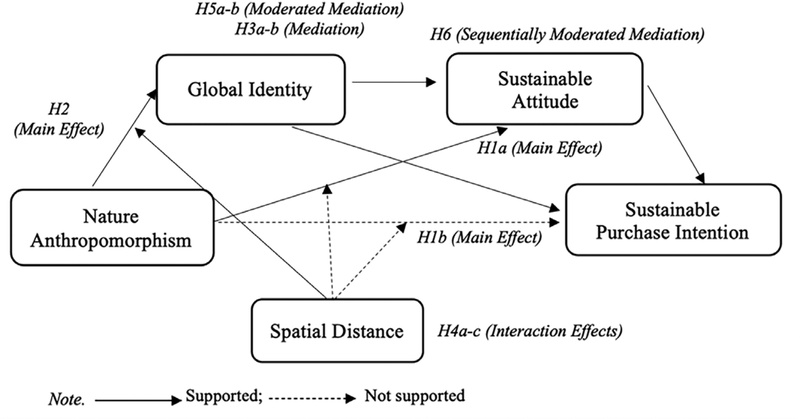
Study Model and Hypotheses
METHODS
We employed an online experiment with a 2 (nature anthropomorphism: presence vs. absence) × 2 (spatial distance: distant vs. close) between-subjects design. Both factors were manipulated through advertising messages. The current study was approved by the Institutional Review Board prior to data collection (IRB Number 77885).
Pre-test and Stimuli Development
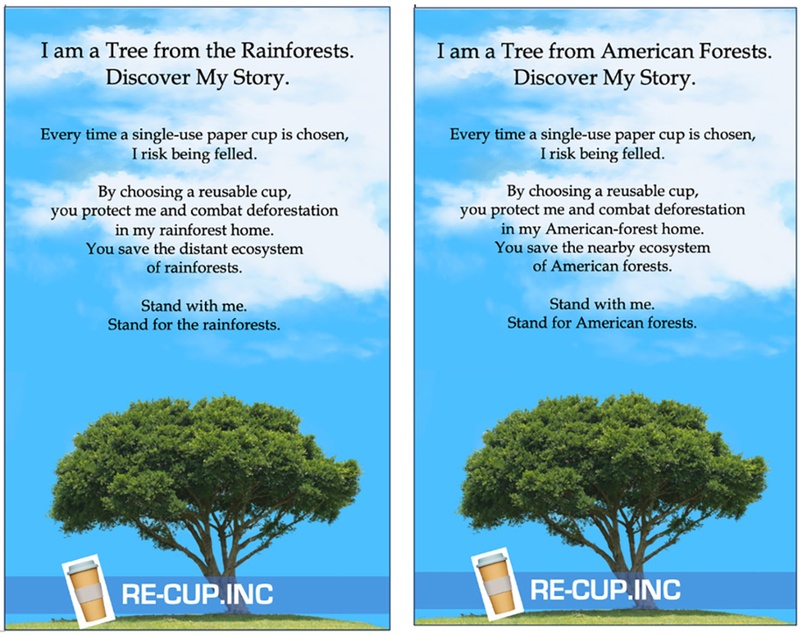
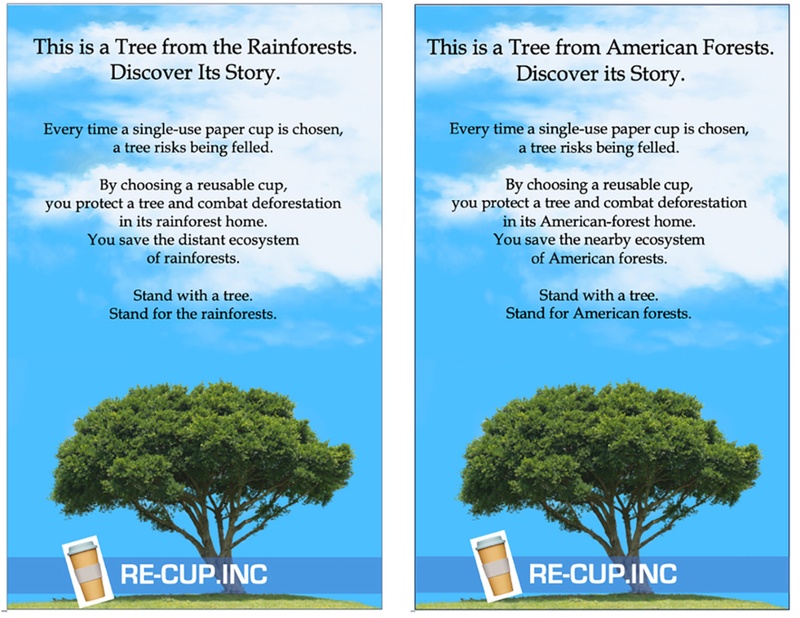
The first pre-test was to identify advertising messages that could effectively induce nature anthropomorphism. We recruited a total of 109 Amazon MTurkers residing in the U.S. Two advertising messages were developed to manipulate nature anthropomorphism (i.e., presence vs. absence), following previous literature (Aggarwal & McGill, 2007; Tam et al., 2013). The presence of nature anthropomorphism was manipulated using first-person language (e.g., I am a tree. … Discover my story …), while the absence of nature anthropomorphism was manipulated through third-person language (e.g., This is a tree. … Discover its story …). A tree was chosen as the target natural entity due to its gender-neutral characteristics in Western culture, where the data was collected. Participants rated their perception of nature anthropomorphism using two items (i.e., to what extent do you feel the tree comes alive like a person in your mind? and does it remind you of some humanlike qualities?) on a seven-point scale (1 = strongly disagree; 7 = strongly agree) (Puzakova & Kwak, 2018; r = .72). As a result, participants in the anthropomorphism condition reported a greater anthropomorphic perception toward nature (M = 5.51, SD = .1.16) than those in the control condition (M = 4.66, SD = 1.67) [t (107) = 3.13, p < .01]. Additionally, participants (100%) evaluated a tree as gender-neutral.
The second pre-test (n = 102 MTurkers) was to select messages that could effectively manipulate spatial distance (i.e., distant vs. close) regarding tree conservation. Following previous studies (e.g., McDonald et al., 2015), we manipulated advertising messages by framing the tree within a geographically distant (e.g., rainforest, distant ecosystem) vs. proximate environment from the perspective of study participants (e.g., American forest, nearby ecosystem). Participants rated their perceived spatial distance using two semantic-differential items (i.e., 1= very close to 7 = very distant; 1= nearby to 7 = faraway) on a seven-point scale (r = .70). Results showed that participants in the distant condition evaluated the tree as significantly farther away (M = 5.24, SD = 1.05) than those in the close condition (M = 4.56, SD = 1.31) [t (100) = 3.05, p < .01]. Thus, two messages were selected to manipulate spatial distance in the main study.
Integrating these results, we developed four different advertising messages, representing the present vs. absent condition of nature anthropomorphism x the distant vs. close condition of spatial distance. A fictitious corporation, Re-Cup Inc., was included in all conditions to promote reusable cup purchases. See Appendix for stimuli.
Sampling, Attention Check, and Procedure
To ensure data quality, we followed best practices for MTurk samples (e.g., Agley et al., 2022) by recruiting participants residing in the same country (i.e., the U.S.) with a HIT approval rating of 95% or higher. Additionally, we conducted attention checks through screening questions by asking them to identify the thumbnail of the manipulation exposed to them. In this procedure, we excluded seven participants who failed to be attentive to the manipulations with incorrect answers from the study sample. As a result, a total of 500 took part in the study, and 493 were included in the final sample.
Upon clicking the landing website, participants were randomly assigned to one of the four conditions and asked to assess their personal involvement in environmental issues. After reviewing one of the stimuli on the next page, they completed attention and manipulation checks, outcome variable measures, and demographic questions. The average age of participants was 35, ranging from 21 to 71 years old (SD = 10.49), and male participants (56.4%) slightly outnumbered females. There were no significant differences across the four conditions in terms of age [F (3, 489) = 1.23, p = .30] and gender [χ2 = 2.32, df = 3, p = .51].
Measures
Sustainable attitude was assessed with five items reflecting an overall attitudinal stance toward safeguarding nature on a seven-point scale from strongly disagree (1) to strongly agree (7) (i.e., important to protect nature; actively practice sustainability for nature, responsible for caring for nature; concerned about the long-term of nature; important to conserve natural resources (α = .79, M = 5.68, SD = .86) (Swaim et al., 2014). Sustainable purchase intention was measured using four items about buying intention of eco-friendly products considering the environment’s benefit on a seven-point scale from strongly disagree (1) to strongly agree (7) (i.e., plan to buy environmentally sustainable products; intend to seek out more opportunities to be more environmentally-friendly purchases; plan to look into how I can play a greater role in buying pro-environmental products; expect to increase my pro-environmental purchases) (α = .77, M = 5.61, SD = .92) (Swaim et al., 2014). Global identity was measured with four items reflecting individuals’ self-perception from a worldwide standpoint and identifying themselves with global citizenship on a seven-point scale from strongly disagree (1) to strongly agree (7) (i.e., my heart mostly belongs to the whole world; I believe people should be made more aware of how connected we are to the rest of the world; I identity that I am a global citizen; I care about knowledge of a global event) (α = .73, M = 5.58, SD = .90) (Ng & Basu, 2019; Tu et al., 2012).
We controlled for individual involvement in environmental issues, which was assessed with the short version of the personal involvement measure with four items on a seven-point scale (i.e., unimportant/important, on no concern/of concern, means nothing/a lot to me; insignificant/significant) (α = .82, M = 5.78, SD = .93) (Mittal, 1995).
RESULTS
Manipulation Checks
We checked the manipulation of nature anthropomorphism with the two items we used in the 1st pre-test on a seven-point scale (r =.73). Results showed that participants in the anthropomorphic condition perceived nature as significantly more anthropomorphic (M = 5.30, SD = .08) than in the control condition (M = 4.33, SD = .09) [F (1, 489) = 66.75, p < .001], without further interaction with the spatial-distance conditions [F (1, 489) = 3.80, p = .06]. Thus, we confirmed the successful manipulations of nature anthropomorphism.
Furthermore, we checked the manipulation of spatial distance with the same two items used in the 2nd pre-test on a seven-point scale (r =.80). Results showed those in the close condition (M = 5.33, SD = .10) evaluated the tree to be addressed in a geographically more proximate location compared to those in the distant condition (M = 5.04, SD = .09) [F (1, 489) = 4.85, p < .05]. There was no significant interaction with the anthropomorphism conditions [F (1, 489) = 1.97, p = .16]. Similarly, participants in the distant condition (M = 5.79, SD = .09) perceived the tree as being in a spatially more distant location rather than those in the close condition (M = 5.02, SD = .10) [F (1, 489) = 33.05, p < .001] without interaction with the anthropomorphism conditions [F (1, 489) = 2.51, p = .11]. These results confirmed the successful manipulation of spatially distant levels.
Hypothesis Testing
As the homogeneity assumption was violated for MANCOVA (Box’s M = 79.82, F = 4.37, for three dependent variables, p < .001), three sets of ANCOVA were alternatively chosen to test the main (H1a-b and H2) and interaction effects (H4a-c). We controlled for environmental-issue involvement as a covariate, based on previous findings that individuals’ involvement in environmental issues influences their responses to anthropomorphism (e.g., Cooremans & Geuens, 2019), as well as their sustainable attitudes and purchases (e.g., Jeong & Kim, 2024). Additionally, we controlled for participants’ gender and age as covariates, given their documented effects on consumer reactions to anthropomorphic cues (e.g., Ahn et al., 2022; Letheren et al., 2016).
The first ANCOVA showed a significant main effect of nature anthropomorphism on sustainable attitude [F (1, 486) = 7.09, p < .01]. Supporting H1a, the presence of nature anthropomorphism (M = 5.74, SE = .04) generated a higher degree of sustainable attitude than the absence of nature anthropomorphism (M = 5.61, SE = .04). However, the interaction effect of nature anthropomorphism and spatial distance on sustainable attitude was not significant [F (1, 486) = .35, p = .56]. Thus, H4a was not supported. The second ANCOVA revealed the main effect of nature anthropomorphism on sustainable purchase intention was not significant [F (1,486) = 2.36, p = .13], showing an insignificant mean difference between the presence (M = 5.64, SE = .04) and absence (M = 5.60, SE = .04) of nature anthropomorphism. Thus, H1b was not supported. The interaction effect with spatial distance was not significant [F (1, 486) = .23, p = .63]. Thus, H4b did not receive support. The third ANCOVA showed a significant main effect of nature anthropomorphism on perceived global identity [F (1, 486) = 4.20, p < .05]. Specifically, the presence of nature anthropomorphism (M = 5.65, SE = .05) yielded a higher perception of global identity than the absence of nature anthropomorphism (M = 5.51, SE = .05), thus supporting H2. The interaction effect with spatial distance was also significant [F (1, 489) = 5.05, p < .05]: in the distant condition, the presence of nature anthropomorphism (M = 5.74, SE = .06) was more effective than the absence of nature anthropomorphism (M = 5.46, SE = .06) (p < .01); in the close condition, there was an insignificant difference between the presence of nature anthropomorphism (M = 5.55, SE = .07) and the absence of nature anthropomorphism (M = 5.56, SE = .07) (p = .85). Thus, H4c was supported. See Table 1 and Figure 2 for more information.

Main and Interaction Effects (ANCOVA)
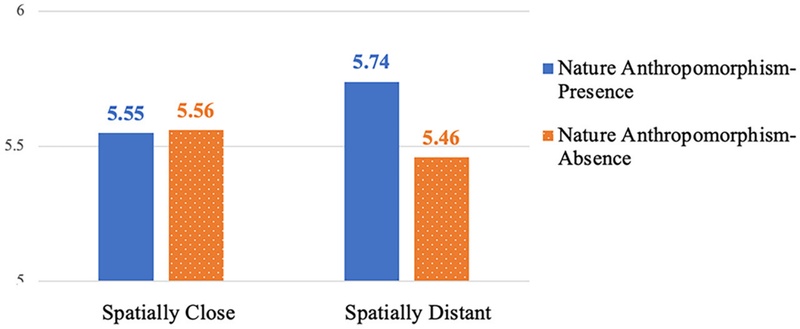
Interaction Effect on Global IdentityNote. *p < .05, **p < .01, ***p < .001
We employed the PROCESS macro (model 4) with 5000 bootstrap samples (A. F. Hayes, 2022) to examine our mediation models. The PROCESS provides several benefits when handling experimental data, such as enabling accurate statistical inferences for indirect effects and model estimates for mediation analyses and moderated mediation analyses and offering bootstrap confidence intervals (CIs) (A. F. Hayes, 2022). To test the simple mediation of global identity (H3a-b), controlling for three covariates, we entered nature anthropomorphism (presence = 1; absence = 0) as the independent variable, global identity as the mediating variable, and sustainable attitude as the dependent variable in the first regression model. Results revealed that global identity positively influenced sustainable attitude [B = .38, SE = .03, p < .001], further demonstrating global identities as a significant mediator behind the main effect of nature anthropomorphism on sustainable attitude [mediation: B = .06, SE = .03, 95% CIs [.0047, .1136]]. Thus, H3a was supported. In the second regression model, we followed the same procedure but substituted the dependent variable with sustainable purchase intention. Results showed the positive impact of global identity on sustainable purchase intention [B = .48, SE = .03, p < .001], supporting H3b with the significant mediation of global identity underlying the main effect of nature anthropomorphism on sustainable purchase intention [mediation: B = .07, SE = .03, 95% CIs [.0069, .1270]]. See Figure 3 for more information.
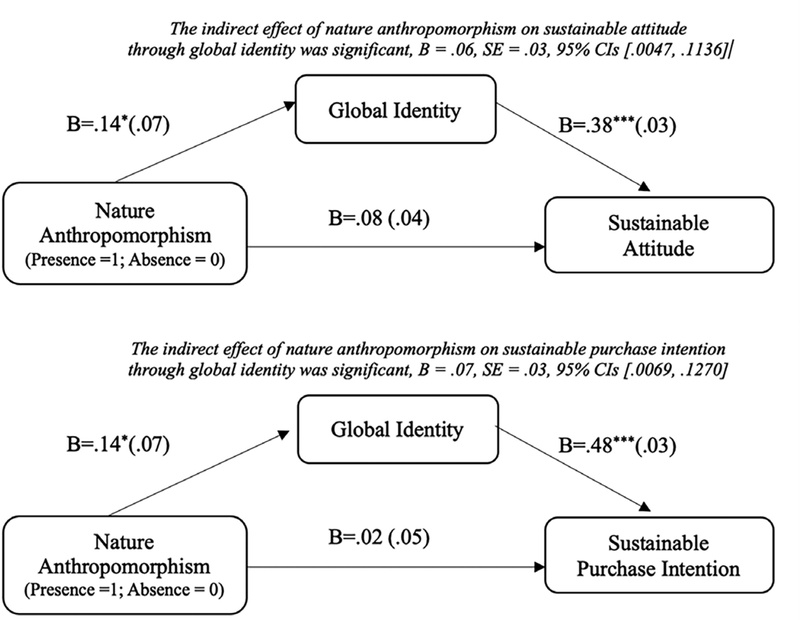
Simple Mediation
We further examined moderated mediation models (H5a-b), controlling for three covariates, using the PROCESS macro (model 8) with 5000 bootstrap samples (A. F. Hayes, 2022). We replicated the previous steps used for simple mediation, with the only difference being the introduction of spatial distance (close = 1; distant = 0) as the moderating variable. The result of the first regression found global identity as a significant mediator underlying the interaction effect of nature anthropomorphism and spatial distance on sustainable attitude [moderated mediation: B = -.11, SE = .04, 95% CIs [-.2141, -.0186]]. Specifically, as confirmed from the third ANCOVA results, the presence (vs. absence) of nature anthropomorphism had a greater effect on shaping global identity [B = -.30, SE = .13, p < .05], particularly when it was paired with distant messages [B = .28, SE = .09, [.1064, .4565]]. However, this effect disappeared with close messages [B = -.01, SE = .10, [-.2019, .1756]]. Further, global identity positively influenced sustainable attitude [B = .38, SE = .03, p < .001]. Thus, the significant mediation of global identity occurred behind the positive impact of nature anthropomorphism on sustainable attitude when paired with spatially distant messages [B = .10, SE = .04, [.0341, .1921]], but not with spatially close messages [B = -.01, SE = .03, [-.0669, .0615]]. Thus, H5a received support. The result of the second regression demonstrated the significant mediation of global identity [moderated mediation: B = -.14, SE = .05, [-.2499, -.0234]] behind the positive impact of anthropomorphized nature messages in shaping sustainable purchase intention, particularly when they were interplayed with spatially distant messages [B = .14, SE = .04, [.0485, .2153]], but not when they were compatible with spatially close messages [B = -.01, SE = .04, [-.0848, .0748]]. Moreover, global identity positively influenced sustainable purchase intention [B = .49, SE = .03, p < .001]. Thus, H5b was supported. See Figure 4 for more information. Furthermore, we employed the PROCESS macro (model 85) with 5000 bootstrap samples (A. F. Hayes, 2022) to examine sequentially moderated mediation, controlling for three covariates (H6). This model included moderated mediations and further contains additional results from the serial mediation where sustainable purchase intention was used as the dependent variable and both global identity and sustainable attitude were sequential mediators. Results confirmed the previous outcomes of moderated mediations; furthermore, the interaction effect of nature anthropomorphism and spatial distance on sustainable purchase intention occurred through a serial mediation of global identity and sustainable attitude [B = -.05, SE = .03, 95 CIs [-.1084, -.0079]]. That is, the indirect effect of nature anthropomorphism on sustainable attitude through global identity was significant only when paired with spatially distant messages [B = .05, SE = .02, [.0146, .0961]], as opposed to spatially close messages [B = -.002, SE =.02, [-.0337, .0277]]; further, sustainable attitude positively influenced sustainable purchase intention [B = .47, SE = .04, p < .001]. Thus, H6 received support. See Figure 5 for details.
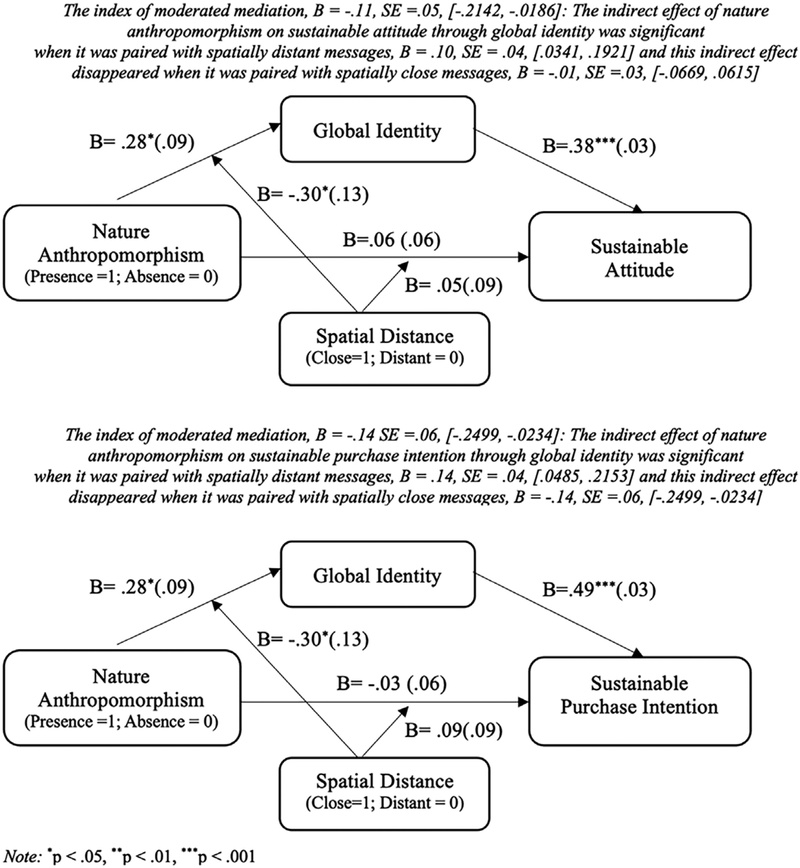
Moderated Mediation
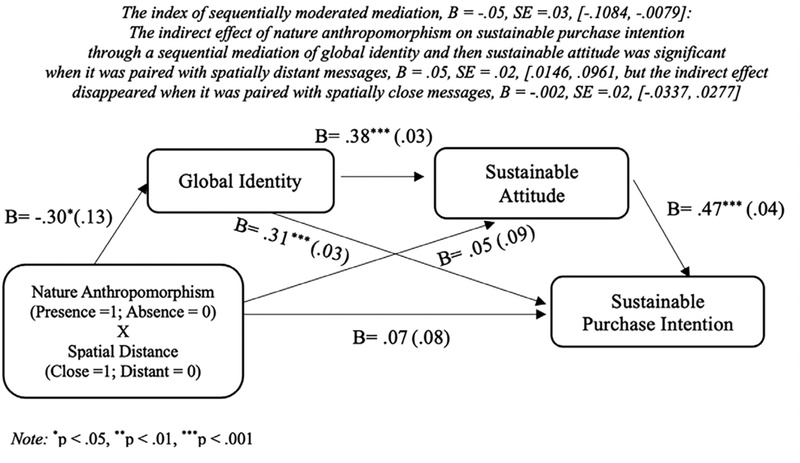
Sequentially Moderated Mediation
DISCUSSION
Theoretical Implications
The present study offers insights into sustainability literature. Our findings suggest that when corporations describe nature using human-like characteristics in their advertising narratives, consumers develop more favorable attitudes toward sustainability. This aligns with previous research emphasizing the effectiveness of humanizing brands as a strategic approach to fostering favorable consumer responses to corporation-led pro-social initiatives (Wen & Song, 2017). By integrating brand anthropomorphism (e.g., Aggarwal & McGill, 2007; MacInnis & Folkes, 2017) with pro-environmental advertising, our findings highlight that attributing human characteristics to natural entities in advertising can effectively shift consumer orientations toward sustainability. Moreover, despite the limited number of empirical studies measuring nature anthropomorphism as an individual trait (e.g., Jeong & Kim, 2024; Letheren et al., 2016; Tam et al., 2013), there remains a lack of specific investigations into how advertising messages can nurture consumer perceptions of personified nature and lead to sustainability. Thus, our research serves as a preliminary empirical study validating the role of nature-centric personas as a compelling advertising strategy for promoting favorable sustainable attitudes among consumers.
Furthermore, our research posits that embedding nature anthropomorphism within pro-environmental advertising strengthens consumers’ global identity. This finding indicates that when consumers discern nature with an anthropomorphic lens, they can develop a self-perception resonating with global citizenship. This insight enriches the existing literature on self-identity (e.g., Tajfel & Turner, 1986) and global identity (e.g., Gao et al., 2017; Loy et al., 2022), further highlighting the substantial role of nature anthropomorphism in empowering consumers to embrace a worldview for addressing environmental issues on a global scale. While recent studies have explored the positive impact of global identity on sustainable behaviors (e.g., Ng & Basu, 2019; Strizhakova & Coulter, 2013), our study provides a novel perspective by underscoring the psychological mediation of global identity in the relationship between nature perception and sustainable consumption. Once consumers view natural entities as possessing human-like qualities, they tend to feel connected to a broader sense of self within the global environment. This self-view, rooted in a sense of global citizenship, subsequently enhances their attitudes toward sustainability and increases their intentions to purchase environment-friendly products. Through these findings, we aspire to advance scholarly discussions on the psychological mechanism through which advertising can contribute to a more sustainable society.
Lastly, our study suggests the interplay between nature anthropomorphism and spatial distance in shaping global identity, which consequently influences sustainable consumption. This finding enhances our understanding of the dynamic factors that drive consumers’ sustainable decisions. Grounded in the psychological distance (Trope & Liberman, 2010), we find that the effect of anthropomorphized nature messages on global identity perception is contingent upon the spatial distance of nature entities. Notably, anthropomorphized narratives about nature are more likely to cultivate global identity when they are paired with a global (vs. local) environment. These results align with previous findings that spatial distance develops an abstract construal (e.g., Trope & Liberman, 2010) and that individuals’ moral considerations are more likely to influence their behaviors in an abstract mindset than in a concrete one (Eyal & Liberman, 2012). Anthropomorphized messages about distant nature encourage consumers to focus on the broader, global benefits of sustainability by strengthening their sense of global citizenship. These results also support the argument that a global environment, characterized by abstractness and distance, can often be accentuated by anthropomorphic perception (A. Y. Wu et al., 2023). Since a psychologically distant object enables consumers to focus on core rather than peripheral features (e.g., Trope & Liberman, 2010), our findings further highlight that consumers process a global environment setting as central to personifying nature, thereby fostering collective commitments to environmental issues. Conversely, a local environment, given its tangible and specific focus, may not be prominently highlighted within the human schema triggered by nature anthropomorphism. Our findings are also supported by recent reports that individuals perceive environmental issues in distant and global locations as more serious than those in proximate and local areas (McDonald et al., 2015; Uzzell, 2000). Moreover, they are more likely to engage in protective actions for distant environments than for their local environments (Spence et al., 2012). Extending upon these suggestions, we emphasize the strategic integration of spatial distance with nature anthropomorphism in the domain of sustainability advertising. While previous literature has extensively explored the separate effects of anthropomorphism (e.g., Aggarwal &McGill, 2007; Jeong & Kim, 2024; MacInnis & Folkes, 2017; Tam et al., 2013) and spatial distance (e.g., Trope & Liberman, 2010; B. Wu et al., 2018), their interactive effects on the global identity and consumer sustainability has remained relatively understudied. Scholars have stressed the need for research that integrates separate strands of environmental communication to better understand how to effectively mobilize individuals in response to environmental challenges (Reysen & Hackett, 2019). Building on this, our research helps bridge this gap by shedding light on the synergistic impact of these factors and contributing to a deeper understanding of their interplay.
Practical Implications
The study provides practical implications for advertising practitioners and businesses. First, corporations can enhance consumer support by integrating nature anthropomorphism into their advertising narratives. Expanding on the persuasive power of narratives in influencing prosocial decisions (Chandler & Schwarz, 2010; Jeong, 2024), we emphasize the positive function of narrative persuasion in corporate communication and highlight the leading role of businesses in cultivating a sustainable culture within society. However, sustainable purchases may not be directly driven by anthropomorphized nature messages. Instead, they may be indirectly shaped through the development of favorable consumer attitudes toward corporate sustainability, which are intensified by personified nature messages and the reinforcement of global identity perceptions. Therefore, we recommend that corporations strategically employ nature anthropomorphism while also addressing consumers’ global responsibility for sustainability in their environmental communications.
Similarly, nature anthropomorphism in advertising can play a significant role in shaping consumers’ self-identity as global citizens. By encouraging individuals to view nature through an anthropomorphic lens, corporations can help individuals cultivate a self-identity that resonates with the interconnected global community, thereby promoting a shared sensitivity toward the global environment. Moreover, recognizing the mediating role of global identity, corporations should consider that consumers develop a broader sense of self linked to global responsibility. This, in turn, can benefit businesses by fostering positive attitudes and purchase intentions for eco-friendly products.
Furthermore, corporations should recognize that anthropomorphized nature narratives, when paired with spatially distant messages, may be more effective in shaping positive consumer responses. Accordingly, businesses should note that advertising messages featuring localized natural entities, which are geographically proximate to their target markets, may not yield the same benefits from nature anthropomorphism despite their specificity. Instead, strategically coupling nature anthropomorphism with spatially distant messages, such as framing the global environment as a humanized entity, could encourage sustainable product choices and contribute to a more sustainable society on a broader scale. This implication is particularly relevant because sustainability efforts require collective commitments worldwide. Therefore, when crafting pro-environmental messages with nature anthropomorphism, corporations should consider the spatial distance associated with global environmental concerns that extend beyond local and national boundaries. Emphasizing corporate sustainable commitments in response to humanized global environmental challenges may enhance the effectiveness of sustainability messages in advertising.
Limitations and Future Studies
Despite the novelty of this study, several limitations should be acknowledged. First, this research represents a single experimental endeavor. While valuable insights have been gained, experimental findings benefit from replication across multiple studies. Future research can enhance generalizability by conducting multiple studies in different contexts or with diverse populations to validate our findings. Second, our manipulation primarily relied on verbal components paired with spatial distance to represent psychological distance. Although our stimuli were selected based on relevant literature and pre-test results, future studies may benefit from exploring additional anthropomorphic cues accessible for corporate communication (e.g., visuals, consumer dialogues). Additionally, investigating alternative psychological distance dimensions (e.g., temporal distance) could offer deeper insights into the focal discussions. Similarly, applying anthropomorphism to different natural entities (e.g., clouds, rivers) could provide a more comprehensive understanding of how nature anthropomorphism influences sustainability. Expanding these manipulations would enhance the generalizability and applicability of our findings across different contexts. Third, we acknowledge that nature anthropomorphism and global identity function as individual differences. This study focused solely on message effectiveness and did not measure participants’ pre-existing perceptions of these concepts. Future research should account for these individual variations, potentially by incorporating them into study models as covariates or moderators to further examine their influence in scholarly discussions. Lastly, due to the lack of available facilities, we measured purchase intention rather than directly measuring purchase behaviors as the dependent variable. Future studies may consider assessing real consumption behaviors in response to pro-environmental advertising messages (e.g., eye-tracking).
Acknowledgments
This work was supported by the OVPR CURATE Program of the University of Kentucky.
Disclosure Statement
No potential conflict of interest was reported by the author.
References
-
Aggarwal, P., & McGill, A. L. (2007). Is that car smiling at me? Schema congruity as a basis for evaluating anthropomorphized products. Journal of Consumer Research, 34, 468–479.
[https://doi.org/10.1086/518544]

-
Agley, J., Xiao, Y., Nolan, R., & Golzarri-Arroyo, L. (2022). Quality control questions on Amazon’s Mechanical Turk (MTurk): A randomized trial of impact on the USAUSIT, PHQ-9, and GAD-7. Behavioral Research Methods, 54, 1885–1892.
[https://doi.org/10.3758/s13428-021-01665-8]
-
Ahn, J., Kim, J., & Sung, Y. (2022). The effect of gender stereotypes on artificial intelligence recommendation. Journal of Business Research, 141, 50–59.
[https://doi.org/10.1016/j.jbusres.2021.12.007]
-
Alden, D. L., Steenkamp, J. B. E., & Batra, R. (2006). Consumer attitudes toward marketplace globalization: Structure, antecedents and consequences. International Journal of Research in Marketing, 23(3), 227–239.
[https://doi.org/10.1016/j.ijresmar.2006.01.010]
-
Barcelos, R., Dantas, D. C., & Sénécal, S. (2018). Watch your tone: How a brand’s tone of voice on social media influences consumer responses. Journal of Interactive Advertising, 41, 60-80.
[https://doi.org/10.1016/j.intmar.2017.10.001]
-
Buchan, N. R., Brewer, M. B., Grimalda, G., Wilson, R. K., Fatas, E., & Foddy, M. (2011). Global social identity and global cooperation. Psychological Science, 22, 821–828.
[https://doi.org/10.1177/0956797611409590]
-
Casalegno, C., Candelo, E., & Santoro, G. (2022). Exploring the antecedents of green and sustainable purchase behavior: A comparison among different generations. Psychology & Marketing, 39, 1007–2021.
[https://doi.org/10.1002/mar.21637]
-
Chandler, J., & Schwarz, N. (2010). Use does not wear ragged the fabric of friendship: Thinking of objects as alive makes people less willing to replace them. Journal of Consumer Psychology, 20(2), 138–145.
[https://doi.org/10.1016/j.jcps.2009.12.008]
-
Chao, C.-M. (2022). What factors determine college students’ green purchase behavior? An empirical investigation of the modified model of goal-directed behavior. The Social Science Journal, 1–17.
[https://doi.org/10.1080/03623319.2022.2049556]
-
Cooremans, K., & Geuens, M. (2019). Same but different: Using anthropomorphism in the battle against food waste. Journal of Public Policy & Marketing, 38(2), 232–245.
[https://doi.org/10.1177/0743915619827941]
-
Eyal, T., & Liberman, N. (2012). Morality and psychological distance: A construal level theory perspective. In M. Mikulincer & P. R. Shaver (Eds.), The social psychology of morality: Exploring the causes of good and evil (pp. 185– 202). American Psychological Association.
[https://doi.org/10.1037/13091-010]
-
Feng, W., Wang, T., & Mu, W. (2020) The influence of anthropomorphic communication in social media on the country-of-origin effect. International Journal of Advertising, 39(8) 1202–1227.
[https://doi.org/10.1080/02650487.2020.1755182]
-
Fritsche, I., Barth, M., Jugert, P., Masson, T., & Reese, G. (2018). A social identity model of pro-environmental action (SIMPEA). Psychological Review, 125(2), 245–269.
[https://doi.org/10.1037/rev0000090]
-
Fujita, K., Trope, Y., Liberman, N., & Levin-Sagi, M. (2006). Construal levels and self-control. Journal of Personality and Social Psychology, 90(3), 351.
[https://doi.org/10.1037/0022-3514.90.3.351]
-
Gao, H., Zhang, Y., & Mittal, V. (2017). How does local–global identity affect price sensitivity? Journal of Marketing, 81, 62–79.
[https://doi.org/10.1509/jm.15.0206]
-
Giacomantonio, M., De Dreu, C. K. W., & Mannetti, L. (2010). Now you see it, now you don't: Interests, issues, and psychological distance in integrative negotiation. Journal of Personality and Social Psychology, 98(5), 761–774.
[https://doi.org/10.1037/a0017879]
-
Grétry, A., Horváth, C., Belei, N., & van Riel, A. (2017). Don’t pretend to be my friend! When an informal brand communication style backfires on social media. Journal of Business Research, 74, 77–89.
[https://doi.org/10.1016/j.jbusres.2017.01.012]
-
Grinstein, A., & Riefler, P. (2015). Citizens of the (green) world? Cosmopolitan orientation and sustainability. Journal of International Business Studies, 46, 694–714.
[https://doi.org/10.1057/jibs.2015.1]
-
Guido, G., & Peluso, A. M. (2015). Brand anthropomorphism: Conceptualization, measurement, and impact on brand personality and loyalty. Journal of Brand Management, 22, 1–19.
[https://doi.org/10.1057/bm.2014.40]
- Hayes, A. F. (2022). Introduction to mediation, moderation, and conditional process analysis: A regression-based approach. The Guilford Press.
-
Hayes, J. L., Britt, B. C., Applequist, J., Ramirez, A., Jr., & Hill, J. (2020). Leveraging textual paralanguage and consumer-brand relationships for more relatable online brand communication: A social presence approach. Journal of Interactive Advertising, 20(1), 17–30.
[https://doi.org/10.1080/15252019.2019.1691093]
-
Jeong, H. J. (2024). The power of anthropomorphic appeals for environmental corporate social responsibility (CSR) advertising: With mediation of psychological closeness and moderation of typefaces. Journal of Current Issues & Research in Advertising, 46(1), 1–20.
[https://doi.org/10.1080/10641734.2024.2334958]
-
Jeong, H. J., & Kim, M. (2024). Appealing to Gen Z with Mother Nature for sustainable consumption: With mediation of psychological closeness to nature and consequence of psychological well-being. Journal of Consumer Behaviour, 23(2), 530–539.
[https://doi.org/10.1002/cb.2222]
-
Khan, M. S., Saengon, P., Alganad, A. M. N., Chongcharoen, D., & Farrukh, M. (2020). Consumer green behaviour: An approach towards environmental sustainability. Sustainable Development, 28(1), 168–1180.
[https://doi.org/10.1002/sd.2066]
-
Kim, K., Lee, S., & Choi, Y. K. (2019). Image proximity in advertising appeals: Spatial distance and product types. Journal of Business Research, 99, 490–497.
[https://doi.org/10.1016/j.jbusres.2017.08.031]
-
Kim, T., & Kim, J. (2021). How spatial distance and message strategy in cause-related marketing ads influence consumers’ ad believability and attitudes. Sustainability, 13(12), 6775.
[https://doi.org/10.3390/su13126775]
-
Kivetz, Y., & Tyler, T. R. (2007). Tomorrow I’ll be me: The effect of time perspective on the activation of idealistic versus pragmatic selves. Organizational Behavior and Human Decision Processes, 102(2), 193–211.
[https://doi.org/10.1016/j.obhdp.2006.07.002]
- KPMG. (2020). The time has come: The KPMG survey of sustainability reporting. Retrieved November 30, 2022, from https://assets.kpmg/content/dam/kpmg/xx/pdf/2020/11/the-time-has-come.pdf
-
Kunchamboo, V., Lee, C. K. C., & Brace-Govan, J. (2017). Nature as extended-self: Sacred nature relationship and implications for responsible consumption behavior. Journal of Business Research, 74, 126–132.
[https://doi.org/10.1016/j.jbusres.2016.10.023]
-
Lavuri, R., Jindal, A., Akram, U., Naik, B. K. R., & Halibas, A. S. (2023). Exploring the antecedents of sustainable consumers’ purchase intentions: Evidence from emerging countries. Sustainable Development, 31, 280–291.
[https://doi.org/10.1002/sd.2389]
-
Letheren, K., Kuhn, K.-A. L., & Lings, I. (2016). Individual difference factors related to anthropomorphic tendency. European Journal of Marketing, 50(5/6), 973–1002.
[https://doi.org/10.1108/EJM-05-2014-0291]
-
Li, X., & Sung, Y. (2021). Anthropomorphism brings us closer: The mediating role of psychological distance in user-AI assistant interactions. Computers in Human Behavior, 118, 106680.
[https://doi.org/10.1016/j.chb.2021.106680]
-
Lim, S., & Hong, H. (2018). The effects of charity advertisements with different donation contexts: Based on the construal level and psychological distance. The Korean Journal of Advertising, 29(8), 135–164.
[https://doi.org/10.14377/KJA.2018.11.30.135]
-
Lin, Z. C., Ruan, H., Zhang, H., & Xiao, X. S. (2024). Antecedents, manifestations, and environmental consequences of destination anthropomorphism: The case of nature-based destinations. Journal of Hospitality and Tourism Management, 58, 432–444.
[https://doi.org/10.1016/j.jhtm.2024.03.001]
-
Loy, L. S., Reese, G., & Spence, A. (2022). Facing a common human fate: Relating global identity and climate change mitigation. Political Psychology, 43(3), 563–581.
[https://doi.org/10.1111/pops.12781]
-
MacInnis, D. J., & Folkes, V. S. (2017). Humanizing brands: When brands seem to be like me, part of me, and in a relationship with me. Journal of Consumer Psychology, 27, 355–374.
[https://doi.org/10.1016/j.jcps.2016.12.003]
-
Matthes, J., & Wonneberger, A. (2014). The skeptical green consumer revisited: Testing the relationship between green consumerism and skepticism toward advertising. Journal of Advertising, 43(2), 115–127.
[https://doi.org/10.1080/00913367.2013.834804]
-
McDonald, R., Chai, H. Y., & Newell, B. R. (2015). Personal experience and the ‘psychological distance’ of climate change: An integrative review. Journal of Environmental Psychology, 44, 109–118.
[https://doi.org/10.1016/j.jenvp.2015.10.003]
- Merriam-Webster. (n.d.). Merriam-Webster dictionary. https://www.merriam-webster.com/dictionary/nature
-
Mittal, B. (1995). A comparative analysis of four scales of consumer involvement. Psychology & Marketing, 12, 663–682.
[https://doi.org/10.1002/mar.4220120708]
-
Mostafa, M. M. (2007). Gender differences in Egyptian consumers’ green purchase behaviour: The effects of environmental knowledge, concern and attitude. International Journal of Consumer Studies, 31(3), 220–229.
[https://doi.org/10.1111/j.1470-6431.2006.00523.x]
-
Ng, S., & Basu, S. (2019). Global identity and preference for environmentally friendly products: The role of personal responsibility. Journal of Cross-Cultural Psychology, 50(8), 919– 936.
[https://doi.org/10.1177/0022022119873432]
- Nielsen (2018). Global consumers seek companies that care about environmental issues (September 11). Retrieved October 20, 2022, from https://www.nielsen.com/eu/en/insights/article/2018/global-consumers-seek-companies-that-care-about-environmental-issues/
-
Park, T., & Kim, M. (2021). The effect of message orientation and construal level on the responses toward public campaign message. The Korean Journal of Advertising , 32(3), 97–118.
[https://doi.org/10.14377/KJA.2021.4.15.97]
-
Peattie, K. (2001). Golden goose or wild goose? The hunt for the green consumer. Business Strategy and the Environment, 10 (4), 187–199.
[https://doi.org/10.1002/bse.292]
-
Puzakova, M., & Kwak, H. (2017). Should anthropomorphized brands engage customers? The impact of social crowding on brand preferences. Journal of Marketing, 81, 99–115.
[https://doi.org/10.1509/jm.16.0211]
-
Rathee, S., & Milfeld, T. (2023). Sustainability advertising: literature review and framework for future research. International Journal of Advertising, 43(1), 7–35.
[https://doi.org/10.1080/02650487.2023.2175300]
-
Reysen, S., & Hackett, J. (2019). Activism as a pathway to global citizenship. The Social Science Journal, 54(2), 132–138.
[https://doi.org/10.1016/j.soscij.2016.09.003]
-
Salnikova, E., Strizhakova Y., & Coulter R. A. (2022). Engaging consumers with environmental sustainability initiatives: Consumer global-local identity and global brand messaging. Journal of Marketing Research, 59(5), 983–1001.
[https://doi.org/10.1177/00222437221078522]
-
Schill, M., & Shaw, D. (2016). Recycling today, sustainability tomorrow: Effects of psychological distance on behavioural practice. European Management Journal, 34(4), 349–362.
[https://doi.org/10.1016/j.emj.2016.05.004]
-
Spence, A., Poortinga, W., & Pidgeon, N. (2012). The psychological distance of climate change. Risk Analysis, 32(6), 957–972.
[https://doi.org/10.1111/j.1539-6924.2011.01695.x]
-
Steenkamp, J. B. E., & De Jong, M. G. (2010). A global investigation into the constellation of consumer attitudes toward global and local products. Journal of Marketing, 74, 18-40.
[https://doi.org/10.1509/jmkg.74.6.18]
-
Strizhakova, Y., & Coulter, R. A. (2013). The “green” side of materialism in emerging BRIC and developed markets: The moderating role of global cultural identity. International Journal of Research in Marketing, 30, 69–82.
[https://doi.org/10.1016/j.ijresmar.2012.08.003]
-
Sung, K. H., & Kim, S. (2021). Do organizational personification and personality matter? The effect of interaction and conversational tone on relationship quality in social media. International Journal of Business Communication, 58(4), 582–606.
[https://doi.org/10.1177/2329488418796631]
-
Swaim, J. A., Maloni, M. J., Napshin, S. A., & Henley, A. B. (2014). Influences on student intention and behavior toward environmental sustainability. Journal of Business Ethics, 124, 465–484.
[https://doi.org/10.1007/s10551-013-1883-z]
- Tajfel, H., & Turner, J. C. (1986). The social identity theory of intergroup behavior. In S. Worchel & W. G. Austin (Eds.), Psychology of intergroup relation (pp.7–24). Hall Publishers.
-
Tam, K.-P., Lee, S.-L., & Chao, M. M. (2013). Saving Mr. Nature: Anthropomorphism enhances connectedness to and protectiveness toward nature. Journal of Experimental Social Psychology, 49, 514–521.
[https://doi.org/10.1016/j.jesp.2013.02.001]
-
Trope, Y., & Liberman, N. (2010). Construal-level theory of psychological distance. Psychological Review, 117(2), 440–463.
[https://doi.org/10.1037/a0018963]
-
Tu, L., Khare, A., & Zhang, Y. (2012). A short 8-item scale for measuring consumers’ local-global identity. International Journal of Research in Marketing, 29, 35–42.
[https://doi.org/10.1016/j.ijresmar.2011.07.003]
- United Nations Brundtland Commission. (1987). Sustainability. United Nations: Academic Impact. https://www.un.org/en/academic-impact/sustainability, .
-
Uzzell, D. L. (2000). The psycho-spatial dimension of global environmental problems. Journal of Environmental Psychology, 20(4), 307–318.
[https://doi.org/10.1006/jevp.2000.0175Getrightsandcontent]
-
Vu, D. M., Ha, N. T., Ngo, T. V. N., Pham, H. T., & Duong, C. D. (2022) Environmental corporate social responsibility initiatives and green purchase intention: An application of the extended theory of planned behavior. Social Responsibility Journal, 18(8), 1627–1645.
[https://doi.org/10.1108/SRJ-06-2021-0220]
-
Wang F., & Basso, F. (2019). “Animals are friends, not food”: Anthropomorphism leads to less favorable attitudes toward meat consumption by inducing feelings of anticipatory guilt. Appetite, 138, 153–173.
[https://doi.org/10.1016/j.appet.2019.03.019]
-
Waytz, A., Cacioppo, J., & Epley, N. (2010). Who sees humans? The stability and importance of individual difference in anthropomorphism. Perspectives on Psychological Science, 5(3), 219–232.
[https://doi.org/10.1177/1745691610369336]
-
Wen, J., & Song, B. (2017). Corporate ethical branding on YouTube: CSR communication strategies and brand anthropomorphism. Journal of Interactive Advertising, 17(1), 28–40.
[https://doi.org/10.1080/15252019.2017.1295291]
-
Williams, M. O., Whitmarsh, L., & Chríost, D. M. G. (2021). The association between anthropomorphism of nature and pro-environmental variables: A systematic review. Biological Conservation, 255, 10022.
[https://doi.org/10.1016/j.biocon.2021.109022]
-
Wimmer, H., & Perner, J. (1983). Beliefs about beliefs: Representation and constraining function of wrong beliefs in young children's understanding of deception. Cognition, 13(1), 103–128.
[https://doi.org/10.1016/0010-0277(83)90004-5]
-
Wu, A. Y., Malter, M. S., & Johar, G. V. (2023). “Recycle Me!” Product anthropomorphism can increase recycling behavior. Journal of the Association for Consumer Research, 8(3), 351–363.
[https://doi.org/10.1086/724999]
-
Wu, B., Li, D., & Zhang, C. (2018). Are benefits of others important? The interaction effect of moral identity and construal level on green consumption. Journal of Contemporary Marketing Science, 1(1), 145–162.
[https://doi.org/10.1108/JCMARS-07-2018-0002]