
Factors Influencing Misinformation Correction through Fact-Checking News: An Application of the Elaboration Likelihood Model

Copyright ⓒ 2021 by the Korean Society for Journalism and Communication Studies
Abstract
This study examines the factors influencing misinformation correction through fact-checking news using the elaboration likelihood model (ELM). A pretest-posttest experimental design was conducted with 502 Korean participants exposed to fact-checking news on a critical public health issue. By focusing on a non-Western context, this study expands fact-checking research beyond Western settings. To enhance ecological validity, a real-world stimulus—a fact-checking report aired on a major TV channel—was utilized. The study explores how motivational factors (need for cognition, issue involvement) and ability factors (news literacy, daily news consumption) influence elaborative processing and how elaboration mediates misinformation correction through attitude change. Additionally, it investigates the moderating effects of media-source credibility and political alignment between individual and the media source. Findings indicate that elaboration significantly mediates the relationship between not only issue involvement (motivational factor) but also news literacy (ability factor) and misinformation correction. However, these mediation effects weaken as political alignment diverges, reducing the efficacy of elaboration. These results contribute to a deeper understanding of the theoretical implications of the ELM in the context of misinformation correction through fact-checking news and suggest practical strategies to enhance the effectiveness of fact-checking interventions in politically polarized environments.
Keywords:
fact-checking news, misinformation correction, elaboration likelihood model, issue involvement, news literacy, political alignmentThe proliferation of digital media has transformed information dissemination, offering unprecedented connectivity and rapid access to knowledge. However, it has simultaneously amplified the spread of misinformation, thereby undermining public understanding and informed decision-making. Guess et al. (2018) argue that misinformation not only erodes knowledge but also entrenches false beliefs, adversely affecting public policymaking and democratic processes. This harmful impact is particularly pronounced during public health crises such as the COVID-19 pandemic, where misinformation impedes effective policy responses and exacerbate societal challenges (Islam et al., 2020; Sell et al., 2021). Fact-checking news has emerged as an essential tool to counteract misinformation by employing evidence-based verification to refute false claims and provide accurate information (Graves et al., 2016). Its importance has grown significantly with the rapid proliferation of misinformation across digital platforms, prompting widespread adoption among major media outlets and social media platforms, including Facebook and Google. Proponents highlight its capacity to effectively reduce misinformation and enhance public understanding, particularly in critical domains like public health and political processes (Eveland, 2002; Nyhan & Reifler, 2010). Conversely, critics emphasize limitations due to cognitive biases, ideological polarization, and the “backfire effect,” wherein attempts at correction may inadvertently reinforce false beliefs (David, 2009). Moreover, the presence of factors like audience engagement, perceived media-source credibility, and political orientation introduces complexity in evaluating the real-world impact of fact-checking interventions (Mao et al., 2022).
In light of these complexities, more focused research is needed to clarif y the specific mechanisms through which fact-checking news influences misinformation correction and attitude change. While prior studies have debated its overall effectiveness, less attention has been devoted to understanding the underlying cognitive processes that determine why fact-checking sometimes succeeds and at other times fails. Specifically, existing research has insufficiently examined the cognitive mechanisms—particularly the role of elaboration—that determine when and why individuals process fact-checking information deeply enough to change their misinformed beliefs and attitudes. This gap limits understanding of precisely how and under what circumstances fact-checking interventions yield persuasive effects. Addressing this gap is essential for developing more targeted and context-sensitive fact-checking strategies that can overcome resistance and facilitate effective correction (Lewandowsky et al., 2012; Mao et al., 2022).
The elaboration likelihood model (ELM; Petty & Cacioppo, 1986) provides a robust theoretical framework for addressing this gap by explaining and predicting the effectiveness of persuasive messages based on cognitive information processing characteristics. Fact-checking news can be conceptualized as a form of persuasive communication, as it aims to correct misinformation and subsequently induce attitude changes on specific issues. Accordingly, the ELM serves as an appropriate theoretical foundation for analyzing the corrective effects of fact-checking news by distinguishing between central and peripheral processing routes that influence message effectiveness.
The ELM provides valuable insights into how individuals engage with information based on their motivation and ability to process it. Central to this model is elaboration, which refers to the extent to which an individual carefully considers issue-relevant information and scrutinizes the arguments presented in persuasive communication (Petty & Cacioppo, 1986). Understanding elaboration is crucial for assessing how fact-checking news can correct misinformation, reshape misperception, and influence public attitudes.
Existing research underscores the significance of various motivational and ability factors in driving elaborative news processing (Lee & Kim, 2016; Kohyama & Fujihara, 1992; Mao et al., 2022). However, relatively few studies have specifically examined the elaboration of fact-checking news and the motivational and 170 Asian Communication Research, Vol. 22, No. 2, August 2025 ELABORATION LIKELIHOOD OF FACT-CHECKING NEWS ability factors that influence this process and subsequent attitude changes, particularly in the context of misinformation correction. Drawing on the ELM (Petty & Cacioppo, 1986), this study proposes that motivational factors— specifically, issue involvement (the personal relevance of the issue to the individual; Petty et al., 1983) and need for cognition (an individual’s inclination toward effortful cognitive activities; Cacioppo & Petty, 1982)—play a crucial role in determining the depth of elaboration when encountering corrective news. Additionally, it is proposed that news literacy (the ability to critically asses news content; Craft et al., 2017) and daily news consumption (frequency of engagement with news content; Fletcher & Park, 2017) serve as essential ability-related factors, shaping individuals’ capability to engage in deeper elaborative processing of fact-checking news.
According to the ELM, these motivational and ability factors are anticipated to directly enhance the level of elaboration, thereby increasing the likelihood of effective misinformation correction (Petty & Cacioppo, 1986). However, recognizing the complexity of media environments, this study also includes contextual and peripheral factors such as media-source credibility and political alignment. Media-source credibility—reflecting perceptions of trustworthiness and expertise (Pornpitakpan, 2004)—and /or political alignment between individuals and media sources (Garrett et al., 2016) can profoundly moderate these relationships, particularly in politically polarized contexts in the era of media distrust (Van Duyn & Collier, 2019), by influencing receptiveness or resistance toward corrective information. Despite growing interest, there remains a lack of empirical clarity regarding how contextual elements—particularly peripheral cues like source credibility and political alignment— shape the persuasive effectiveness of fact-checking efforts across diverse media environments. These gaps hinder a comprehensive understanding of how fact-checking news functions across diverse audience profiles and media contexts.
This study addresses these gaps by investigating moderated mediation relationships. Specifically, it examines how elaboration mediates the effects of motivational factors (i.e., need for cognition and issue involvement) and ability factors (i.e., news literacy and daily news consumption) on misinformation correction. Additionally, it explores how external moderators—source credibility and political alignment—influence the strength of these mediation effects. By analyzing the mechanisms through which fact-checking news generates psychological resistance or acceptance and facilitates attitude change, this study aims to clarify the practical effects and limitations of fact-checking news. Thus, rather than broadly addressing mixed views on the general effectiveness of fact-checking, this study specifically clarifies the cognitive and contextual conditions under which fact-checking interventions are most likely to be effective, offering theoretically grounded and empirically precise contributions to the misinformation correction literature. In addition, by focusing on a high-stakes public health issue (i.e., a healthcare crisis in South Korea), this study seeks not only to advance theoretical applications of the ELM but also to provide practical recommendations for enhancing the effectiveness of fact-checking news.
LITERATURE REVIEW
The Role of Fact-Checking in Correcting Misinformation
In South Korea , a health care crisis of unprecedented scale has recently unfolded. On February 6, 2024, the South Korean government abruptly announced a plan to drastically increase medical school enrollments, sparking widespread disruption. Specifically, the government proposed adding 2,000 new medical school slots each year starting in 2025, resulting in a total increase of 10,000 students over five years. In response, medical residents resigned en masse, and medical students filed for leaves of absence in protest. Additionally, practicing physicians publicly opposed the policy by collectively refusing to treat patients. Despite the government’s firm response, which involved multiple agencies coordinating efforts to manage the healthcare workers’ pushback, the crisis that begin in early 2024 remains unresolved.
This severe shortage and disruption in medical personnel has led to significant delays and difficulties in accessing timely medical care, resulting in substantial treatment backlogs. The most critical impacts have been observed in the emergency rooms of large hospitals, exacerbated by the long-standing public health issue in Korea: the overcrowding of emergency rooms with non-urgent patients. It has been reported that many Koreans tend to prefer seeking care at large hospitals rather than smaller local clinics, driven by the perception that large hospitals provide higher-quality care despite their limited accessibility (Jang, 2019; Shin & Choi, 2022).
To address these issues, in August 2024, the South Korean government announced plans to reduce emergency room overcrowding by increasing out-of-pocket costs for patients with non-urgent conditions. These visits were identified as a primary cause of disruptions in emergency room services during the crisis. At the same time, some media outlets reported, in a fact-checking format, that contrary to common public misinformation or misperceptions, it is indeed a fact that ‘a surge of patients with minor ailments at emergency rooms of major hospitals causes disruptions in the treatment of critically ill patients.’ However, the corrective effects of such fact-checking news on public misinformation have not yet been empirically verified.
Fact-checking has become an essential tool in combating misinformation, particularly in high-stakes contexts such as public health crises and elections. Research demonstrates that fact-checking interventions effectively correct false claims and enhance public understanding through evidence-based corrections (Walter et al., 2020). For instance, during the COVID-19 pandemic, fact-checking played a crucial role in mitigating misinformation by curbing the spread of false health claims and promoting accurate information (Nyhan et al., 2020). Its significance is particularly evident in public health crises, where timely corrections can influence life-saving behaviors such as vaccination uptake (Vraga & Bode, 2020).
Despite its proven benefits, fact-checking is not universally effective in countering misinformation. Its efficacy diminishes in highly polarized or emotionally charged contexts, where individuals often exhibit cognitive biases such as motivated reasoning, leading them to resist corrections that challenge their deeply held ideological beliefs. For example, confirmation bias may prompt individuals to prioritize information that aligns with their existing views while dismissing contradictory evidence, even when the latter is factually accurate (Lewandowsky et al., 2012).
A more significant challenge is the backfire effect, in which individuals reinforce their false beliefs when confronted with corrections. This phenomenon is particularly pronounced in ideologically polarized contexts, where corrections are perceived as threats to personal identity or values (Nyhan & Reifler, 2010). Although some studies suggest that the backfire effect may be less prevalent than initially believed, it nevertheless underscores the psychological barriers that impede the acceptance of fact-checking interventions (Wood & Porter, 2019).
Furthermore, the effectiveness of fact-checking varies across different audience segments, necessitating further scrutiny. Individuals differ in cultural norms, political ideologies, and cognitive predispositions, all of which shape their perception and reception of fact-checking news. For example, cultural contexts influence the perceived credibility of fact-checkers, while political polarization can heighten skepticism toward corrections issued by media sources perceived as ideologically opposed (Pennycook & Rand, 2019). Individuals with strong partisan biases may engage in selective interpretation of fact-checking content, reinforcing their preexisting beliefs (Garrett et al., 2013). Additionally, those with lower levels of news literacy or cognitive ability may struggle to engage deeply with fact-checking content, relying instead on peripheral cues such as the perceived credibility of the fact-checking source (Mao et al., 2022).
These challenges highlight the necessity of developing tailored strategies for implementing fact-checking interventions. Designing adaptive approaches that account for psychological, cultural, and ideological differences may enhance fact-checking’s ability to mitigate misinformation across diverse contexts. Expanding research in this area is crucial for refining fact-checking methodologies and improving audience receptivity, ultimately addressing the complexities of misinformation in the modern information landscape.
Elaboration of Fact-Checking News
The ELM, proposed by Petty and Cacioppo (1986), explains the cognitive mechanisms underlying attitude change in response to persuasive communication. The model distinguishes between two primary routes of information processing: the central route and the peripheral route, which differ in the degree of elaboration, or the extent of cognitive effort exerted to evaluate a message.
The central route is characterized by high elaboration, wherein individuals engage in careful analysis of message content, evaluate the strength of arguments, and scrutinize supporting evidence. This route is activated when individuals possess both the motivation and ability to process the information. Attitude change that occur through central processing tend to be more enduring and resistant to counterarguments, as they are rooted in critical reasoning and deep cognitive engagement (Petty & Cacioppo, 1986).
In contrast, the peripheral route involves low elaboration, where individuals rely on superficial cues rather than substantive content when forming attitudes. Factors such as the attractiveness of the source, the number of arguments presented, or emotional appeals play a significant role in this process. Peripheral processing is more likely to occur when individuals lack either the motivation or ability to engage deeply with a message. Attitudes formed through the peripheral route are often temporary and more susceptible to external influences (Petty & Cacioppo, 1986).
Elaboration is a key determinant of the extent to which individuals engage with information and, consequently, the durability of attitude and behavioral changes. High elaboration encourages deeper cognitive engagement, fostering stable and well-reasoned attitudes. Conversely, low elaboration results in weaker and less enduring attitude shifts. Research has shown that elaboration facilitates critical thinking and enables individuals to form informed judgments, making it a crucial factor in the effectiveness of persuasive communication (Petty & Cacioppo, 1986; Petty et al., 1997). In fact, Eveland (2001) demonstrated that elaboration significantly enhances knowledge acquisition from news, suggesting that individuals who actively process fact-checking content are more likely to internalize corrections and update their attitudes.
Applying the principles of the ELM, elaboration is expected to play a central role in misinformation correction within the context of fact-checking news. When individuals engage in high elaboration, they critically assess the evidence presented in fact-checking content, leading to more thorough cognitive processing. This process enhances their ability to distinguish credible information from misleading claims. By promoting detailed information scrutiny, elaboration not only facilitates the rejection of misinformation but also supports the adoption of factually accurate beliefs. Consequently, high elaboration fosters meaningful changes in perceptions and attitudes, underscoring the importance of evidence-based reasoning. Thus, the effectiveness of fact-checking news is likely to be amplified when it encourages elaborative processing.
Motivational and Ability Factors Affecting the Elaboration of Fact-Checking News
According to the ELM (Petty & Cacioppo, 1986), motivational factors, such as need for cognition and issue involvement, play a crucial role in driving elaborative processing of fact-checking news. Cacioppo et al. (1996) describe need for cognition as a dispositional trait that influences the extent to which individuals engage in and enjoy effortful cognitive activities. Given that fact-checking news requires analytical evaluation of misinformation claims, need for cognition serves as a key motivational factor in determining the depth of engagement with corrective information. Research suggests that individuals with a high need for cognition are more likely to critically evaluate information, leading to deeper engagement with fact-checking content. For instance, Kohyama and Fujihara (1992) found that need for cognition significantly enhances elaborative processing and facilitates attitude change when individuals possess the cognitive capacity to process information deeply. Similarly, David (2009) demonstrated that issue involvement—the degree to which a topic is personally relevant—heightens motivation to scrutinize news content, thereby increasing engagement with fact-checking interventions. These findings suggest that motivational factors, such as need for cognition and issue involvement, not only improve information processing but also enhance the effectiveness of fact-checking news by fostering sustained attention and critical evaluation.
According to the ELM (Petty & Cacioppo, 1986), elaboration is contingent upon both motivational and ability-related factors. Ability factors, specifically news literacy and daily news consumption, significantly determine an individual’s cognitive capacity to thoroughly process and scrutinize persuasive messages such as fact-checking news (Tully et al., 2020). News literacy, defined as the capacity to critically evaluate news information, directly influences one’s capability to discern credible information from misinformation (Vraga & Tully, 2021). Lee and Kim (2016) found that individuals with higher news literacy were more likely to engage in elaborative processing when exposed to news infographics, thereby amplifying the impact of fact-checking content. Similarly, Ashley et al. (2013) found that individuals with higher news literacy engage in more systematic processing of news content, enabling them to evaluate credibility and detect misinformation.
Additionally, daily news consumption, reflecting an individual’s habitual or frequent news consumption, increases familiarity with current issues, facilitating comprehension and detailed assessment of fact-checking messages, thereby fostering higher elaboration likelihood and effectiveness in correcting misinformation (Amazeen & Bucy, 2019). Similarly, Mao et al. (2022) highlighted that regular exposure to news strengthens individuals’ cognitive ability to process fact-checking information, although factors such as information overload and message fatigue can attenuate this effect. These findings underscore the importance of ability factors in empowering individuals to effectively engage with fact-checking, particularly in complex or high-stakes contexts.
Building on these findings, this study empirically examines the differential effects of motivational factors (need for cognition and issue involvement) and ability factors (news literacy and daily news consumption time) on the elaboration of fact-checking news. To address these relationships, the study proposes the following research hypotheses:
- H1a: Need for cognition will have a positive effect on elaboration.
- H1b: Issue involvement will have a positive effect on elaboration.
- H1c: News literacy will have a positive effect on elaboration.
- H1d: Daily news consumption time will have a positive effect on elaboration.
If the above hypotheses on the effects of motivational and ability factors on elaboration are supported, then:
- H2a: Elaboration will mediate the positive effect of need for cognition on misinformation correction.
- H2b: Elaboration will mediate the positive effect of issue involvement on misinformation correction.
- H2c: Elaboration will mediate the positive effect of news literacy on misinformation correction.
- H2d: Elaboration will mediate the positive effect of daily news consumption time on misinformation correction.
Moderators of Misinformation Correction: Media-Source Credibility and Difference in Political Disposition
Media-source credibility, functioning as a peripheral cue, plays a critical role in shaping audience engagement with and acceptance of fact-checking news. Research consistently demonstrates that higher media-source credibility increases trust and engagement with fact-checking content (Metzger et al., 2003). Metzger et al. (2003) define media-source credibility as a combination of trustworthiness and expertise, both of which are essential in influencing information processing and acceptance. Within the ELM, source credibility—including media credibility—functions as a peripheral cue that may influence both central and peripheral routes of information processing to attitude change (Chaiken, 1980; Petty & Cacioppo, 1986).
Specifically, audiences often rely on credibility heuristics as peripheral cues to assess information, which may lead to superficial processing. High-credibility sources can strengthen the persuasive impact of arguments and facilitate central-route processing, fostering deeper cognitive engagement with fact-checking content (Petty & Cacioppo, 1986; Pornpitakpan, 2004). In contrast, low-credibility sources are more likely to result in dismissive or shallow processing, with individuals relying on other peripheral cues, such as the popularity or visual appeal of content, to evaluate the veracity of information (Chaiken & Maheswaran, 1994).
The implications of media-source credibility are particularly pronounced in crisis situations, such as public health emergences. For example, during the COVID-19 pandemic, Swire-Thompson and Lazer (2020) found that credible sources significantly enhanced the efficacy of corrective information by reducing the persistence of misinformation. Similarly, Vraga and Bode (2020) demonstrated that individuals were more likely to recall and trust corrective health information when disseminated by sources deemed credible. However, achieving widespread perceptions of credibility for fact-checking sources remains challenging, particularly in polarized media environments where audience biases influence whether individuals perceive fact-checking news as credible or dismiss it entirely. This issue is further exacerbated by the proliferation of low-credibility sources online, which dilute the effectiveness of legitimate corrections.
Beyond media-source credibility, the alignment—or lack thereof—between an individual’s political disposition and the perceived political stance of a media outlet may significantly moderate receptivity to fact-checking news. Research indicates that individuals are more likely to accept corrective information from media outlets aligned with their political beliefs, whereas corrections from politically incongruent sources often encounter resistance or skepticism (Garrett et al., 2013). Bateman and Jackson (2024) also highlight that fact-checking interventions often struggle in politically polarized environments, where individuals resist corrections that contradict their ideological beliefs. This resistance is amplified by cognitive biases, such as selective exposure and confirmation bias, which lead individuals to favor information that reinforces their preexisting beliefs (Stroud, 2011). In fact, Nyhan and Reifler (2010) observed that when fact-checking content contradicts an individual’s political views, it can trigger the backfire effect, where corrections inadvertently reinforce false beliefs. This phenomenon underscores the need to develop tailored fact-checking strategies that address ideological divides.
Further research highlights potential strategies to mitigate the challenges posed by political alignment. For instance, Bateman and Jackson (2024) emphasize the importance of using credible and neutral sources to counter disinformation, suggesting that bipartisan or ideologically neutral messengers can reduce resistance to corrective information, particularly in politically polarized environments. Similarly, Nabi et al. (2020) propose that framing corrective messages to emphasize shared values or universal principles can help mitigate resistance stemming from ideological differences. Additionally, Pennycook and Rand (2019) demonstrate that encouraging reflective thinking and reducing reliance on intuitive judgments can enhance receptivity to fact-checking content, regardless of political alignment.
Building on these findings, the present study proposes the following hypotheses to examine the moderating roles of media-source credibility and political disposition differences in the mediation effect of elaboration on misinformation correction:
- H3: Media-outlet credibility strengthens the positive indirect effect of motivational and ability factors on misinformation correction through elaboration. Specifically, higher media-outlet credibility enhances the impact of elaboration on correcting misinformation due to the interaction between media-outlet credibility and elaboration.
- H4: The difference in political disposition between the individual and the media outlet weakens the positive indirect effect of motivational and ability factors on misinformation correction through elaboration. Specifically, larger political gaps reduce the effectiveness of elaboration in correcting misinformation due to the interaction between the political disposition differences and elaboration.
By investigating these moderating factors, this study aims to contribute to the development of more effective strategies for combating misinformation in an increasingly polarized political environment. Figure 1 presents all the relationships among the variables proposed in the research hypotheses above.
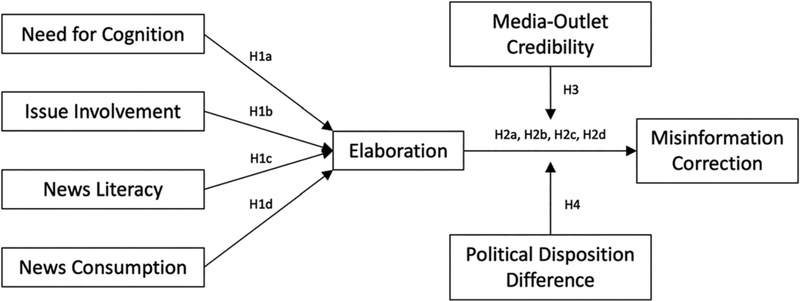
Hypothesized Model of Moderated Mediation Effects for Fact-Checking News
METHOD
Research Design & Participants
This study employed an online pretest-posttest experimental design to assess changes in participants’ attitudes toward a specific issue before and after an intervention. Participants’ initial attitudes were measured before exposure to the experimental stimulus—a fact-checking news video. Following the intervention, their post-intervention attitudes were reassessed.
The study focused on a pressing public healthcare crisis in Korea during the data collection period, which spanned from August 1 to September 16, 2024. Specifically, it examined the overcrowding of emergency rooms in large hospitals due to non-urgent patients, a problem that disrupted the treatment of critically ill individuals. This issue had gained significant public attention and was widely debated across various platforms, where both accurate information and misinformation circulated. The experimental stimulus, a fact-checking news video, provided verified and accurate information about the issue. The fact-checking news had received the Excellence in Fact-Checking Award from SNU Fact Check, Korea’s leading fact-checking news platform, ensuring its credibility as an appropriate intervention tool.
A total of 531 participants were recruited through snowball sampling via social media platforms, including Facebook, Instagram, and KakaoTalk. Participants completed an online survey to collect demographic information, average daily news consumption (in minutes), news literacy, need for cognition, political disposition, and perceived credibility of major broadcasting channels, including the source of the fact-checking news video. Additionally, pre-existing attitudes and involvement with the issue were assessed. Participants were then exposed to a 3-minute-18-second fact-checking news video. To ensure engagement with the experimental stimulus, a screening question about the video source was administered after the intervention. Furthermore, participants’ levels of elaboration on the fact-checking news and their post-intervention attitudes toward the issue were measured.
Responses from 29 participants who failed to correctly identify the source of the fact-checking news in the screening question were excluded from the analysis, resulting in 502 valid responses. The final sample comprised 300 males (59.8%) and 202 females (40.2%), with an age range of 19 to 82 years (M = 42.31, SD = 14.55), representing various regions across the nation. In terms of educational attainment, 25 participants (5.0%) had a high school diploma or lower, 99 participants (19.7%) were college students, 178 participants (35.5%) held a university degree, and 200 participants (39.8%) had graduate-level education. The median monthly household income of the sample ranged between 7.01 and 8.00 million KRW.
Measures
This study identified need for cognition and issue involvement as motivational factors expected to influence the elaboration of fact-checking news. The following explains how each variable was measured.
Need for Cognition. Based on recent research (de Holanda Coelho et al., 2020), the need for cognition scale (NCS-6) was used to assess participants’ need for cognition. The NCS-6 is a validated short-form version of the original scale (NCS-18; Petty & Cacioppo, 1986) designed to measure the extent to which individuals engage in and enjoy effortful cognitive activities. The scale consists of six items, each rated on a seven-point Likert scale (1 = Strongly Disagree, 7 = Strongly Agree): The items include: I would prefer complex to simple problems (M = 4.04, SD = 1.39); I like to have the responsibility of handling a situation that requires a lot of thinking (M = 4.03, SD = 1.51); Thinking is not my idea of fun (reverse-scored; M = 4.89, SD = 1.48); I would rather do something that requires little thought than something that is sure to challenge my thinking abilities (reverse-scored; M = 4.91, SD = 1.54); I really enjoy a task that involves coming up with new solutions to problems (M = 4.72, SD = 1.34); and I would prefer a task that is intellectual, difficult, and important to one that is somewhat important but does not require much thought (M = 4.33, SD = 1.44). These items exhibited a one-factor structure with good internal reliability (Cronbach’s α = .850).
Issue Involvement. The issue addressed in this study pertains to the emergency medical system in large hospitals, particularly the influx of patients with minor conditions that disrupt the treatment of critically ill patients. A three-item scale, widely used in prior research (e.g., Park et al., 2016; Yang et al., 2015), was adopted to measure participants’ involvement with the issue. The items, rated on a seven-point Likert scale (1 = Strongly Disagree, 7 = Strongly Agree), included: The emergency medical system of large hospitals is an important issue to me (M = 4.97, SD = 1.30); The emergency medical system of large hospitals is an issue that interests me (M = 5.16, SD = 1.18); and The emergency medical system of large hospitals in an issue related to me (M = 4.72, SD = 1.34). This scale demonstrated good internal reliability (Cronbach’s α = .864).
This study identified news literacy and average daily news consumption as ability factors influencing the elaboration of fact-checking news. Each factor was measured as follows.
News Literacy. To assess news literacy, a three-item scale was adopted from previous research (Heo, 2020; S. J. Lee & Yang, 2017). Participants rated their agreement with the following statements on a seven-point Likert scale (1 = Strongly Disagree, 7 = Strongly Agree): I am capable of finding the news information I want (M = 5.73, SD = 1.03); I am capable of understanding the content of the news (M = 5.62, SD = .99); and I am capable of interpreting the news from my own perspective (M = 5.39, SD = 1.14). the scale demonstrated good internal reliability (Cronbach’s α = .825).
Daily News Consumption Time. Participants responded to the question: On average, how many minutes per day do you spend consuming news through various media, such as newspapers, TV, radio, the internet, and social media? Reported responses ranged from 0 to 660 minutes, with an average daily news consumption of 60.08 minutes (SD = 63.91).
The self-reported cognitive effort scale, developed by Petty and Cacioppo (1986), was used to measure participants’ elaboration on fact-checking news regarding the emergency medical system in large hospitals, which was presented as the experimental stimulus. Immediately after watching the fact-checking news video, participants responded to the questions: To what extent were you trying hard to evaluate the fact-checking news? (M = 4.60, SD = 1.26) and How much effort did you put into evaluating the fact-checking news? (M = 4.30, SD = 1.28). Both items were rated on a seven-point Likert scale ranging from 1 (Not at all) to 7 (Completely). The reliability between the two items was good (Cronbach’s α = .835).
To assess the impact of fact-checking news, the study measured changes in participant’ beliefs in a statement regarding the issue of emergency room overcrowding in large hospitals. While the statement presented in the pre-test was factually accurate, prior research shows that public misperceptions often involve both misinformation (false beliefs) and the absence of accurate information (Nyhan & Reifler, 2010; Walter & Tukachinsky, 2020). Therefore, this study conceptualizes “misinformation correction” as the process of updating or affirming factual understanding in response to evidence-based verification—especially in contexts where misinformation or doubt is socially prevalent. This approach reflects real-world media interventions that aim to preemptively reinforce factual understanding among audiences exposed to pervasive misinformation (Lewandowsky et al., 2012).
To measure pre-attitudes, participants were presented with the statement, “The influx of mild cases to the emergency rooms of large hospitals causes delays in the treatment of critically ill patients,” and rated the extent to which they perceived the statement as factual on a seven-point Likert scale ranging from 1 (Not at all true) to 7 (Completely true) (M = 4.00, SD = 1.38). Participants then watched a 3-minute-18-second fact-checking news video addressing the actual problem of mild cases overwhelming emergency rooms in large hospitals, which in turn caused difficulties for critically ill patients. Following the video, the same statement used in the pre-attitude measure was presented again to assess post-attitudes (M = 4.35, SD = 1.41). Higher scores closer to 7 on both pre- and post-measurements indicated greater alignment with the real-world situation as conveyed by the fact-checking news.
The misinformation correction effect was calculated as the difference between post-attitude and pre-attitude scores for each participant. A positive attitude change score (ranging from 1 to 6) indicated the fact-checking news was effective in correcting misinformation. Conversely, a negative score (ranging from -1 to -6) suggested a backfire effect, where exposure to fact-checking news reinforced participants’ misconceptions. A score of 0 indicated no attitude change, implying that the fact-checking intervention had no measurable effect. However, for participants whose pre-attitude scores were at the extreme ends of the scale (1: n = 8; 7: n = 11) and who exhibited no attitude change, their pre-existing attitudes were considered somewhat reinforced. To account for this, the average attitude-change scores of participants who shifted attitudes in the same direction were assigned to these groups. Specifically, participants with pre- and post-attitudes of 1 were assigned the average attitude change score (M = -0.48) of participants whose scores ranged from 0 to -5 (n = 307). Similarly, participants with pre- and post-attitudes of 7 were assigned the average attitude change score (M = 0.83) of participants whose scores ranged from 0 to 5 (n = 392).
Although the theoretical range of attitude change scores was from -6 to 6, the observed range in this study was from -5 to 5. Among the participants, 107 (21.31%) exhibited a backfire effect with negative attitude change scores, 208 (41.43%) showed no change, and 187 (37.25%) demonstrated positive attitude change, indicating the intended effect of the fact-checking news. The overall average attitude change score across all participants was M = 0.36, SD = 1.42 (see Table 1).

Frequency of Attitude Change (Misinformation Correction) Scores(N=502)
The discussion of the theoretical background and research hypotheses anticipated that the credibility of fact-checking news sources and the political orientation differences between the audience and media outlets would moderate the process of attitude change through the elaboration of fact-checking news. These variables were measured as follows.
Credibility of Media Outlet. Before exposure to fact-checking news, participants rated the perceived credibility of each of Korea’s seven major broadcasting stations on a seven-point Likert scale ranging from 1 (Not at all credible) to 7 (Very credible). Among these seven stations, the overall credibility rating for the broadcasting station that provided the fact-checking news used as the experimental stimulus in this study was low (M = 2.80, SD = 1.47).
Difference in Political Disposition between Individual and Media Outlet. Participants’ self-reported political dispositions (M = 3.50, SD = 1.15) and their perceptions of the political dispositions of the fact-checking news outlet (M = 6.11, SD = 1.21) were measured using a seven-point Likert scale ranging from 1 (Very Progressive) to 7 (Very Conservative). The difference in political disposition between each participant and the media outlet was calculated by taking the absolute value of the difference between their respective political disposition scores (M = 2.70, SD = 1.73). By using absolute scores, the analysis focused on the magnitude of the discrepancy between participants’ political dispositions and those of the media outlet. This approach eliminated directional biases, simplified data interpretation, and aligned with the research objectives, which prioritized the extent of difference over its direction.
RESULTS
Motivational and Ability Factors Influencing the Elaboration of Fact-Checking News
A hierarchical regression analysis was conducted to identify the motivational and ability factors influencing the elaboration of fact-checking news, as outlined in the research hypotheses (i.e., H1a, H1b, H1c, and H1d). In Model 1, the demographic characteristics of the participants (gender, age, education level, and monthly household income) were included as control variables. In model 2, motivational factors (need for cognition and issue involvement) and ability factors (news literacy and daily news consumption time) were added.
As summarized in Table 2, the results indicated that both Model 1 (F(6, 495) = 4.387, p < .001) and Model 2 (F(10, 491) = 7.307, p < .001) were statistically significant. Model 1, which included only demographic variables, explained 5.0% of the variance in news elaboration (adjusted R2 = .039). When motivational and ability factors were added in Model 2, the explained variance significantly increased by 7.9%, F(4, 491) = 11.147, p < .001, resulting in a total of 13.0% of variance explained (adjusted R2 = .112). This confirmed that motivational and ability factors had a statistically significant impact on elaboration, even after controlling for demographic characteristics. The Durbin-Watson statistics was 2.084, indicating no violations of the assumption of independence of residuals, and the variance inflation factor (VIF) values were all below 10, suggesting no concerns regarding multicollinearity.
Motivation and Ability Factors Affecting Elaboration
The significance of the regression coefficients in Model 2 revealed that among the demographic characteristics, gender (ß = .122, p = .005) and educational level, specifically university graduation (Edu-3: ß = -.282, p = .005), had statistically significant effects on the elaboration of fact-checking news. Specifically, females exhibited a higher level of elaboration compared to males, and university graduates demonstrated lower elaboration levels compared to those with other education levels. After controlling for demographic variables, the motivation factor of issue involvement (ß = .169, p < .001) and the ability factor of news literacy (ß = .169, p < .001) were found to have statistically significant positive effects on the elaboration of fact-checking news, supporting H1b and H1c. However, the motivation factor of need for cognition (ß = .046, p = .335) and the ability factor of daily news consumption (ß = .047, p = .284) were not found to significantly affect elaboration, leading to the rejection H1a and H1d.
Mediation of Elaboration
Building on the analysis results regarding the motivational and ability factors influencing the elaboration of fact-checking news, additional analyses were conducted to test the hypotheses (H2b and H2c) concerning the mediated effects of issue involvement (as a motivational factor) and news literacy (as an ability factor) on attitude change (i.e., misinformation correction) through elaboration.
A mediation analysis was conducted using Hayes’ (2022) PROCESS macro (Model 4) to examine whether elaboration mediates the relationship between issue involvement and attitude change. The analysis was performed at 95% confidence level with 5,000 bootstrap samples, controlling for demographic characteristics (gender, age, education, and household income). The sample consisted of 502 participants.
As shown in Table 3, the analysis revealed that issue involvement had a significant positive direct effect on elaboration (B = .214, SE = .044, t = 4.903, p < .001, 95% CI [.128, .299]), indicating that higher levels of issue involvement were associated with greater elaboration. The model explained 9.5% of the variance in elaboration (R2 = .095, F(7, 494) = 7.369, p < .001).
Regression Coefficients for Direct Effects of Issue Involvement on Elaboration and Attitude Change after Controlling for Demographic Charactersitics
In the second part of the model, the direct effect of issue involvement on attitude change was non-significant (B = -.029, SE = .056, t = -.520, p = .603, 95% CI [-.139, .081]). However, elaboration had a significant positive direct effect on attitude change (B = .155, SE = .056, t = 2.739, p = .006, 95% CI [.044, .266]), suggesting that higher levels of elaboration were associated with greater attitude change. The model explained 3.1% of the variance in attitude change (R2 = .031, F(8, 493) = 1.984, p = .047).
The total effect of issue involvement on attitude change was non-significant (B =.004, SE = .055, t =.071, p = .943, 95% CI [-.104, .112]). The model explained 1.6% of the variance in attitude change (R2 = .016, F(7, 494) = 1.181, p = .312). However, the indirect effect of issue involvement on attitude change through elaboration was significant (B = .033, Boot SE = .015, 95% Boot CI [.006, .065]), indicating that elaboration significantly mediated the relationship between issue involvement and attitude change. The completely standardized indirect effect was ß = .027, Boot SE = .012, 95% Boot CI [.005, .053] (see Table 4).
Indirect Effect of Issue Involvement via Elaboration on Attitude Change after Controlling for Demographic Charactersitics
In summary, the mediation analysis supported H2b, which proposed that elaboration mediates the relationship between issue involvement and misinformation correction through attitude change. Although the direct effect of issue involvement on attitude change was non-significant, issue involvement indirectly influenced attitude change through its positive effect on elaboration. This finding suggests that individuals with higher issue involvement tend to engage in more elaborative processing of fact-checking news, which, in turn, leads to greater misinformation correction—that is, greater changes in their attitudes.
Another mediation analysis was conducted to examine whether elaboration mediates the relationship between news literacy and attitude change, while controlling for demographic characteristics (see Table 5). The results showed that news literacy had a significant positive direct effect on elaboration (B = .293, SE = .058, t = 5.003, p < .001, 95% CI [.178, .407]). This finding indicates that individuals with higher news literacy engage in more elaborative processing. The model accounted for 9.6% of the variance in elaboration (R2 = .096, F(7, 494) = 7.518, p < .001).
Regression Coefficients for Direct Effects of News Literacy on Elaboration and Attitude Change after Controlling for Demographic Charactersitics
In the second part of the model, the direct effect of news literacy on attitude change was non-significant (B =.074, SE = .075, t =.978, p = .328, 95% CI [-.074, .221]). However, elaboration had a significant positive direct effect on attitude change (B = .136, SE = .056, t = 2.411, p = .016, 95% CI [.025, .247]), suggesting that increased elaboration leads to greater attitude change. The model explained 3.3% of the variance in attitude change (R2 = .033, F(8, 493) = 2.073, p = .037).
The total effect of news literacy on attitude change was non-significant (B =.113, SE = .074, t = 1.538, p = .125, 95% CI [-.031, .258]). The model explained 2.1% of the variance in attitude change (R2 = .021, F(7, 494) = 1.524, p = .157). However, the indirect effect of news literacy on attitude change through elaboration was significant (B = .040, Boot SE = .019, 95% Boot CI [.005, .081]), showing that elaboration mediated the relationship between news literacy and attitude change. The completely standardized indirect effect was ß = .025, Boot SE = .012, 95% Boot CI [.003, .051] (see Table 6).
Indirect Effect of News Literacy via Elaboration on Attitude Change after Controlling for Demographic Charactersitics
In conclusion, the mediation analysis confirmed H2c, which posited that elaboration mediates the relationship between news literacy and attitude change. While the direct effect of news literacy on attitude change was not significant, news literacy had an indirect positive effect on attitude change via elaboration. This indicates that individuals with higher news literacy are more likely to engage in elaborative processing of fact-checking news, which subsequently leads to greater misinformation correction—that is, greater attitude change.
Moderated Mediation
A series of moderated mediation analyses were conducted using Hayes’ (2022) PROCESS macro (Model 58) to examine whether elaboration mediates the relationship between issue involvement and news literacy and attitude change, with media-source credibility as a moderator. The analyses controlled for demographic characteristics (gender, age, education, and household income) and included a sample of 502 participants.
As shown in Table 7, issue involvement had a significant positive direct effect on elaboration (B =.194, SE =.082, t = 2.368, p = .018, 95% CI [.033, .355]), suggesting that higher levels of issue involvement are associated with greater elaboration. However, media-source credibility did not significantly affect elaboration (B =.127, SE =.136, t = .937, p = .349, 95% CI [-.140, .394]). Additionally, the interaction between issue involvement and media-source credibility was not significant (B = .004, SE =.027, t =.137, p = .891, 95% CI [-.049, .056]). The model explained 12.6% of the variance in elaboration (R² = .126, F(9, 492) = 7.913, p < .001).
Moderated Mediation Analysis: Issue Involvement on Attitude Change through Elaboration Moderated by Media Credibility
The direct effect of issue involvement on attitude change was non-significant (B = -.032, SE =.055, t = -.586, p = .558, 95% CI [-.141,.076]). Similarly, elaboration did not have a significant direct effect on attitude change (B = -.008, SE =.107, t = -.073, p = .942, 95% CI [-.218, .203]). The interaction between elaboration and media-source credibility on attitude change was also not significant (B = .046, SE =.035, t = 1.329, p = .185, 95% CI [-.022, .114]). The model explained 6.4% of the variance in attitude change (R² = .064, F(10, 491) = 3.351, p < .001).
As presented in Table 8, news literacy had a significant positive direct effect on elaboration (B =.297, SE =.118, t = 2.518, p = .012, 95% CI [.065, .528]), suggesting that higher levels of news literacy are associated with greater elaboration. However, media-source credibility did not significantly affect elaboration (B =.132, SE =.219, t = .602, p = .548, 95% CI [-.299, .563]). Additionally, the interaction between news literacy and media-source credibility was not significant (B = .006, SE =.038, t =.166, p = .868, 95% CI [-.068, .081]). The model explained 13.9% of the variance in elaboration (R² = .139, F(9, 492) = 8.816, p < .001).
Moderated Mediation Analysis: News Literacy on Attitude Change through Elaboration Moderated by Media Credibility
The direct effect of news literacy on attitude change was non-significant (B =.105, SE = .075, t = 1.406, p = .160, 95% CI [-.042, .252]). Similarly, elaboration did not have a significant direct effect on attitude change (B = -.026, SE = .107, t = -.240, p = .810, 95% CI [-.235, .184]).
The interaction between elaboration and media-source credibility on attitude change was also not significant (B =.043, SE =.035, t = 1.236, p = .217, 95% CI [-.025, .111]). The model explained 6.7% of the variance in attitude change (R² = .067, F(10, 491) = 3.525, p < .001).
Overall, these findings suggest that media-source credibility does not moderate the mediation effect of elaboration between either issue involvement or news literacy and attitude change. Thus, H3, which predicted the moderating effects of media-source credibility, is rejected.
A series of moderated mediation analyses were conducted using Hayes’ (2022) PROCESS macro (Model 58) to investigate whether elaboration mediates the relationship between issue involvement or news literacy and attitude change, moderated by the difference in political disposition between the individual and the media outlet. The analyses controlled for demographic characteristics (gender, age, education, and household income).
As shown in Table 9, issue involvement had a significant positive direct effect on elaboration (B = .251, SE = .083, t(492) = 3.013, p = .003, 95% CI [.087, .414]), suggesting that higher levels of issue involvement are associated with greater elaboration. However, the moderation by political disposition difference was non-significant (B = -.015, SE = .025, t = -.589, p = .556, 95% CI [-.064, .034]), indicating that political disposition differences do not moderate the effect of issue involvement on elaboration. The model explained 10.0% of the variance in elaboration (R² = .100, F(9, 492) = 6.092, p < .001).
Moderated Mediation Analysis: Issue Involvement on Attitude Change through Elaboration Moderated by Difference in Political Disposition between Individual and Media Outlet
The direct effect of issue involvement on attitude change was non-significant (B = -.038, SE = .056, t = -.682, p = .495, 95% CI [-.148, .072]). However, elaboration had a significant positive direct effect on attitude change (B = .338, SE = .107, t = 3.144, p = .002, 95% CI [.127, .549]). Importantly, the interaction between elaboration and political disposition difference was significant (B = -.065, SE = .031, t = -2.088, p = .037, 95% CI [-.126, -.004]), indicating that the relationship between elaboration and attitude change weakens as political disposition differences increase. The model explained 4.7% of the variance in attitude change (R² = .047, F(10, 491) = 2.396, p = .009). The moderated effect is illustrated in Figure 2.
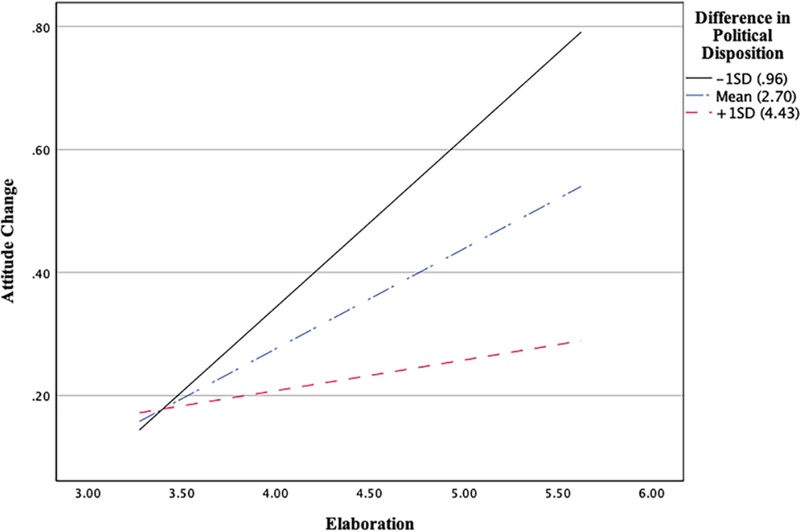
The Interaction between Elaboration and Difference in Political Disposition on Attitude Change (IV=Issue Involvement)
The indirect effect of issue involvement on attitude change via elaboration was moderated by political disposition difference. Specifically, the mediation effect was stronger at lower levels of political disposition difference. For example, at one standard deviation below the mean (B = .065, Boot SE = .027, Boot 95% CI [.018, .123]), the mediation was significant, whereas at one standard deviation above the mean, the effect was non-significant (B = .009, Boot SE = .016, Boot 95% CI [-.018, .047]).
In summary, elaboration mediated the relationship between issue involvement and attitude change, but the strength of this mediation was moderated by political disposition difference. As political disposition differences increased, the positive effect of elaboration on attitude change weakened, suggesting that elaboration is less effective for attitude change or misinformation correction when political alignment between individuals and media outlets is highly divergent.
Additionally, as presented in Table 10, news literacy had a significant direct effect on elaboration (B = .397, SE = .098, t = 4.065, p < .001, 95% CI [.205, .589]), suggesting that higher news literacy is associated with greater elaboration. However, the interaction between news literacy and political disposition difference was non-significant (B = -.028, SE = .031, t = -.891, p = .720, 95% CI [-.089, .033]), indicating that political disposition difference does not moderate the relationship between news literacy and elaboration. The model explained 11.4% of the variance in elaboration (R² = .114, F(9, 492) = 7.052, p < .001).
Moderated Mediation Analysis: News Literacy on Attitude Change through Elaboration Moderated by Difference in Political Disposition between Individual and Media Outlet
The direct effect of news literacy on attitude change was non-significant (B = .098, SE = .077, t = 1.280, p = .201, 95% CI [-.053, .249]). However, elaboration had a significant positive direct effect on attitude change (B = .301, SE = .108, t = 2.783, p = .006, 95% CI [.089, .514]). The interaction between elaboration and political disposition difference was marginally significant (B = -.061, SE = .031, t = -1.966, p = .050, 95% CI [-.123, .000]), suggesting that the positive relationship between elaboration and attitude change decreases as political disposition differences increase. The model explained 4.9% of the variance in attitude change (R² = .049, F(10, 491) = 2.518, p = .006), and the moderated effect is illustrated in Figure 3.
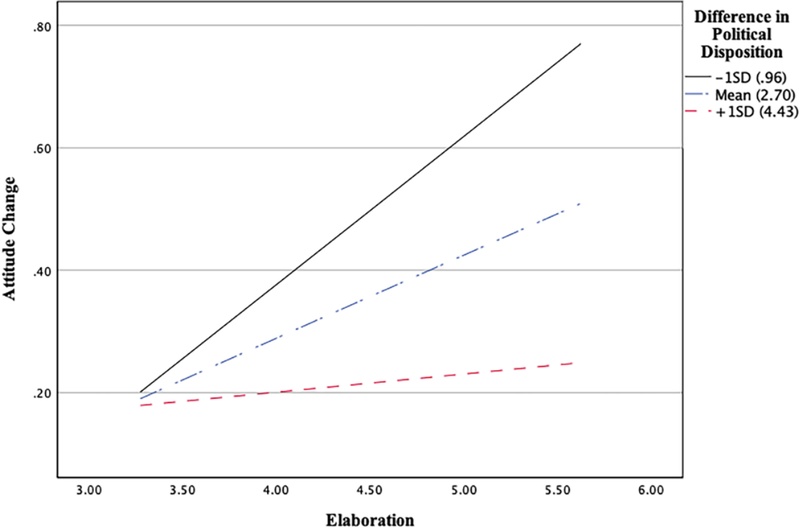
The Interaction between Elaboration and Difference in Political Disposition on Attitude Change (IV=News Literacy)
The indirect effect of news literacy on attitude change via elaboration was moderated by political disposition difference. The mediation effect was stronger at lower levels of political disposition difference. For example, at one standard deviation below the mean, the mediation was significant (B = .090, Boot SE = .038, Boot 95% CI [.021, .170]). However, at higher levels of political disposition difference (one standard deviation above the mean), the mediation was non-significant (B = .008, Boot SE = .021, Boot 95% CI [-.035, .051]).
Overall, these findings suggest that elaboration mediates the relationship between news literacy and attitude change, but this mediation is moderated by political disposition differences. Specifically, as political disposition differences increase, the positive effect of elaboration on attitude change weakens, indicating that when political alignment between the individual and the media outlet is highly divergent, the impact of elaboration on attitude change or misinformation correction is diminished. Therefore, H4, predicting the moderated mediation effect of political disposition difference, is supported in this study. Figure 4 provides a complete summary of the hypothesized model tested in this study.
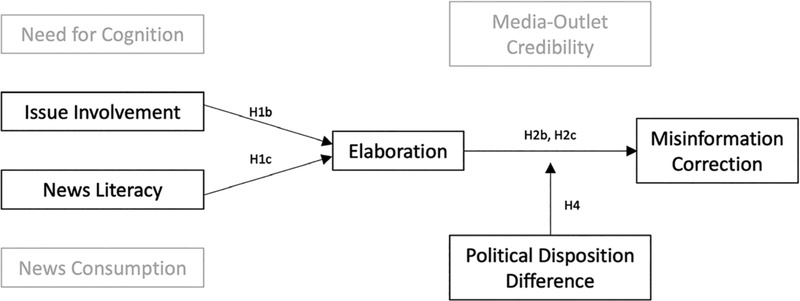
Summary of Hypothesis Testing Results in the Proposed Model of Moderated Mediation Effects of Fact-Checking News on Misinformation Correction
DISCUSSION
The purpose of this study was to systematically investigate the mechanisms through which fact-checking news corrects audience misinformation, utilizing the ELM. The central findings support the hypothesized moderated mediation model, demonstrating that elaboration mediates the positive effects of motivational (i.e., issue involvement) and ability (i.e., news literacy) factors on misinformation correction. Moreover, these mediated effects were moderated by the difference in political disposition between the individual and the media-outlet, highlighting how the positive effect of elaboration on misinformation correction varies significantly depending on peripheral or contextual factors.
Specifically, the study confirms that both issue involvement (a motivational factor) and news literacy (an ability factor) significantly influence the elaboration of fact-checking news. These findings align with dual-process theories of persuasion, such as the ELM, which suggests that motivation and ability are key determinants of elaboration (Petty & Cacioppo, 1986). However, the non-significant effects of need for cognition and news consumption warrant further discussion.
Issue involvement had a significant positive effect, consistent with prior findings that individuals who are highly involved in an issue are more likely to engage in deeper cognitive processing (Johnson & Eagly, 1989). When individuals perceive an issue as personally relevant, they are more motivated to critically evaluate fact-checking news, leading to greater elaboration (Kunda, 1990). This suggests that fact-checking organizations should frame their content in ways that enhance audience involvement to encourage deeper engagement.
News literacy also significantly predicted elaboration, supporting prior research indicating that individuals with higher media literacy engage in more systematic processing of news content (Ashley et al., 2013; Vraga & Tully, 2021). News-literate individuals are better equipped to distinguish credible sources from misinformation, making them more likely to scrutinize fact-checking news in detail. Ashley et al. (2013) argue that news literacy education is essential for improving individuals’ ability to critically assess news content. The findings of the present study support this claim by demonstrating that individuals with higher news literacy engage in greater elaboration on fact-checking news, leading to more effective misinformation correction.
Despite being a well-established predictor of elaboration in persuasion research (Cacioppo et al., 1996), need for cognition did not significantly impact elaboration in this study. This result might be explained by the nature of fact-checking news itself—individuals high in need for cognition may already be skeptical and require additional incentives to engage deeply (Cacioppo et al., 1996). Alternatively, the format of fact-checking news (e.g., short summaries) may not align with the preference of high-need-for-cognition individuals, who tend to favor more complex, detailed analyses. These findings suggest that fact-checking news may require additional complexity or interactive elements, such as presenting more detailed argumentation or fostering interactive discussion environments, to appeal to individuals with high need for cognition. Similarly, the non-significant effect of daily news consumption suggests that mere exposure to news does not necessarily translate into deeper elaboration. Prior studies have shown that habitual news consumers often rely on heuristics rather than critical analysis (Tewksbury & Rittenberg, 2012), supporting the notion that quantity of news exposure does not guarantee quality of information processing. In addition, while news consumption increases exposure to information, Eveland (2001) found that learning from news is primarily driven by attention and elaboration, rather than mere exposure. This may explain why daily news consumption did not significantly predict elaboration in the present study, as passive exposure does not necessarily lead to deeper cognitive engagement with fact-checking news.
The mediation analyses confirm that elaboration plays a crucial role in linking both issue involvement and news literacy to attitude change in response to misinformation correction. While neither issue involvement nor news literacy directly influenced attitude change, their effects were fully mediated by elaboration. These findings align with the ELM, which suggests that individuals are more likely to adjust their attitudes when they engage in deeper cognitive processing of persuasive messages (Petty & Cacioppo, 1986).
The indirect effect of issue involvement on attitude change through elaboration suggests that individuals highly involved in an issue are more motivated to process fact-checking news carefully, leading to greater misinformation correction and attitude change. Prior research supports this idea, demonstrating that when individuals perceive an issue as personally relevant, they are more likely to scrutinize information, evaluate its credibility, and adjust their attitudes accordingly (Chong & Druckman, 2007). However, the non-significant direct effect of issue involvement indicates that motivation alone is insufficient; elaborative processing must occur for it to lead to meaningful attitude shifts.
Similarly, the mediation effect of elaboration on the relationship between news literacy and attitude change underscores the importance of cognitive processing in fact-checking effectiveness. Individuals with higher news literacy possess the analytical skills necessary to evaluate information critically, yet these skills only contribute to attitude change when they engage in elaborative processing. This finding aligns with previous studies suggesting that news literacy alone does not necessarily lead to belief updating; instead, individuals must actively process fact-checking news to correct misinformation (Vraga & Tully, 2021). The lack of a direct effect of news literacy on attitude change supports the argument that passive exposure to news literacy education is insufficient—individuals must be encouraged to apply their knowledge actively through deeper engagement.
The findings from the moderated mediation analyses indicate that media-source credibility does not moderate the mediation effect of elaboration between either issue involvement or news literacy and attitude change, leading to the rejection of H3. This suggests that regardless of how credible an individual perceives a media source to be, their elaborative processing of fact-checking news—whether motivated by issue involvement or guided by news literacy— functions independently in influencing attitude change. However, the results support H4, which posited that the mediation of elaboration is moderated by political alignment between the individual and the media outlet. The diminishing effect of elaboration on attitude change as political disposition differences increase aligns with prior research on motivated reasoning and partisan bias (Taber & Lodge, 2006). Individuals are more likely to resist attitude change when corrective information comes from sources they perceive as ideologically opposed to their beliefs (Nyhan & Reifler, 2010).
These finding highlight the challenge of breaking through partisan resistance to misinformation correction, as elaborative processing alone does not guarantee attitude change when corrective information contradicts an individual’s ideological beliefs. Building on Bateman and Jackson’s (2024) policy recommendations, the findings of this study suggest that fact-checking news interventions should leverage bipartisan or ideologically neutral messengers to enhance credibility and reduce audience resistance. Additionally, framing fact-checking content around shared values rather than directly confronting misinformation may increase the effectiveness of elaboration in attitude change, particularly in politically polarized environments (Chong & Druckman, 2007). In addition, investigating the role of social endorsement (e.g., peer sharing of fact-checking news) may provide insights into alternative ways of increasing trust in politically incongruent fact-checking sources. While the present study examines the cognitive mechanisms underlying misinformation correction, Bateman and Jackson (2024) emphasize that effective disinformation countermeasures must be supported by broader policy frameworks. Their findings suggest that structural interventions, such as improving media transparency and fostering cross-platform collaborations, may complement individual-level cognitive strategies in enhancing the impact of fact-checking news.
Although demographic variables—including gender, age, education level, and household income—were not central to the research hypotheses, they were controlled in the statistical analyses and provide supplementary insights into audience segmentation, highlighting potential areas for future research. The findings of this study suggest that demographic factors, specifically gender and educational attainment, play a significant role in how individuals engage with and elaborate on fact-checking news. This aligns with prior research in media psychology and political communication, which has highlighted the influence of individual differences in information processing (Eveland, 2001).
The observed trend that females exhibit higher levels of elaboration than males aligns with past findings on gender differences in information processing. Research suggests that women are more likely to engage in effortful cognitive processing of news and political information due to greater socialization toward deliberative thinking and conscientiousness in evaluating information (Vraga et al., 2015). Additionally, women tend to be more skeptical about unverified news and cautious in evaluating misinformation (Pennycook & Rand, 2019), which may explain their higher levels of elaboration when engaging with fact-checking news.
The finding that university graduates exhibit lower levels of elaboration compared to participants with different educational backgrounds is intriguing and somewhat counterintuitive. While higher education is generally associated with increased cognitive engagement (Zaller, 1992), some studies suggest that individuals with university degrees might rely more on heuristics rather than detailed information processing (Taber & Lodge, 2006). Educated individuals often develop cognitive shortcuts, enabling them to filter information quickly without engaging in deep elaboration (Lodge & Taber, 2013). Furthermore, prior research indicates that university graduates may feel more confident in their existing knowledge and, as a result, be less motivated to scrutinize fact-checking content in detail (Flynn et al., 2017). These findings suggest that fact-checking organizations may need to tailor their strategies to engage those with university level of education more effectively.
This study advances the application of the ELM by demonstrating how elaboration mediates the impact of motivational and ability factors on misinformation correction through fact-checking news. Furthermore, the exploration of moderating variables, such as media-source credibility and political disposition differences, provides a nuanced understanding of the conditions under which fact-checking interventions succeed or falter. However, several limitations should be acknowledged. First, the use of a single public health issue as the experimental context may limit the generalizability of the findings to other domains, such as politics or environmental issues. Second, the reliance on self-reported measures for elaboration and attitude change introduces potential biases. Third, the snowball sampling technique utilized in this study may introduce sampling bias and result in homogeneity within the sample. Consequently, participants may not adequately represent the broader population in terms of demographics, political orientation, or news consumption behaviors. Additionally, this method may disproportionately include individuals who are already interested in the issue of emergency room overcrowding in large hospitals, potentially inflating observed levels of elaboration or news literacy. These limitations may limit the generalizability of the findings, particularly in contexts involving more diverse or disengaged populations. Future research should incorporate objective measures, longitudinal designs, and more rigorous sampling strategies to enhance the internal and external validity of the results.
In conclusion, this study provides actionable insights for improving the design and implementation of fact-checking news, emphasizing the central role of elaboration and the challenges posed by political polarization. By addressing these dynamics, media practitioners and researchers can better combat misinformation and enhance public understanding in an era of digital information proliferation..
Acknowledgments
This work was supported by Joongbu University Research & Development Fund, in 2024.
Disclosure Statement
No potential conflict of interest was reported by the author.
References
-
Amazeen, M. A., & Bucy, E. P. (2019). Conferring resistance to digital disinformation: The inoculating influence of procedural news knowledge. Journal of Broadcasting & Electronic Media, 63(3), 415–432.
[https://doi.org/10.1080/08838151.2019.1653101]

-
Ashley, S., Maksl, A., & Craft, S. (2013). Developing a news media literacy scale. Journalism & Mass Communication Educator, 68(1), 7–21.
[https://doi.org/10.1177/1077695812469802]
- Bateman, J. & Jackson, D. (2024). Countering disinformation effectively: An evidence-based policy guide. CEIP: Carnegie Endowment for International Peace. United States of America. Retrieved from https://coilink.org/20.500.12592/rjdfszton05Jan2025, .
-
Cacioppo, J. T., & Petty, R. E. (1982). The need for cognition. Journal of Personality and Social Psychology, 42(1), 116–131.
[https://doi.org/10.1037/0022-3514.42.1.116]
-
Cacioppo, J. T., Petty, R. E., Feinstein, J. A., & Jarvis, W. B. G. (1996). Dispositional differences in cognitive motivation: The life and times of individuals varying in need for cognition. Psychological Bulletin, 119(2), 197–253.
[https://doi.org/10.1037/0033-2909.119.2.197]
-
Chaiken, S. (1980). Heuristic versus systematic information processing and the use of source versus message cues in persuasion. Journal of Personality and Social Psychology, 39(5), 752–766.
[https://doi.org/10.1037/0022-3514.39.5.752]
-
Chaiken, S., & Maheswaran, D. (1994). Heuristic processing can bias systematic processing: Effects of source credibility, argument ambiguity, and task importance on attitude judgment. Journal of Personality and Social Psychology, 66(3), 460–473.
[https://doi.org/10.1037/0022-3514.66.3.460]
-
Chong, D., & Druckman, J. N. (2007). Framing theory. Annual Review of Political Science, 10(1), 103–126.
[https://doi.org/10.1146/annurev.polisci.10.072805.103054]
-
Craft, S., Ashley, S., & Maksl, A. (2017). News media literacy and conspiracy theory endorsement. Communication and the Public, 2(4), 388–401.
[https://doi.org/10.1177/2057047317725539]
-
David, C. C. (2009). Learning political information from the news: A closer look at the role of motivation. Journal of Communication, 59(2), 243–261.
[https://doi.org/10.1111/J.1460-2466.2009.01414.X]
-
de Holanda Coelho, G. L., Hanel, P. H., & Wolf, L. J. (2020). The very efficient assessment of need for cognition: Developing a six-item version. Assessment, 27(8), 1870–1885.
[https://doi.org/10.1177/1073191118793208]
-
Eveland, W. P., Jr. (2001). The cognitive mediation model of learning from the news: Evidence from nonelection, off-year election, and presidential election contests. Communication Research, 28(5), 571–601.
[https://doi.org/10.1177/009365001028005001]
-
Eveland, W. P., Jr. (2002). News information processing as mediator of the relationship between motivations and political knowledge. Journalism & Mass Communication Quarterly, 79(1), 26–40.
[https://doi.org/10.1177/107769900207900103]
-
Fletcher, R., & Park, S. (2017). The impact of trust in the news media on online news consumption and participation. Digital Journalism, 5(10), 1281–1299.
[https://doi.org/10.1080/21670811.2017.1279979]
-
Flynn, D. J., Nyhan, B., & Reifler, J. (2017). The nature and origins of misperceptions: Understanding false and unsupported beliefs about politics. Political Psychology, 38(S1), 127–150.
[https://doi.org/10.1111/pops.12394]
-
Garrett, R. K., Nisbet, E. C., & Lynch, E. K. (2013). Undermining the corrective effects of media-based political fact-checking? The role of contextual cues and naïve theory. Journal of Communication, 63(4), 617–637.
[https://doi.org/10.1111/jcom.12038]
-
Garrett, R. K., Weeks, B. E., & Neo, R. L. (2016). Driving a wedge between evidence and beliefs: How online ideological news exposure promotes political misperceptions. Journal of Computer-Mediated Communication, 21(5), 331–348.
[https://doi.org/10.1111/jcc4.12164]
-
Graves, L., Nyhan, B., & Reifler, J. (2016). Understanding innovations in journalistic practice: A field experiment examining motivations for fact-checking. Journal of Communication, 66(1), 102–138.
[https://doi.org/10.1111/JCOM.12198]
- Guess, A., Nyhan, B., & Reifler, J. (2018). Selective exposure to misinformation: Evidence from the consumption of fake news during the 2016 US presidential campaign. European Research Council, 9(3), 4. http://www.ask-force.org/web/Fundamentalists/Guess-Selective-Exposure-to-Misinformation-Evidence-Presidential-Campaign-2018.pdf
- Hayes, A. F. (2022). Introduction to mediation, moderation, and conditional process analysis: A regression-based approach (3rd ed.). The Guilford Press.
-
Heo, Y. (2020). Influence of news literacy on the perceived impact and regulatory attitude of fake news: Definition of fake news as moderator. Korean Journal of Communication & Information, 101, 506–534.
[https://doi.org/10.46407/kjci.2020.06.101.506]
-
Islam, M. S., Sarkar, T., Khan, S. H., Kamal, A.-H. M., Hasan, S. M. M., Kabir, A., Yeasmin, D., Islam, M. A., Chowdhury, K. I. A., Anwar, K. S., Chughtai, A. A., & Seale, H. (2020). COVID-19-related infodemic and its impact on public health: A global social media analysis. The American Journal of Tropical Medicine and Hygiene, 103(4), 1621–1629.
[https://doi.org/10.4269/ajtmh.20-0812]
-
Jang, S. I. (2019). The improvement strategy and causes of the patients’ concentrations on large hospitals. Journal of Public Health and Medicine, 3(1), 165–171.
[https://doi.org/10.29339/pha.3.1.165]
-
Johnson, B. T., & Eagly, A. H. (1989). Effects of involvement on persuasion: A meta-analysis. Psychological Bulletin, 106(2), 290–314.
[https://doi.org/10.1037/0033-2909.106.2.290]
-
Kohyama, T., & Fujihara, T. (1992). Effects of need for cognition and distraction on issue-relevant elaboration and attitude change. The Japanese Journal of Experimental Social Psychology, 31(3), 222–230.
[https://doi.org/10.2130/JJESP.31.222]
-
Kunda, Z. (1990). The case for motivated reasoning. Psychological Bulletin, 108(3), 480–498.
[https://doi.org/10.1037/0033-2909.108.3.480]
-
Lee, E. J., & Kim, Y. W. (2016). Effects of infographics on news elaboration, acquisition, and evaluation: Prior knowledge and issue involvement as moderators. New Media & Society, 18(8), 1579–1598.
[https://doi.org/10.1177/1461444814567982]
- Lee, S. J., & Yang, J. A. (2017). The effects of news literacy on communication and community competencies. Korean Journal of Broadcasting and Telecommunication Studies, 31(6), 152–183.
-
Lewandowsky, S., Ecker, U. K. H., Seifert, C. M., Schwarz, N., & Cook, J. (2012). Misinformation and its correction: Continued influence and successful debiasing. Psychological Science in the Public Interest, 13(3), 106–131.
[https://doi.org/10.1177/1529100612451018]
-
Lodge, M., & Taber, C. S. (2013). The rationalizing voter. Cambridge University Press.
[https://doi.org/10.1017/CBO9781139032490]
-
Mao, B., Jia, X., & Huang, Q. (2022). How do information overload and message fatigue reduce information processing in the era of COVID-19? An ability-motivation approach. Journal of Information Science, 50(5), 1242–1254.
[https://doi.org/10.1177/01655515221118047]
-
Metzger, M. J., Flanagin, A. J., Eyal, K., Lemus, D. R., & Mccann, R. M. (2003). Credibility for the 21st century: Integrating perspectives on source, message, and media credibility in the contemporary media environment. Annals of the International Communication Association, 27(1), 293–335.
[https://doi.org/10.1080/23808985.2003.11679029]
-
Nabi, R. L., Walter, N., Oshidary, N., Endacott, C. G., Love-Nichols, J., Lew, Z. J., & Aune, A. (2020). Can emotions capture the elusive gain-loss framing effect? A meta-analysis. Communication Research, 47(8), 1107–1130.
[https://doi.org/10.1177/0093650219861256]
-
Nyhan, B., Porter, E., Reifler, J., & Wood, T. J. (2020). Taking fact-checks literally but not seriously? The effects of journalistic fact-checking on factual beliefs and candidate favorability. Political Behavior, 42(3), 939–960.
[https://doi.org/10.1007/s11109-019-09528-x]
-
Nyhan, B., & Reifler, J. (2010). When corrections fail: The persistence of political misperceptions. Political Behavior, 32(2), 303–330.
[https://doi.org/10.1007/s11109-010-9112-2]
-
Park, H. G., Kim, S. H., & Yang, J. A. (2016). The effects of exposure to MERS information and issue involvement on perceived information influence, disease prevention and information sharing. Journal of Media Economics & Culture, 14(3), 7–48.
[https://doi.org/10.21328/JMEC.2016.08.14.3.7]
-
Pennycook, G., & Rand, D. G. (2019). Fighting misinformation on social media using crowdsourced judgments of news source quality. PNAS Proceedings of the National Academy of Sciences of the United States of America, 116(7), 2521–2526.
[https://doi.org/10.1073/pnas.1806781116]
-
Petty, R . E., & Cacioppo, J. T. (1986). Communication and persuasion: Central and peripheral routes to attitude change. Springer-Verlag.
[https://doi.org/10.1007/978-1-4612-4964-1]
-
Petty, R. E., Cacioppo, J. T., & Schumann, D. (1983). Central and peripheral routes to advertising effectiveness: The moderating role of involvement. Journal of Consumer Research, 10(2), 135–146.
[https://doi.org/10.1086/208954]
-
Petty, R. E., Wegener, D. T., & Fabrigar, L. R. (1997). Attitudes and attitude change. Annual Review of Psychology, 48(1), 609–647.
[https://doi.org/10.1146/annurev.psych.48.1.609]
-
Pornpitakpan, C. (2004). The persuasiveness of source credibility: A critical review of five decades’ evidence. Journal of Applied Social Psychology, 34(2), 243–281.
[https://doi.org/10.1111/j.1559-1816.2004.tb02547.x]
- Sell, T. K., Hosangadi, D., Smith, E., Trotochaud, M., Vasudevan, P., Gronvall, G. K., Rivera, Y., Sutton, J., Ruiz, A., & Cicero, A. (2021). National priorities to combat misinformation and disinformation for COVID-19 and future public health threats: A call for a national strategy. Johns Hopkins Center for Health Security. https://www.centerforhealthsecurity.org/sites/default/files/2023-02/210322-misinformation.pdf
-
Shin, J., & Choi, B. R. (2022). A study on the change of medical service experience. HIRA Research, 2(1), 65–74.
[https://doi.org/10.52937/hira.22.2.1.65]
-
Stroud, N. J. (2011). Niche news: The politics of news choice. Oxford University Press.
[https://doi.org/10.1093/acprof:oso/9780199755509.001.0001]
-
Swire-Thompson, B., & Lazer, D. (2020). Public health and online misinformation: Challenges and recommendations. Annual Review of Public Health, 41(1), 433–451.
[https://doi.org/10.1146/annurev-publhealth-040119-094127]
-
Taber, C. S., & Lodge, M. (2006). Motivated skepticism in the evaluation of political beliefs. American Journal of Political Science, 50(3), 755–769.
[https://doi.org/10.1111/j.1540-5907.2006.00214.x]
-
Tewksbury, D., & Rittenberg, J. (2012). News on the internet: Information and citizenship in the 21st century. Oxford University Press.
[https://doi.org/10.1093/acprof:osobl/9780195391961.001.0001]
-
Tully, M., Vraga, E. K., & Bode, L. (2020). Designing and testing news literacy messages for social media. Mass Communication & Society, 23(1), 22–46.
[https://doi.org/10.1080/15205436.2019.1604970]
-
Van Duyn, E., & Collier, J. (2019). Priming and fake news: The effects of elite discourse on evaluations of news media. Mass Communication and Society, 22(1), 29–48.
[https://doi.org/10.1080/15205436.2018.1511807]
-
Vraga, E. K., & Bode, L. (2020). Defining misinformation and understanding its bounded nature: Using expertise and evidence for describing misinformation. Political Communication, 37(1), 136–144.
[https://doi.org/10.1080/10584609.2020.1716500]
-
Vraga, E. K., & Tully, M. (2021). News literacy, social media behaviors, and skepticism toward information on social media. Information, Communication & Society, 24(2), 150–166.
[https://doi.org/10.1080/1369118X.2019.1637445]
-
Vraga, E. K., Tully, M., Kotcher, J. E., Smithson, A.-B., & Broeckelman-Post, M. A. (2015). A multi-dimensional approach to measuring news media literacy. Journal of Media Literacy Education, 7(3), 41–53.
[https://doi.org/10.23860/jmle-7-3-4]
-
Walter, N., Cohen, J., Holbert, R. L., & Morag, Y. (2020). Fact-checking: A meta-analysis of what works and for whom. Political Communication, 37(3), 350–375.
[https://doi.org/10.1080/10584609.2019.1668894]
-
Walter, N., & Tukachinsky, R. (2020). A meta-analytic examination of the continued influence of misinformation in the face of correction: How powerful is it, why does it happen, and how to stop it? Communication Research, 47(2), 155–177.
[https://doi.org/10.1177/0093650219854600]
-
Wood, T., & Porter, E. (2019). The elusive backfire effect: Mass attitudes’ steadfast factual adherence. Political Behavior, 41(1), 135–163.
[https://doi.org/10.1007/s11109-018-9443-y]
- Yang, J. A., Lee, J. H., Jeong, I., & Choi, Y. J. (2015). The effects of attitude ambivalence and issue involvement on news exposure and attitude change: Differences between the undecided and the mild partisan on a controversial issue. Korean Journal of Journalism & Communication Studies, 59(3), 395–422.
-
Zaller, J. (1992). The nature and origins of mass opinion. Cambridge University Press.
[https://doi.org/10.1017/CBO9780511818691]