
Predicting Acceptance of COVID-19 Vaccination: Application of A Modified Health Belief Model
 ; Huijing Zhang1 ; Youllee Kim2
Copyright ⓒ 2021 by the Korean Society for Journalism and Communication Studies
Abstract
Although the health belief model (HBM) is commonly used to predict preventive behaviors, previous research shows inconsistent results. To better predict vaccination intention against infectious disease, this study implemented Ronis’ (1992) modified HBM. In a survey of 266 participants, perceived risk (i.e., susceptibility and severity) under both action and inaction conditions, perceived benefits and costs of vaccination, self-efficacy for vaccination, and vaccination intention were measured to test the hypothesized model. Vaccination intention was negatively associated with action-conditional risk perceptions while positively associated with inaction-conditional risk perceptions. Furthermore, vaccination intention was positively associated with perceived benefits and self-efficacy, but negatively associated with perceived costs. Perceived benefits mediated the influence of action and inaction susceptibility on vaccination intention. The modified HBM explained the variance of vaccination intention to a high degree (R2 = .54), demonstrating its utility in predicting vaccination intention and designing targeted interventions to combat vaccine hesitancy.
Keywords:
vaccine acceptance, vaccine hesitancy, health belief model, side-effects, COVID-19Vaccination is an effective method for protecting individuals from infectious diseases, which are some of the leading causes of death worldwide (Fauci, 2001). This effectiveness was vividly demonstrated during the COVID‑19 pandemic, which resulted in over 7 million confirmed deaths globally by mid‑2023 (WHO, 2023). Remarkably, the first COVID‑19 vaccines—developed in under a year after the identification of SARS‑CoV‑2—received emergency authorization in December 2020, with mass inoculation campaigns commencing immediately (CDC, 2024a, 2024b). Studies estimate that COVID‑19 vaccinations prevented approximately 19.8 million deaths worldwide between December 2020 and December 2021 (Watson et al., 2022). As the virus evolved, emerging variants such as Alpha, Beta, Delta, and eventually Omicron and its numerous subvariants, spurred development of updated mRNA vaccines, as well as vector and protein-based vaccines. These successive waves of vaccine reformulation and booster campaigns contributed to sustained reductions in infection rates, hospitalization, and mortality throughout the pandemic (Johns Hopkins University, 2023). The successful prevention of a broad spectrum of infectious diseases not only benefits the individuals in question but also has positive implications for society, the economy, and politics (Dean & Halloran, 2022). However, a significant number of individuals continue to exhibit hesitancy or outright refusal to be vaccinated due to concerns regarding vaccine safety and potential adverse effects (Padamsee et al., 2022; Y. Kim & Chung, 2022). It is therefore crucial to identify psychological factors that can influence vaccination intentions as a means to enhance vaccination acceptance.
The health belief model (HBM; Janz & Becker, 1984; Rosenstock, 1966) is among the most commonly used psychological models for predicting preventive actions (Karl et al., 2022). HBM (Rosenstock, 1966) introduced four critical beliefs that predict preventive actions: perceived susceptibility (i.e., perceived likelihood of experiencing health risk), perceived severity (i.e., perceived seriousness of health risk), perceived benefits of the preventive action, and perceived costs of taking the action. HBM has been widely applied to predict vaccination behavior or intention as a preventive measure against infectious diseases. When applied to such contexts, some studies found results consistent with the model (e.g., Ma & Ma, 2022; Nazione et al., 2021; Yıldırım et al., 2020), while others reported inconsistent findings (e.g., Kowalski & Black, 2021; Park et al., 2020; Williams et al., 2015). These inconsistent findings have also been documented in meta-analyses of the HBM (e.g., Carpenter, 2010; Harrison et al., 1992). Carpenter’s (2010) meta-analysis, which synthesized results from 18 prior studies, reported that perceived susceptibility—a central construct of the HBM—did not significantly predict preventive behavioral intentions. Another key predictor, perceived severity, also showed a relatively weak association with preventive behavioral intentions. These findings highlight the need to refine the HBM to improve its predictive utility for preventive health behaviors.
To enhance the HBM’s ability to predict preventive actions, Ronis (1992) made modifications that highlight the conditionality of risk perceptions and the mediating role of perceived benefit. Despite support from some researchers (Brewer et al., 2004; Ronis, 1992; van der Velde et al., 1996), the modified HBM is still rarely applied to predict health behaviors. Following previous research that highlighted the importance of considering the reciprocal relationship between conditional risk perceptions and health behaviors (e.g., H. K. Kim et al., 2022), we implement Ronis’ modified HBM to better predict vaccination intention. Findings from this study are expected to offer insights into theoretical implications for more accurately predicting vaccination intention, as well as practical implications for promoting this health behavior.
Health Belief Model and its Modified Version
The health belief model (HBM) was proposed to explain and predict health-related behaviors by focusing on individuals’ beliefs and attitudes toward health conditions and preventive actions (Rosentock, 1966; Rosentock et al., 1988). The model posits that health-related behaviors are determined by four key factors: perceived susceptibility, perceived severity, perceived benefits, and perceived costs (or perceived barriers). Perceived susceptibility refers to “one’s subjective perception of the risk of contracting a condition” (Janz & Becker, 1984, p. 2). Perceived severity reflects beliefs about the seriousness of the consequences associated with the condition, including both medical and social consequences (Janz & Becker, 1984). Perceived benefits refer to desirable outcomes, such as reduction of the health threat, which motivate individuals to take health actions (Glanz et al., 2015). Perceived costs (often referred to as perceived barriers) include the psychological, financial, and other costs (e.g., side effects) of the action that may hinder individuals from adopting the recommended behavior (Rosenstock, 1966). In addition to those four variables, Rosenstock et al. (1988) later added self-efficacy, or confidence that one can successfully execute the behaviors required to produce the outcomes (Bandura, 1997), as a predictor for preventive behavior.
HBM has been tested by numerous studies in various health contexts (e.g., Farquharson et al., 2004; Kaufert et al., 1986; N. A. Smith et al., 1987). Even though many studies supported HBM, some studies found weak or null effects of health belief variables proposed in HBM (Carpenter, 2010; Cho et al., 2013; Harrison et al., 1992). In a meta-analysis to evaluate the effectiveness of the conventional HBM with 18 studies (total N = 2,702), Carpenter (2010) found that both perceived benefits (r = .27) and perceived costs (r = .30) had a moderate association with preventive actions. However, perceived severity had a relatively weak association with preventive actions (r = .15) and perceived susceptibility had an almost null relationship with preventive actions (r = .05). Such results showed that HBM has limitations in its explanation, especially in explaining the impact of susceptibility.
To enhance HBM’s predictability of preventive actions, Ronis (1992) made two major changes to the conventional HBM and proposed “the integrated model” (p. 127) of health behaviors. The first change relates to the conceptualization of perceived risk factors. The initial version of HBM did not consider individuals’ future action plans in conceptualizing perceived risks (i.e., perceived susceptibility and severity). In the modified HBM, Ronis highlighted the conditionality of risk perceptions, focusing specifically on how a person’s sense of vulnerability or threat severity depends on their behavioral choices. Specifically, the modified HBM includes two types of perceived susceptibility: inaction-conditional susceptibility (i.e., perceived susceptibility when preventive actions are not taken) and action-conditional susceptibility (i.e., perceived susceptibility when preventive actions are taken). If individuals believe that they are likely to get the disease if they do not take action (i.e., high inaction-conditional susceptibility), they are more inclined to take preventive action. By contrast, individuals are less inclined to take preventive action if they believe that they are likely to get the disease even if they take the action (i.e., high action-conditional susceptibility). Similarly, Ronis suggested that perceived severity should be distinguished based on the conditionality of future actions. High inaction-conditional severity would increase preventive action intentions whereas high inaction-conditional severity would decrease preventive action intentions.
A closer examination of the original HBM reveals that perceived susceptibility and severity refer to individuals’ subjective assessments of risk before taking any preventive action. However, early studies of HBM did not conceptually clarify the relationship between risk perceptions and preventive behavior. For instance, Janz and Becker (1984, p. 2) define risk perceptions simply as “one’s subjective perception of the risk of contracting a condition.” As a result of such a ambiguous conceptualization, perceived susceptibility has often been measured merely as the likelihood of developing a disease in the future—for example, by asking questions such as, “How likely do you think you are to get the COVID-19 virus within the next two months?” (Kowalski & Black, 2021, p. 17). In response to such items, individuals who are objectively at high risk but already intend to engage in preventive behaviors may report a low perceived susceptibility. This ambiguity in measurement may partly explain why Carpenter’s (2010) meta-analysis found that the average correlation between perceived susceptibility and preventive behavior was close to zero (Y. Kim & Chung, 2023). Ronis’ (1992) conceptual refinement—distinguishing between perceived risk perecptions assuming no preventive behavior and perceived risks assuming preventive behavior—helped eliminate measurement ambiguity at its source. This distinction has since been adopted by multiple researchers (Brewer et al., 2004; van der Velde et al., 1996).
The other change to the conventional HBM involves the mediating role of perceived benefits. As in the conventional HBM, Ronis (1992) defined perceived benefits of the preventive action as “desirable nonhealth outcomes (e.g., “fresh breath” as an outcome of tooth brushing) and reduction of the health threat (by reduced susceptibility, reduced severity, or both)” (p. 127). Ronis hypothesized that perceived benefits have a positive effect on intentions for preventive actions. However, unlike the conventional HBM, Ronis hypothesized that perceived benefits would mediate the effects of perceived susceptibility and perceived severity on the behavioral outcomes. Ronis’ hypothesis regarding the mediating effect of perceived benefits was based on the idea that perceived benefits are determined by the amount of the reduction in perceived susceptibility and perceived severity. The perceived benefits of a preventive action are determined by the difference between inaction-conditional susceptibility and action-conditional susceptibility, as well as by the difference between inaction-conditional severity and action-conditional severity. Thus, perceived benefits would be greater when the reduction of the perceived susceptibility increases and the reduction of the perceived severity increases.
Consequently, perceived benefits mediate the effects of perceived susceptibility and severity on the behavioral outcomes.
Ronis’ modified HBM was first validated in his own study, which applied the full model to the prevention of infectious diseases and oral health conditions. Subsequent studies did not employ the full model but focused primarily on the susceptibility component. In Ronis’ original research, experimental manipulations involved presenting participants with varying information about the likelihood of infection with or without vaccination in the case of a hypothetical infectious disease. The findings supported the full model. Brewer et al. (2004) applied the susceptibility component of the modified HBM to the context of the Lyme disease vaccine and found results consistent with the model. Similarly, van der Velde et al. (1996) applied the susceptibility component of the modified HBM in an AIDS-related context and also reported findings that aligned with the model. Notably, since Ronis’ original work, no studies to our knowledge have tested the full modified HBM. This represents a critical oversight, as Ronis’ modifications—designed to enhance both predictive accuracy and theoretical coherence—remain empirically underexamined. Focusing only on individual components has limited insight into how the model’s constructs interact, weakening the foundation for designing effective, theory-driven interventions. This study addresses that gap by applying the full modified HBM to the prediction of vaccination behavior, offering a more rigorous test of the model in a real-world health context. Although the original HBM has been widely applied to infectious disease prevention (e.g., Kowalski & Black, 2021; Ma & Ma, 2021), our study is the first to apply Ronis’ modified version to predict actual preventive behaviors in response to real-world infectious disease threats such as COVID-19.
Application of the Modified HBM to Predict Vaccination Intention against COVID-19
In the current study, we adjusted the modified HBM to fit the vaccination context to effectively predict vaccination acceptance. Perceived susceptibility should be measured both in the condition of not getting vaccinated (i.e., susceptibility without vaccination) and in the condition of getting vaccinated (i.e., susceptibility with vaccination). As susceptibility without vaccination increases, vaccination intention would be expected to increase, but as susceptibility with vaccination increases, vaccination intention would be expected to decrease. Similarly, perceived severity should be measured both in the condition of not getting vaccinated (i.e., severity without vaccination) and in the condition of getting vaccinated (i.e., severity with vaccination). It is expected that, as severity without vaccination increases, vaccination intention will increase, while as severity with vaccination increases, vaccination intention will decrease.
- H1. Vaccination intention is (a) positively associated with susceptibility without vaccination, but (b) negatively associated with susceptibility with vaccination.
- H2. Vaccination intention is (a) positively associated with severity without vaccination increases, but (b) negatively associated with severity with vaccination.
Perceived Benefits of Vaccination
As was the case in the conventional HBM, Ronis (1992) hypothesized that perceived benefits have a positive effect on intentions for preventive actions. Ronis also defined the perceived benefits of preventive action in the form of the reduction of health threats. In the vaccination context, one of the main benefits of getting vaccinated would be the reduction in perceived susceptibility between when no vaccination is taken and when the vaccination is taken. That is, the greater the decrease in perceived susceptibility when vaccinated compared to when no vaccine is taken, the greater the estimated benefit of getting vaccinated. As with perceived susceptibility, the reduction in perceived severity between when no vaccination is taken and when the vaccination is taken is another main benefit of getting vaccinated.
- H3. Vaccination intention is positively associated with vaccination benefits.
- H4. Vaccination benefits mediate the relationship between (a) susceptibility without vaccination and vaccination intention and (b) susceptibility with vaccination and vaccination intention
- H5. Vaccination benefits mediate the relationship between (a) severity without vaccination and vaccination intention and (b) severity with vaccination and vaccination intention
Perceived Costs of Vaccination
Following the conventional HBM, Ronis (1992) defined perceived costs as the consequences of undesirables or negatives and proposed that perceived costs have negative effects on health behavior intentions. In the vaccination context, one of the most salient perceived costs is the side effects of vaccination (e.g., fever, headache, and myocarditis). Indeed, fear of the side effects of vaccination was found to be a major factor of COVID-19 vaccine hesitancy (Sudharsanan et al., 2022). Many people hesitate to be vaccinated because of concerns regarding the safety of the vaccine or potential adverse effects (H. K. Kim et al., 2022; Padamsee et al., 2022). As the side effects of vaccination are also a type of health risk, perceived susceptibility and perceived severity can be used to measure individual’s perceived risks of side effects of vaccination. That is, the perceived chance of having side effects after getting vaccinated (i.e., susceptibility to vaccination side-effects) and the perceived severity of the side effects of vaccination (i.e., severity of vaccination side-effects) can negatively affect vaccination intention.
- H6. Vaccination intention is negatively associated with perceived susceptibility to vaccination side-effects.
- H7. Vaccination intention is negatively associated with perceived severity of vaccination side-effects.
Self-Efficacy for Vaccination
Self-efficacy refers to one’s confidence that they can successfully execute the behaviors required to produce the outcomes (Bandura, 1977), and it has been found to be an important predictor of health behavior intention (Sheeran et al., 2016). Several studies have tested the effect of self-efficacy on the intention of vaccination for infectious disease, with the results showing that self-efficacy had a positive effect on vaccination intention (Mehta et al., 2013; Petrovic et al., 2011; Wu et al., 2022). Even though Ronis (1992) did not test the effect of self-efficacy on health behavior intention in the modified HBM, we include self-efficacy as a health belief that predicts vaccination intention.
- H8. Vaccination intention is positively associated with self-efficacy for vaccination.
Figure 1 represents the proposed hypotheses as a causal model.
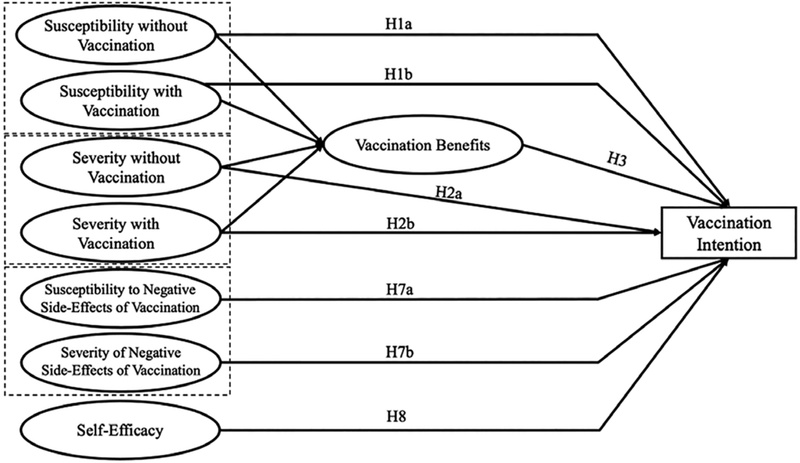
A Modified Model of Health Belief Model to Predict Acceptance of VaccineNote. H4a: Susceptibility without Vaccination → Vaccination Benefits → Vaccination IntentionH4b: Susceptibility with Vaccination → Vaccination Benefits → Vaccination IntentionH5a: Severity without Vaccination → Vaccination Benefits → Vaccination IntentionH5b: Severity with Vaccination → Vaccination Benefits → Vaccination Intention
METHODS
To test the proposed hypotheses, we conducted an online survey measuring the key variables of the modified HBM in the context of COVID-19 bivalent vaccination. The survey was approved by the Institutional Review Board of the first author’s institution. The survey was conducted from January to February 2023, during which the government of South Korea recommended that people who either had not been vaccinated or had not been infected with COVID-19 in the past three months should get a COVID-19 bivalent booster dose to protect against the omicron variant.1 Based on the COVID-19 bivalent vaccine inoculation guideline given by the Korea Disease Control and Prevention Agency, only people who had neither been infected with COVID-19 nor received COVID-19 vaccines in the past three months were recruited as survey participants.
Survey Participants and Procedures
In total, 266 participants (133 females) aged between 20 and 69 years old (M = 44.87, SD = 14.01) were recruited through an online survey firm in Korea (Macromill Embrain) using quota sampling. IRB approval was obtained from the first author's instsitution. After providing informed consent, participants answered questions about their demographic information. Participants were then shown promotional material and instructions providing information about COVID-19 bivalent vaccine boosters, as published by the Korea Disease Control and Prevention Agency and the Ministry of Health and Welfare of Korea. To minimize potential message effects on vaccination acceptance, only basic and limited information was included in the message. Participants then answered questions about their various beliefs about COVID-19 and the bivalent vaccine.
Measures
For most measures, we used an 11-point Likert scale (0 = Not agree at all; 10 = Completely agree); the scale used for measurement is only reported when another scale has been used.
Vaccination Intention
An individual’s intention of getting the COVID-19 bivalent vaccine was measured utilizing a single item based on measures used in previous studies (Guvenc et al., 2016; Li et al., 2022): “Do you have any intention of getting a COVID-19 bivalent vaccine booster dose this winter (by March 2023)? Please indicate your level of agreement with the following single statement: I will get a COVID-19 bivalent vaccine” (M = 3.51, SD = 2.62).
Perceived Susceptibility
Conditional and unconditional perceived susceptibility to COVID-19 were measured using items that were adapted from previous studies (Chung et al., 2022; Patwary et al., 2021). Susceptibility without vaccinations was measured using two items: First, “If I do not get a COVID-19 bivalent vaccine booster dose, I will get infected with COVID-19”, and second, “If I do not get a COVID-19 bivalent vaccine booster dose, the possibility that I will get infected with COVID-19 is [ ]%.” To the second question, participants indicated the perceived likelihood of getting infected with COVID-19 on a 10% interval scale. The responses to these two items were averaged into a composite score, with higher scores indicating a higher perceived susceptibility when not getting vaccination (Cronbach’s α = .76, M = 4.08, SD = 1.92).
To measure susceptibility with vaccination, we used the following statement: “If I get a COVID-19 bivalent vaccine booster dose, I will get infected with COVID-19” and “If I get a COVID-19 bivalent vaccine booster dose, the possibility that I will get infected with COVID-19 is [ ]%” The responses to these two items were averaged into a composite score, with higher scores indicating a higher perceived susceptibility when getting vaccination (Cronbach’s α = .86, M = 4.12, SD = 1.84).
Perceived Severity
The perceived severity of COVID-19 was measured in two ways: severity without vaccination and severity with vaccination. Severity without vaccination was measured using two items: “The severity of symptoms of COVID-19 if you do not get a COVID-19 bivalent vaccine” (0 = Not severe at all; 10 = Completely severe), and “If I do not get a COVID-19 bivalent vaccine, being infected with COVID-19 will be very fatal to me” (0 = Not fatal at all; 10 = Completely fatal). The responses to these two items were averaged into a composite score, with higher scores indicating a higher perceived severity when not getting the vaccination (Cronbach’s α = .86, M = 4.40, SD = 1.87).
Severity with vaccination was measured using two items: “The severity of symptoms of COVID-19 if you get a COVID-19 bivalent vaccine” (0 = Not severe at all; 10 = Completely severe), and “If I get a COVID-19 bivalent vaccine, being infected with COVID-19 will be very fatal to me” (0 = Not fatal at all; 10 = Completely fatal). The responses to these two items were averaged into a composite score, with higher scores indicating a higher perceived severity when getting the vaccination (Cronbach’s α = .87, M = 5.25, SD = 1.91).
Perceived Benefits of Vaccination
Vaccination benefits were measured using three items based on previous studies (Al-Metwali et al., 2021; Wong et al., 2021): “The COVID-19 bivalent vaccine will be helpful to my life and health,” “The COVID-19 bivalent vaccine booster dose will reduce the susceptibility to COVID-19,” and “The COVID-19 bivalent vaccine will reduce the severity of COVID-19.” The responses to these three items were averaged into a composite score, with higher scores indicating a higher perceived severity when getting the vaccination (Cronbach’s α = .89, M = 4.96, SD = 1.81).
Perceived Costs of Vaccination
The two dimensions of perceived costs, susceptibility and severity of vaccination of side-effects, were also measured. Susceptibility to vaccination side-effects was measured with two items based on previous studies (Chung et al., 2022; Mo & Lau, 2015; P. J. Smith et al., 2011): “If I get a COVID-19 bivalent vaccine booster dose, I will experience side-effects” and “If I get a COVID-19 bivalent vaccine booster dose, the possibility that I will experience side-effects is [ ]%” Participants indicated the perceived likelihood of experiencing side-effects on a 10% interval scale. The responses to these two items were averaged into a composite score, with higher scores indicating higher perceived susceptibility to vaccination side-effects (Cronbach’s α = .94, M = 5.20, SD = 2.12).
Severity of vaccination side-effects was measured with two items based on previous studies (Badr et al., 2021; Chung et al., 2022): “The severity of side-effects if you get a COVID-19 bivalent vaccine” (0 = Not severe at all; 10 = Completely severe), and “If I have side-effects after getting the COVID-19 bivalent vaccine, it will be very fatal to me” (0 = Not fatal at all; 10 = Completely fatal). The responses to these two items were averaged into a composite score, with higher scores indicating higher perceived severity to vaccination side-effects (Cronbach’s α = .93, M = 5.44, SD = 2.11).
Self-Efficacy for Vaccination
In both types of questionnaires, self-efficacy for COVID-19 vaccination was measured with two items based on items that were previously used by Ling et al. (2019): “I could get the COVID-19 bivalent vaccine if I wanted to,” and “It is easy for me to get the COVID-19 bivalent vaccine”. The responses to these two items were averaged into a composite score, with higher scores indicating higher self-efficacy for vaccination (Cronbach’s α = .65, M = 5.90, SD = 2.48).
RESULTS
Hypotheses Testing: Modified HBM (H1 to H8)
Proposed hypotheses about the modified HBM (H1 to H8) were tested using structural equation modeling (AMOS 27.0). Bivariate correlations among the observable variables are presented in Table 1. In testing the model, we controlled for the effects of age, sex, COVID-19 infection history, and vaccination history on the variables.

Means, Standard Deviations, and Correlations among the Study Variables(N =266)
Model Fit
The measurement model was tested only for latent variables with multiple indicators, χ2 (91, N = 266) = 228.54, CFI = .95, RMSEA = .08, with 90% CI [.06, .09]. The measurement model showed a reasonable fit (Bentler & Raykov, 2000; Browne & Cudeck, 1993). The full model that includes both measurement and structural models was tested, with the results shown in Figure 2. The direct link between susceptibility without vaccination and vaccination intention was not specified in the proposed model, but it was included to test whether the mediation relationship was either full or partial. The direct links to vaccination intention from susceptibility with vaccination, severity without vaccination, and severity with vaccination were also specified in the model. The full model was tested and found to have a good fit with the data, χ2 (103, N = 266) = 255.65, NFI = .92, CFI = .95, RMSEA = .08, with 90% CI [.06, .09], TLI = .92 (Bentler & Raykov, 2000; Browne & Cudeck, 1993).
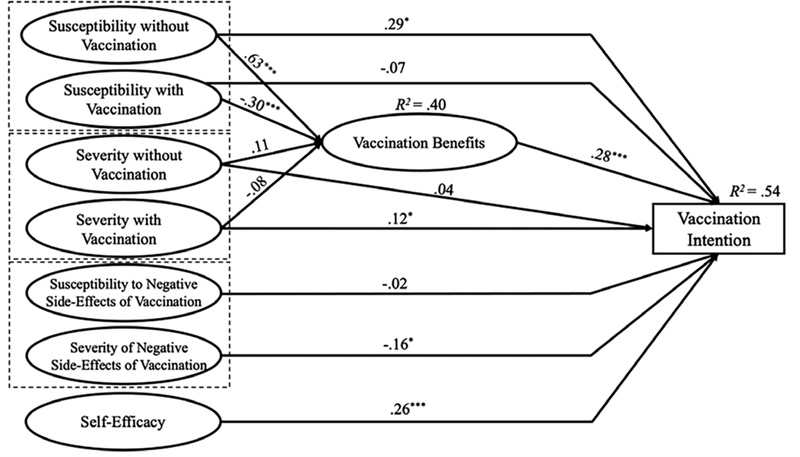
Results of Structural Equation Modeling Analysis of the Modified HBMNote. All latent variables aside from vaccination benefits were measured using two observed indicators, and vaccination benefits was measured using three indicators (standardized factors loadings = [.57, .97]). Vaccination intention was a single-indicator variable. The model fit was χ2 (103, N = 266) = 255.65, NFI = .92, CFI = .95, RMSEA = .08, with 90% CI [.06, .09], TLI = .92 (Bentler & Raykov, 2000; Browne & Cudeck, 1993). The parameters shown on the paths are the standardized regression weights. These parameters were estimated using bootstrapping procedures (2,000 bootstrap samples) and bias-corrected confidence intervals (Hayes & Scharkow, 2013).* p < .05. *** p < .001.
Hypotheses Testing
H1 predicted that vaccination intention is positively associated with (a) susceptibility without vaccination increases, but (b) negatively associated with susceptibility with vaccination. Susceptibility without vaccination was positively associated with vaccination intention (β = .45, SE = 0.18, p <.001). Susceptibility with vaccination had no significant effect on vaccination intention (β = -.14, SE = 0.11, p = .063). H1a was supported but H1b was not supported. H2 predicted that vaccination intention is positively associated with (a) severity without vaccination increases, but (b) negatively associated with severity with vaccination. Neither severity without vaccination (β = .08, SE = 0.12, p = .372) nor severity with vaccination (β = .10, SE = 0.07, p = .069) had a significant effect on vaccination intention. H2a and H2b were not supported.
Supporting, H3, vaccination benefits was positively associated with vaccination intention (β = .28, SE = 0.12, p < .001). To test the mediating effects of perceived vaccination benefits proposed in H4 and H5, we used bootstrapping procedures with 2,000 resamples to generate 95% bias-corrected confidence intervals. H4 predicted the mediating role of vaccination benefits in the relationship (a) between susceptibility without vaccination and vaccination intention and (b) between susceptibility with vaccination and vaccination intention. The indirect effect of susceptibility without vaccination on vaccination intention through vaccination benefits was statistically significant (β = .18, bootstrap SE = .11, 95%, bootstrap CI [0.13, 0.50], p = .010). Given that susceptibility without vaccination had a significant direct effect on vaccination intention, vaccination benefits partially mediated this relationship. The indirect effect of susceptibility with vaccination on vaccination intention through vaccination benefits was statistically significant (β = -.08, bootstrap SE = .06, 95%, bootstrap CI [-0.24, -0.04], p = .010). Given that susceptibility with vaccination did not have a direct effect on vaccination intention, vaccination benefits fully mediated this relationship. Both H4 and H4b were supported.
H5 predicted the mediating role of vaccination benefits in the relationship (a) between severity without vaccination and vaccination intention and (b) between severity with vaccination and vaccination intention. The indirect effect of severity without vaccination on vaccination intention through vaccination benefits was statistically not significant (β = .03, bootstrap SE = .07, 95%, bootstrap CI [-0.05, 0.19], p = .475). H5a was not supported. The indirect effect of severity with vaccination on vaccination intentions through vaccination benefits was not statistically significant (β = -.02, bootstrap SE = .04, 95%, bootstrap CI [-0.11, 0.004], p = .165). H5b was not supported.
H6 predicted that vaccination intention is negatively associated with perceived susceptibility to vaccination side effects. Susceptibility to side effects had no significant effect on vaccination intention (β = -.02, SE = 0.09, p = .732). H6 was not supported. H7 predicted that vaccination intention is negatively associated with the perceived severity of vaccination side effects increases. The severity of side effects was negatively associated with vaccination intention (β = -.16, SE = 0.08, p = .024). H7 was supported. Lastly, self-efficacy had a positive effect on vaccination intention (β = .26, SE = 0.12, p < .001). H8 was supported.
DISCUSSION
Although many studies applied the conventional HBM to predict health behaviors, studies have found inconsistent and limited support for the model (Cho et al., 2013; Harrison et al., 1992). The current study applied Ronis’ (1992) modified HBM to explore how different health beliefs affect individuals’ intentions to receive the COVID-19 vaccination. Unlike many prior vaccination intention studies that applied the conventional HBM, this study measured perceived risk perceptions in two different conditions (i.e., with and without vaccination) and tested the mediating role of perceived benefits. By modifying the conventional HBM, the new model explained 54% of the variance in vaccination intentions.
Aligning with previous studies that highlighted the importance of measuring conditional risk perceptions (e.g., Brewer et al., 2004; H. K. Kim et al., 2022), our findings largely support the utility of assessing inaction-conditional (i.e., perceived susceptibility and severity when preventive actions are not taken) and action-conditional (i.e., perceived susceptibility and severity when preventive actions are taken) risk perceptions in predicting preventive health behaviors. When people expect that their likelihood of getting COVID-19 is higher without taking vaccination, they would be more likely to have higher intention to get vaccinated. Although the relationship between perceived susceptibility with vaccination and vaccination intention was not statistically significant, it showed an expected negative trend, with a p-value of .063.
Contrary to our expectation, the lack of a statistically significant relationship between perceived severity (with and without vaccination) and vaccination intention should be interpreted in light of the current study context. During the months of January and February 2023, when the data for this study was collected, confirmed COVID-19 cases in South Korea surged due to the new Omicron variant. It is possible that individuals are more concerned about whether the vaccine can prevent COVID-19 infection (i.e., susceptibility) rather than alleviating symptoms if they do contract the virus (i.e., severity). We also speculate that with a prolonged experience with COVID-19, the perceived severity of the disease may have a limited or negligible effect on vaccination intention. In fact, our study found a negative association between vaccination intention and the perceived severity of potential side effects from vaccination. In light of these findings, we recommend that health communication efforts to promote vaccination should address different perceptions of severity.
Another notable finding is the mediating effect of perceived benefits. Most studies that applied the conventional HBM did not test this mediating effect of perceived benefits (e.g., Mercadante & Law, 2021; Orji et al., 2012). In the present study, consistent with Ronis’ (1992) modified HBM, perceived benefits of vaccination mediated the relationship between perceived susceptibility (both with and without vaccination) and vaccination intention. Despite Ronis’s efforts to refine HBM's theoretical predictions, few studies have incorporated conditional risk perceptions or the mediating role of perceived benefits in predicting health behaviors. We hope our study provides empirical evidence to support and advocate for the predictions of the modified HBM. Meanwhile, the conceptual definition of perceived benefit includes the reduction of risk expected from performing the recommended behavior. In the original HBM, perceived susceptibility essentially reflects inaction-conditional susceptibility. When both inaction-conditional and action-conditional susceptibility are measured together, the difference between the two can represent the perceived degree of risk reduction.
Ronis modeled these two susceptibility variables as determinants of perceived benefit. In this framework, the two susceptibility variables and perceived benefits may conceptually overlap to some extent, as perceived benefit can encompass risk reduction. However, perceived benefit can also include other advantages beyond risk reductition supporting its use as a distinct variable within the HBM. There remains a need to further refine the conceptual definition of perceived benefit and to develop more valid measures for its assessment.
Additionally, this study incorporated self-efficacy into the modified HBM as a variable to provide a better explanation for differences in health-related behaviors among individuals (Rosenstock et al., 1988). Although many studies found that self-efficacy has a positive effect on vaccination intention (Mehta et al., 2013, Petrovic et al., 2011), studies on vaccination that utilized HBM did not measure the effect of self-efficacy (Badr et al., 2021; Mercadante & Law, 2021; Santos et al., 2017). The present study found that self-efficacy was a powerful predictor of vaccination intention, suggesting that self-efficacy should be included in the modified HBM as a predictor of vaccination acceptance. In practice, ensuring individuals that they are capable of receiving vaccinations would be an effective way to promote vaccination acceptance.
Limitations and Suggestions for Future Study
This study has several limitations that suggest directions for future research. First, the context of the current study has some unique characteristics. For instance, the data was collected during a specific time period when the general public may have already formed beliefs about risk perceptions and vaccination. Collecting data at the onset of the COVID-19 pandemic or during the initial vaccine rollout could have yielded more significant results. This study also focused on vaccination, which is a form of preventive health behavior. Future studies that apply modified HBM could test health promotion behaviors.
Next, this study focused on five individual health beliefs (i.e., perceived susceptibility, perceived severity, perceived benefits, perceived costs, and self-efficacy; Glanz et al., 2015). In addition to these individual beliefs, cues to action, which is a term that refers to strategies to activate health behavior, have also been used in many HBM studies as a predictor of health behaviors (Glanz et al., 2015). Future studies could measure cues to action as a predictor of vaccination intention in the modified HBM to enhance the predictive power.
Another important limitation of this study is the exclusion of vaccine-related information exposure and message effects, which could significantly influence individuals’ risk perception and vaccination intention. Although the modified HBM was applied to predict COVID-19 vaccination intention based on perceived risk, the present study did not account for exposure to relevant messages or information. In particular, the extent of exposure to vaccine-promoting messages disseminated by government or public health agencies through mass media or social media, as well as exposure to messages highlighting potential side effects of the vaccine, may shape how individuals perceive the risks associated with COVID-19 and their intention to be vaccinated. Interpersonal communication about such topics may also play a crucial role in shaping beliefs and behavioral intentions. Future research should apply the modified HBM while incorporating variables that measure the degree and nature of message exposure—both supportive and critical—to better understand their impact on perceived risk and vaccination behavior.
As observed in many other countries, the decision to receive a COVID-19 vaccine in South Korea was not solely based on medical or scientific considerations but was, in part, shaped by political orientations. The pandemic and associated public health measures, including vaccination, became subjects of political discourse, with different political groups advancing contrasting arguments. Consequently, some individuals formed vaccine-related beliefs and attitudes based on their political orientation or their level of trust in the government (Baek et al., 2022; Fridman et al., 2021). Political orientation has been shown to influence not only vaccine attitudes but also compliance with public health guidelines (Barrios & Hochberg, 2021). Given this context, studies employing the modified health belief model to predict vaccination intentions should consider political orientation as a potential confounding variable. However, the present study did not include any measure of political orientation and thus was unable to statistically control its potential influence. Future studies applying the modified HBM to COVID-19 or other pandemic-related behaviors should incorporate political orientation to enhance the robustness of their findings.
The HBM was first proposed in the 1950s and has continued to make significant contributions to health communication research and the design of health campaigns for over six decades. Like all scientific models, the HBM has evolved over time, shaped by new empirical findings and developments in adjacent theoretical frameworks. This process of ongoing refinement through self-reflection and scholarly debate is not only natural but also desirable—and indeed essential—for the advancement of knowledge (Chung, 2024; Kuhn, 1960). Within this context, Ronis’s (1992) revision of the HBM stands out as particularly noteworthy. We applied Ronis’s model to behavioral responses to infectious diseases and found empirical evidence supporting its validity. We look forward to meaningful scholarly dialogue comparing Ronis’s model to the traditional HBM as such engagement can deepen our understanding of health-related behaviors and enhance the model’s predictive utility.
Disclosure Statement
No potential conflict of interest was reported by the author.
Ethics Approval Statement
This study was approved by the first author’s University Institutional Review Board.
Data Availability Statement
The data that support the findings of this study are available on request from the corresponding author.
Participant consent statement
Before taking the survey, participants were presented with informed consent form in which we explained the purpose, procedures, benefits, and risk of the survey.
References
-
Al-Metwali, B. Z., Al-Jumaili, A. A., Al-Alag, Z. A., & Sorofman, B. (2021). Exploring the acceptance of COVID-19 vaccine among healthcare workers and general population using Health Belief Model. Journal of Evaluation in Clinical Practice, 27(5), 1112–1122.
[https://doi.org/10.1111/jep.13581]

-
Badr, H., Zhang, X., Oluyomi, A., Woodard, L. D., Adepoju, O. E., Raza, S. A., & Amos, C. I. (2021). Overcoming COVID-19 vaccine hesitancy: Insights from an online population-based survey in the United States. Vaccines, 9(10), 1100.
[https://doi.org/10.3390/vaccines9101100]
- Baek, Y. M., Lee, M., & Choi, D. H. (2022). Political polarization and COVID-19 vaccine hesitancy in South Korea. Korean Journal of Communication and Information, 100(2), 123–150.
-
Bandura, A. (1977). Self-efficacy: Toward a unifying theory of behavioral change. Psychological Review, 84(2), 191–251.
[https://doi.org/10.1037/0033-295X.84.2.191]
-
Barrios, J. M., & Hochberg, Y. (2021). Risk perception through the lens of politics in the time of the COVID-19 pandemic. Journal of Financial Economics, 142(2), 862–879.
[https://doi.org/10.1016/j.jfineco.2020.05.008]
-
Bentler, P. M., & Raykov, T. (2000). On measures of explained variance in nonrecursive structural equation models. Journal of Applied Psychology, 85(1), 125–131.
[https://doi.org/10.1037/0021-9010.85.1.125]
-
Brewer, N. T., Weinstein, N. D., Cuite, C. L., & Herrington, J. E. (2004). Risk perceptions and their relation to risk behavior. Annals of Behavioral Medicine, 27(2), 125–130.
[https://doi.org/10.1207/s15324796abm2702_7]
- Browne, M. W., & Cudeck, R. (1993). Alternative ways of assessing model fit. Sage Publications.
-
Carpenter, C. J. (2010). A meta-analysis of the effectiveness of health belief model variables in predicting behavior. Health Communication, 25(8), 661–669.
[https://doi.org/10.1080/10410236.2010.521906]
- CDC. (2024a). CDC Museum COVID-19 timeline. https://www.cdc.gov/museum/timeline/covid19.html
- CDC. (2024b). Building confidence in COVID-19 vaccines. https://www.cdc.gov/vaccines/covid-19/vaccinate-with-confidence.html
-
Cho, H., Lee, J. S., & Lee, S. (2013). Optimistic bias about H1N1 flu: Testing the links between risk communication, optimistic bias, and self-protection behavior. Health Communication, 28, 146–158.
[https://doi.org/10.1080/10410236.2012.664805]
-
Chung, S. (2024, December 30). Advancing communication science: Reflections on my editorship at Asian Communication Research. Asian Communication Research, 21(3), 5−14.
[https://doi.org/10.20879/acr.2024.21.032]
-
Chung, S., Kim, Y., & Shim, M. (2022). Types of perceived risk likelihood and prediction of preventive behaviors: Absolute vs. comparative, and conditional vs. unconditional risk perceptions. Korean Journal of Journalism & Communication Studies, 66(2), 155-187.
[https://doi.org/10.20879/kjjcs.2022.66.2.004]
-
Dean, N. E., & Halloran, M. E. (2022). Protecting the herd with vaccination. Science, 375(6585), 1088–1089.
[https://doi.org/10.1126/science.abo2959]
-
Farquharson, L., Noble, L. M., Barker, C., & Behrens, R. H. (2004). Health beliefs and communication in the travel clinic consultation as predictors of adherence to malaria chemoprophylaxis. British journal of health psychology, 9(2), 201-217.
[https://doi.org/10.1348/135910704773891050]
-
Fauci, A. S. (2001). Infectious diseases: Considerations for the 21st century. Clinical Infectious Diseases, 32(5), 675–685.
[https://doi.org/10.1086/319235]
-
Fridman, A., Gershon, R ., & Gneezy, A. (2021). COVID-19 and vaccine hesitancy: A longitudinal study. PLoS ONE, 16(4), e0250123.
[https://doi.org/10.1371/journal.pone.0250123]
- Glanz, K., Rimer, B. K., & Viswanath, K. (Eds.). (2015). Health behavior: Theory, research, and practice. John Wiley & Sons.
-
Guvenc, G., Seven, M., & Akyuz, A. (2016). Health belief model scale for human papilloma virus and its vaccination: Adaptation and psychometric testing. Journal of Pediatric and Adolescent Gynecology, 29(3), 252–258.
[https://doi.org/10.1016/j.jpag.2015.09.007]
-
Harrison, J. A., Mullen, P. D., & Green, L. W. (1992). A meta-analysis of studies of the health belief model with adults. Health Education Research, 7(1), 107–116.
[https://doi.org/10.1093/her/7.1.107]
-
Janz, N. K., & Becker, M. H. (1984). The health belief model: A decade later. Health Education Quarterly, 11(1), 1–47.
[https://doi.org/10.1177/109019818401100101]
- Johns Hopkins University. (2023). Coronavirus resource center. https://coronavirus.jhu.edu/
-
Karl, K. A., Peluchette, J. V., & Aghakhani, N. (2022). Virtual work meetings during the COVID-19 pandemic: The good, bad, and ugly. Small Group Research, 53(3), 343–365.
[https://doi.org/10.1177/10464964211015286]
-
Kaufert, J. M., Rabkin, S. W., Syrotuik, J., Boyko, E., & Shane, F. (1986). Health beliefs as predictors of success of alternate modalities of smoking cessation: results of a controlled trial. Journal of Behavioral Medicine, 9(5), 475-489.
[https://doi.org/10.1007/BF00845134]
-
Kim, H. K., Chung, S., Kim, Y., & Lee, S. (2022). Conditional risk perception and protection behavior: Testing the behavior motivation hypothesis and the risk reappraisal hypothesis. Social Science & Medicine, 298, 114868.
[https://doi.org/10.1016/j.socscimed.2022.114868]
-
Kim, Y., & Chung, S. (2022). Risk-likelihood perceptions and preventive behaviors against infectious diseases: Testing different types of risk-likelihood perceptions in the context of MERS and COVID-19. Health Communication, 38(10), 2221–2234.
[https://doi.org/10.1080/10410236.2022.2059831]
- Korea Disease Control and Prevention Agency. (2023, January 5). 2022년 53주차 주간 건강과 질병_주요 감염병 통계(2023. 1. 5.) [Weekly Health and Disease Report, Week 53 of 2022: Major Infectious Disease Statistics (January 5, 2023)]. https://www.kdca.go.kr/board/board.es?mid=a20601010100&bid=0024
-
Kowalski, R. M., & Black, K. J. (2021). Protection motivation and the COVID-19 virus. Health Communication, 36(1), 15–22.
[https://doi.org/10.1080/10410236.2020.1847448]
- Kuhn. T. S. (1970). The structure of scientific revolutions (2nd ed.). University of Chicago Press.
-
Li, Z., Ji, Y., & Sun, X. (2022). The impact of vaccine hesitation on the intentions to get COVID-19 vaccines: The use of the health belief model and the theory of planned behavior model. Frontiers in Public Health, 10, 882909.
[https://doi.org/10.3389/fpubh.2022.882909]
-
Ling, M., Kothe, E. J., & Mullan, B. A. (2019). Predicting intention to receive a seasonal influenza vaccination using protection motivation theory. Social Science & Medicine, 233, 87–92.
[https://doi.org/10.1016/j.socscimed.2019.06.002]
-
Ma, Z., & Ma, R. (2022). Predicting intentions to vaccinate against COVID-19 and seasonal flu: The role of consideration of future and immediate consequences. Health Communication, 37(8), 952–961.
[https://doi.org/10.1080/10410236.2021.1877913]
-
Mehta, P., Sharma, M., & Lee, R. C. (2013). Designing and evaluating a health belief model-based intervention to increase intent of HPV vaccination among college males. International Quarterly of Community Health Education, 34(1), 101–117.
[https://doi.org/10.2190/IQ.34.1.h]
-
Mercadante, A. R., & Law, A. V. (2021). Will they, or won’t they? Examining patients’ vaccine intention for flu and COVID-19 using the health belief model. Research in Social and Administrative Pharmacy, 17(9), 1596–1605.
[https://doi.org/10.1016/j.sapharm.2020.12.012]
-
Mo, P. K. H., & Lau, J. T. F. (2015). Influenza vaccination uptake and associated factors among elderly population in Hong Kong: The application of the health belief model. Health Education Research, 30(5), 706–718.
[https://doi.org/10.1093/her/cyv038]
-
Nazione, S., Perrault, E., & Pace, K. (2021). Impact of information exposure on perceived risk, efficacy, and preventative behaviors at the beginning of the COVID-19 pandemic in the United States. Health Communication, 36(1), 23–31.
[https://doi.org/10.1080/10410236.2020.1847446]
-
Orji, R., Vassileva, J., & Mandryk, R. (2012). Towards an effective health interventions design: An extension of the health belief model. Online Journal of Public Health Informatics, 4(3).
[https://doi.org/10.5210/ojphi.v4i3.4321]
-
Padamsee, T. J., Bond, R. M., Dixon, G. N., Hovick, S. R., Na, K., Nisbet, E. C., Wegener, D. T., & Garrett, R. K. (2022). Changes in COVID-19 vaccine hesitancy among Black and White individuals in the US. JAMA Network Open, 5(1), e2144470.
[https://doi.org/10.1001/jamanetworkopen.2021.44470]
-
Park, T., Ju, I., Ohs, J. E., & Hinsley, A. (2020). Optimistic bias and preventive behavioral engagement in the context of COVID-19. Research in Social and Administrative Pharmacy, 17(1), 1859–1866.
[https://doi.org/10.1016/j.sapharm.2020.06.004]
-
Patwary, M. M., Bardhan, M., Disha, A. S., Hasan, M., Haque, M. Z., Sultana, R., Hossain, M. R., Browning, M. H. E. M., Alam, M. A., & Sallam, M. (2021). Determinants of COVID-19 vaccine acceptance among the adult population of Bangladesh using the health belief model and the theory of planned behavior model. Vaccines, 9(12), 1393.
[https://doi.org/10.3390/vaccines9121393]
-
Petrovic, K., Burney, S., & Fletcher, J. (2011). The relationship of knowledge, health value and health self-efficacy with men’s intentions to receive the human papillomavirus (HPV) vaccine. Journal of Health Psychology, 16(8), 1198–1207.
[https://doi.org/10.1177/1359105311402861]
- Public Relations Management Team of COVID-19 Vaccination Response Promotion Team. (2022, December 28). (For the elderly) Posters for staying health during the winter (Moderna BA.4/5 was added). Korea Disease Control and Prevention Agency. https://www.kdca.go.kr/gallery.es?mid=a20503020000&bid=0003&b_list=9&act=view&list_no=145966&nPage=1&vlist_no_npage=2&keyField=&keyWord=&orderby=
-
Ronis, D. L. (1992). Conditional health threats: Health beliefs, decisions, and behaviors among adults. Health Psychology, 11(2), 127–134.
[https://doi.org/10.1037/0278-6133.11.2.127]
-
Rosenstock, I. M. (1966). Why people use health services. The Milbank Memorial Fund Quarterly, 44(3), 94–127.
[https://doi.org/10.2307/3348967]
-
Rosenstock, I. M., Strecher, V. J., & Becker, M. H. (1988). Social learning theory and the health belief model. Health Education Quarterly, 15(2), 175–183.
[https://doi.org/10.1177/109019818801500203]
-
Santos, A. J., Kislaya, I., Machado, A., & Nunes, B. (2017). Beliefs and attitudes towards the influenza vaccine in high-risk individuals. Epidemiology & Infection, 145(9), 1786–1796.
[https://doi.org/10.1017/S0950268817000814]
-
Sheeran, P., Maki, A., Montanaro, E., Avishai-Yitshak, A., Bryan, A., Klein, W. M., Miles, E., & Rothman, A. J. (2016). The impact of changing attitudes, norms, and self-efficacy on health-related intentions and behavior: A meta-analysis. Health Psychology, 35(11), 1178–1188.
[https://doi.org/10.1037/hea0000387]
-
Smith, N. A., Ley, P., Seale, J. P., & Shaw, J. (1987). Health beliefs, satisfaction, and compliance. Patient Education and Counseling, 10, 279–286.
[https://doi.org/10.1016/0738-3991(87)90129-7]
-
Smith, P. J., Humiston, S. G., Marcuse, E. K., Zhao, Z., Dorell, C. G., Howes, C., & Hibbs, B. (2011). Parental delay or refusal of vaccine doses, childhood vaccination coverage at 24 months of age, and the health belief model. Public Health Reports, 126(2_suppl), 135–146.
[https://doi.org/10.1177/00333549111260S215]
-
Sudharsanan, N., Favaretti, C., Hachaturyan, V., Bärnighausen, T., & Vandormael, A. (2022). Effects of side-effect risk framing strategies on COVID-19 vaccine intentions: A randomized controlled trial. Elife, 11, e78765.
[https://doi.org/10.7554/eLife.78765]
-
van der Velde, F. W., Hooykaas, C., & van der Pligt, J. (1996). Conditional versus unconditional risk estimates in models of AIDS-related risk behaviour. Psychology and Health, 12(1), 87–100.
[https://doi.org/10.1080/08870449608406924]
-
Watson, O. J., Barnsley, G., Toor, J., Hogan, A. B., Winskill, P., & Ghani, A. C. (2022). Global impact of the first year of COVID-19 vaccination: A mathematical modelling study. The Lancet Infectious Diseases, 22(9), 1293–1302.
[https://doi.org/10.1016/S1473-3099(22)00320-6]
- WHO. (2023, May 15). Coronavirus. World Health Organization. https://www.who.int/health-topics/coronavirus#tab=tab_1
-
Williams, L., Rasmussen, S., Kleczkowski, A., Maharaj, S., & Cairns, N. (2015). Protection motivation theory and social distancing behaviour in response to a simulated infectious disease epidemic. Psychology, Health & Medicine, 20(7), 832–837.
[https://doi.org/10.1080/13548506.2015.1028946]
-
Wong, M. C., Wong, E. L., Huang, J., Cheung, A. W., Law, K., Chong, M. K., Ng, R. W., Lai, C. K., Boon, S. S., Lau, J. T., Chen, Z., & Chan, P. K. (2021). Acceptance of the COVID-19 vaccine based on the health belief model: A population-based survey in Hong Kong. Vaccine, 39(7), 1148–1156.
[https://doi.org/10.1016/j.vaccine.2020.12.083]
-
Wu, F., Yuan, Y., Deng, Z., Yin, D., Shen, Q., Zeng, J., Xie, Y., Xu, M, Yang, M., Jiang, S., Zhang, C., Lu, H., & Sun, C. (2022). Acceptance of COVID‐19 booster vaccination based on the protection motivation theory: A cross‐sectional study in China. Journal of Medical Virology, 94(9), 4115–4124.
[https://doi.org/10.1002/jmv.27825]
-
Yıldırım, M., Geçer, E., & Akgül, Ö. (2020). The impacts of vulnerability, perceived risk, and fear on preventive behaviours against COVID-19. Psychology, Health & Medicine, 26(1), 35–43.
[https://doi.org/10.1080/13548506.2020.1776891]