
How Relative Information Preferences of TV and YouTube Users Affect Political Participation: Mediation Effects of Political News Consumption and Fact-Checking and the Moderated Mediation Effects of Generation
 ; Yongkuk Chung1
; Se Jung Kim2
; Yongkuk Chung1
; Se Jung Kim2
Copyright ⓒ 2026 by the Korean Society for Journalism and Communication Studies
Abstract
This study examined how relative information preference on TV and YouTube affects political participation in South Korea, focusing on the mediating roles of political news consumption and fact-checking and the moderated mediation role of generational differences. Using data from the 2022 Korean Media Survey (n = 5,391), the current study tested a moderated mediation model comparing legacy media (TV) with platform media (YouTube) across generations. Results revealed that TV information preference directly increased political participation, whereas YouTube information preference did not. However, both TV and YouTube information preferences indirectly enhanced political participation through political news consumption and fact-checking. Generational differences moderated these indirect effects: Generation Y showed stronger mediation effects than Baby Boomers, driven by higher political news consumption, more frequent fact-checking, and a greater preference for informational content on YouTube relative to other genres. These findings extend prior research on singlemedium information preference by comparing legacy and platform media within a unified framework and by identifying the mechanisms through which relative information preference leads to political participation. The study also highlights that generational moderation of these mediating pathways manifests differently across TV and YouTube, emphasizing the importance of platform-specific analyses in understanding political participation.
Keywords:
relative information preference, TV, YouTube, political news consumption, fact-checking, political participationPolitical participation is one of the core principles of democracy. It plays a vital role in fostering responsible citizens, social change, and improvement. In this regard, many scholars have focused on whether media can help or hinder people’s ability to be informed and promote political participation (e.g., Andersen et al., 2021; Bolton et al., 2013; Kim, Chen, et al., 2013; Lee et al., 2022; Melo & Stockemer, 2014; Sotirovic & McLeod, 2001). However, research on the relationship between media use and political participation has been inconsistent. Yang and Song (2014) point out that the inconsistent findings on the relationship between media use and political participation are due to the lack of consideration of media users’ individual dispositions and attitudes (Yang & Song, 2014). In other words, the relationship between media use and political participation should not only consider the amount of media used, but also the personal attitudes, interests, and characteristics of media users. Accordingly, Yang and Song (2014) suggest that relative information preference (i.e., how much a person prefers information or news over other genres) is an important variable that affects political news-seeking behavior and political participation. In addition, they distinguished between the psychological characteristics of individuals and motivational factors in terms of the use and gratification, explaining relative information preference as an attitudinal or dispositional dimension of media users.
In a multimedia environment, various media platforms and recommendation algorithms provide content that matches the user’s preferences, allowing media users to selectively acquire information or news. The selection behavior that symbolizes these individual preferences may change with variations in media content or over time. Therefore, it is more appropriate to understand the relative information preference as a preference for information or news compared to other genres based on the use of different media types rather than a fixed dispositional dimension of individuals. Furthermore, the media landscape is constantly changing due to advances in digital technology and the widespread use of the internet. This not only shows that users’ consumption behavior varies depending on the type of media, but also implies that users have different preferences for specific genres for different types of media. However, there is very little research on how genre preference affects political participation as an individual attitude dimension. Yang and Song (2014) tested the mediating effect of political news-seeking behavior by emphasizing the importance of ‘how one accesses preferred information content’ in the process of how relative information preferences in the media lead to political participation. Also, it is necessary to consider ‘how people use the information they receive.’
Moreover, politically oriented people tend to rely on fact-checking to guide them when there is uncertainty about the clarity of information and their position (Amazeen, 2015). Fact-checking is defined as the act of verifying information using various media to confirm the truthfulness and accuracy of information (Amazeen, 2015; Fridkin et al., 2015). It is an important tool for verifying and analyzing the accuracy of political claims or media articles based on objective evidence. However, existing studies lack research on the impact of fact-checking behavior on political participation. Based on research findings that perceptions of fake news have a negative impact on political participation, further research is needed on how fact-checking can be used to verify the accuracy of information and promote active political participation. In addition, previous studies have examined the direct relationship between relative information preference for media and political news consumption (Kim, Chen, et al., 2013; Yang & Song, 2014), political news consumption, and political participation (Dilliplane, 2011; W. Zhang, 2012). However, the role of political news consumption and fact-checking in the relationship between relative information preference for media and political participation remains unexplored. Therefore, this study aims to examine the relationships between relative information preference for media and political participation using mediating variables of political news consumption and fact-checking.
Lastly, it is necessary to examine the generational differences in the relationship between relative information preference for media and political participation. This is because generational differences may affect the relationship between political news consumption (Boulianne & Shehata, 2022; Mitchell et al., 2015) and political participation (Melo & Stockemer, 2014). Generations can be categorized through demographic characteristics and age, which can lead to differences in media use and political participation. Generation is also a sociostructural variable, and media preferences and usage can change over time, influencing individuals’ ideas, values, and political participation behaviors (Kim, Hsu, et al., 2013; Quintelier & Hooghe, 2011). Understanding these generational differences is important for identifying the mediating effects of political news consumption and fact-checking. This study categorizes Generation Y, Generation X, and Baby Boomers according to their birth years and explores whether relative information preferences for media have different effects on political news consumption and political participation through fact-checking.
Taken together, the purpose of this study is to test the indirect effects of relative preferences for news and information in different media consumption environments on political news consumption, fact-checking, and political participation by comparing TV and YouTube. The present study also examined how these indirect effects vary across generations. By comparing relative information preferences on TV and YouTube, this study aims to extend the scope of previous studies, which have been limited to single-media analyses, and to reveal how the relationship between media genre preferences and political participation differs across media.
Theoretical Discussion
The media environment has changed dramatically due to the rapid development of media technology. In the past, information was mainly obtained through traditional media such as TV, radio, and newspapers, but with the spread of the Internet, users can obtain information in a more personalized and accessible way through various media (Andersen et al., 2021). YouTube, in particular, has an overwhelmingly high usage rate due to its outstanding advantages as a free platform that does not require registration or subscription. Thus, unlike TV users who mainly consume news (Ksiazek et al., 2010), social media users, such as those on YouTube, can prefer entertainment content (Prior, 2005; Scheufele & Nisbet, 2002). These findings show that media use behavior varies depending on the media type.
In order to understand media use behavior for various media content, many previous studies have raised the importance of attitudes toward media. Lehmann (1971), through the Choice Model, argued that TV viewers have preferences for program characteristics and select programs that they believe will best satisfy those preferences. In addition, according to the uses and gratifications theory (Katz et al., 1973), media users selectively utilize media to satisfy their specific needs and seek to obtain their satisfaction. Prior (2005) suggests that content preferences strongly influence content selection, and these preferences are reinforced when users have access to different types of media. From these perspectives, media users identify the content that they are most interested in and prefer, and are more likely to seek out and consume content in that category (Heeter, 1985). These arguments illustrate the need to prioritize user interests and preferences to understand media use behavior.
Several scholars have emphasized the importance of media users’ genre preferences and linked them to political outcomes. Most notably, Prior (2005, 2007) introduced the concept of Relative Entertainment Preference, a measure that captures the relative strength of informational versus entertainment orientations within an individual.
Relative entertainment preference is obtained by directly assessing the position of news in comparison to other genres, thereby reflecting a clear news–entertainment contrast. Building on a similar logic but shifting the focus to the inverse concept, preference for information rather than entertainment, Yang and Song (2014) approached the construct from a different angle. Taking into account the convergence of information and entertainment in today’s multichannel multimedia environment, as well as the structural constraints of the secondary datasets available to them, they proposed the concept of relative information preference, which reflects the comparative dominance of informational orientation. Rather than focusing solely on the rank of news, their approach assigns predetermined informativeness scores to various genres and constructs an index by weighting these scores according to respondents’ ranked choices. Relative information preference is thus inferred indirectly through an aggregated informativeness score. Following Yang and Song (2014), the present study defines relative information preference as the comparative dominance of informational preference within the same individual.
While relative information preference is theoretically conceptualized in prior research as a relatively stable orientation (Prior, 2007), the present study does not directly measure that disposition. Instead, we focus on its observable behavioral expression within platform-specific choice structures. Television’s editorial curation and news-oriented programming can facilitate frequent and incidental exposure to informational content (Scheufele & Nisbet, 2002), allowing underlying preferences to be more readily activated. In contrast, YouTube’s algorithmic personalization tends to promote entertainment-oriented content, which means that exposure to political information requires stronger user motivation (Kim, Chen, et al., 2013; Prior, 2005; Scheufele & Nisbet, 2002).
Therefore, assessing relative information preference separately for TV and YouTube does not assume that individuals possess different preferences across platforms. Rather, it acknowledges that the same informational orientation may be behaviorally expressed differently under distinct media affordances and content architectures. This platform-specific operationalization allows us to examine how informational prioritization within each environment is associated with political participation outcomes. Although prior studies have examined genre preferences (e.g., Prior, 2005; Quintelier & Hooghe, 2011) or media effects on political participation independently (e.g., Dilliplane, 2011; Kenski & Stroud, 2006), fewer studies have investigated how relative informational prioritization within distinct media environments relates to political participation in a high-choice multimedia context. Accordingly, this study examines the effect of relative information preference on political participation separately in TV and YouTube environments.
Previous studies have focused on specific media to test the effect of relative preferences for entertainment content on political participation. For example, Prior (2005) argued that users’ preference for entertainment content on TV leads to passive political participation behavior. Kim, Chen, et al. (2013) also found that greater access to entertainment content relative to news genres on the Internet was associated with less political participation. Scheufele and Nisbet (2002) found that people who use the Internet for entertainment purposes may be less politically engaged than those who use the Internet for information seeking. However, these studies mainly focused on the relative amount of preferential use of entertainment content. Yang and Song (2014) emphasized that when relative preferences for specific content influence civic participation, these preferences are not simply the result of behavioral exposure to the content, but rather a preceding factor that influences attitudes. They also argued that relative information preference is an attitudinal or dispositional dimension of media users, distinguishing it from the psychological characteristics of individuals and motivational factors from a uses and gratifications perspective. Of course, information preference can be viewed as a personality trait, but it seems to be more similar to the concept of attitude, given its variable nature that changes over time and across situations. Specifically, over time, individuals go through different experiences and events, and these experiences can change their preferences for different news or political information. In addition, in today’s media environment, various media platforms can provide a rich and diverse range of content, including information or news, and recommendation algorithms can tailor content to a user’s personal preferences. Users may selectively acquire information or news based on the content provided by each platform, and these choices may change over time and with changes in media content. In other words, media users’ preferences for information or news may be influenced by personal experience, media environment, and other factors. Besides, individual content preferences may vary for each media type.
At the attitudinal level, Yang and Song (2014) conducted an investigation to examine the relationship between preferences for different media genres and civic engagement. They found that individuals with higher preferences for news and information had lower levels of civic engagement, while those who were more receptive to and more knowledgeable about various political and social issues from TV had higher levels of civic engagement. Although previous studies have confirmed that relative information preference for media has a significant impact on civic participation, these studies did not distinguish between different types of civic participation through factor analysis. Instead, they indexed civic participation based on the level of participation, using several different scales (voting, writing and scraping internet posts, and social/political activities) based on the level of participation. This approach differs from previous studies on civic participation (e.g., Ksiazek et al., 2010) in that it integrates civic participation into a single index.
The present study suggests that media users who prefer news or informational content are more likely to be interested in politics and social issues, and through such content, they may acquire political knowledge, become more informed about current events and social issues, and be more likely to engage in civic engagement activities. In other words, how users use media is important in the relationship between relative information preference for media and civic engagement. Therefore, this study aims to examine individual media use behavior in the relationship between TV and YouTube users’ relative information preferences and civic engagement. In addition, we set the following research hypothesis based on the judgment that existing studies have shown that relative information preference for media affects political participation.
- Hypothesis 1. Relative information preferences for media TV (H1-a) and YouTube (H1-b) will influence political participation.
While some studies have confirmed the relationship between relative information preferences for media and political participation, they have mainly focused on the dimension of preferred use of specific content (Kim, Chen, et al., 2013; Prior, 2005; Quintelier & Hooghe, 2011) or preferred attitudes toward a single content (Yang & Song, 2014). In other words, a comprehensive understanding of how informational preferences for media type interact with political participation in different media consumption environments is still limited, and more research is needed. In particular, it is necessary to study how media users who prefer informational content over entertainment content on platforms such as YouTube utilize the opportunity to be exposed to political information and how it affects their political participation.
Given the lack of consideration in the literature on how the relative informational preferences for TV and YouTube may promote political participation in a multimedia environment, this study focuses on the role of individual media use behaviors, particularly political news consumption and fact-checking.
Based on the previous discussion, a media user’s preference for a particular piece of content has a significant impact on an individual’s content consumption. Media users with higher relative information preferences are generally more likely to be interested in and spend more time on political news. In particular, Kim, Chen, et al. (2013) argued that media users who favor news over entertainment content are more likely to pay attention to and seek out news and information even though they encounter it accidentally online. Users with a high information preference are interested in social and political issues, have a deeper knowledge and understanding of these issues, and are skilled at finding and analyzing political situations. Therefore, we can expect that the higher the relative information preference of media users, the more likely they are to consume informative or political news.
In addition, previous studies have consistently investigated the relationship between political news consumption and political participation. For example, W. Zhang (2012) studied the impact of political news consumption on political participation among Singaporean and Taiwanese users and found that the more news about politics people consume, the more they engage in political behavior. In particular, access to and use of partisan news with a similar political orientation to oneself tended to contribute to political participation (Dilliplane, 2011). Based on these findings, it can be inferred that media users’ consumption of political news can promote political participation.
In this context, Yang and Song (2014) also tested the mediating effect of news-seeking behavior on the effect of content preferences on civic engagement. They measured information-seeking behavior with items that included news media and interpersonal communication. However, since these questions include both media use and interpersonal communication, it is difficult to determine which aspect is more important in terms of its impact on political participation.
Accordingly, this study aims to verify political news consumption, which refers to the act of individuals accessing and utilizing political news through the media, rather than information-seeking behavior, including interpersonal communication.
Political news consumption is generally considered a key antecedent of citizens’ political participation (Bolton et al., 2013; Dilliplane, 2011; W. Zhang, 2012). However, in today’s high-choice media environment characterized by abundant and often conflicting information, exposure alone does not ensure participation. How individuals process and evaluate political information plays a critical role (Lim et al., 2021).
In one study, fact-checking was defined as an individual's behavior of verifying information through various media when faced with news or information whose authenticity and accuracy are questionable (Lim et al., 2021). Furthermore, fact-checking was defined as the act of verifying and analyzing the accuracy of political claims or media articles based on objective evidence using various methods (D. Zhang et al., 2022). Based on these existing studies, this study defines fact-checking as the act of doubting the accuracy or authenticity of news received through the media and actively checking the facts.
The theoretical nexus between fact-checking and political participation, however, is marked by a nuanced tension. From a pessimistic perspective, heightened awareness of misinformation may paradoxically precipitate ‘political withdrawal.’ Recent studies show that pervasive “fake news” discourse may erode the foundations of democratic participation. When citizens are repeatedly exposed to elite rhetoric that amplifies the threat of misinformation, it can cultivate a broader sense of cynicism (Jones-Jang et al., 2021), diminish the perceived credibility of news, particularly when individuals encounter contradictory fact-checking messages (Van Der Meer et al., 2023), and heighten distrust toward media and political institutions (Van Duyn & Collier, 2019). Crucially, these studies indicate that while fact-checking aims to validate information, the mere perception that any online information could be false can harm public trust. Furthermore, some interventions designed to counter misinformation have failed to improve individuals’ ability to discriminate between true and fake news (Modirrousta-Galian & Higham, 2023). This atmosphere of doubt may lead individuals to disengage from the political process under the assumption that objective truth is unattainable (York et al., 2020).
In contrast to such passive cynicism, this study conceptualizes active fact-checking as a motivated and cognitively engaged mode of information processing. We argue that rather than suppressing engagement, the act of verification serves as a psychological bridge that translates skepticism into mobilization through three distinct mechanisms: First, fact-checking increases epistemic political efficacy, defined as confidence in one’s ability to distinguish political facts from falsehoods (Pingree, 2011). Higher epistemic political efficacy encourages active evaluation of political information and expressive political behaviors, including sharing opinions and engaging in political discussion (Pingree et al., 2013). Second, when misinformation challenges political identity or group interests, fact-checking functions as an identity-protective response that motivates corrective political action (Chia et al., 2024; Edgerly et al., 2020). Third, fact-checking is more prevalent among individuals with high political interest (Amazeen et al., 2019; Robertson et al., 2020). Rather than disengaging due to skepticism, these users actively seek additional information and engage in fact-based discussions (Brandtzaeg et al., 2018), which strengthens their motivation to influence political outcomes (Kenski & Stroud, 2006; Levy & Akiva, 2019). Moreover, misinformed individuals may nevertheless participate actively (Hochschild & Einstein, 2015) because anger and threat perception can serve as powerful motivators for political action.
In sum, unlike passive exposure, which may reduce individuals’ willingness to engage, active fact-checking transforms cognitive effort into political participation that takes place through digital media channels. Based on this theoretical logic, we posit that fact-checking is the key psychological mechanism that translates relative media information preference into political participation, especially in digital environments where misinformation is salient and contested. Specifically, individuals with a stronger preference for informational content are more likely to consume political news, which triggers the motivated process of fact-checking, ultimately culminating in active participation. However, prior studies have largely focused on direct effects, neglecting the multi-step cognitive processes underlying participation. To address these limitations, this study aims to examine the relationship between relative information preference for media and political news consumption, which in turn leads to fact-checking behavior, resulting in active political participation eventually. In addition, considering the differences in relative information preferences between TV and YouTube and the fact that political news consumption and fact-checking behaviors may differ depending on the media, it is necessary to examine the mediating effects of political news consumption and fact-checking by media type.
- Hypothesis 2. Relative information preference for TV will positively and indirectly influence political participation through (a) political news consumption and (b) fact-checking.
- Hypothesis 3. Relative information preference for YouTube will positively and indirectly influence political participation through (a) political news consumption and (b) fact-checking.
This study assumes that relative information preferences for media affect political participation and the mediating effects of political news consumption and fact-checking on this relationship. However, this relationship may differ across generational groups. In particular, generational groups may vary in their demand for political information (Andersen et al., 2021; Mitchell et al., 2015), media use purposes, and information credibility (Marchi, 2012; Westerman et al., 2014). Furthermore, age is a crucial sociodemographic variable, and media preferences and usage may change over time, influencing individuals' beliefs, values, and political participation behaviors (Kim, Chen, et al., 2013; Quintelier & Hooghe, 2011). This study aims to explore how generational preferences for media affect political participation and the mediating effects of political news consumption and fact-checking.
Many previous studies have empirically demonstrated generational differences in political news consumption. For example, Mitchell et al. (2015) found that Generation Y relies on Facebook for political news, while Baby Boomers rely on local television, and Generation Y consumes less political news. Boulianne and Shehata (2022) studied the differences in online news consumption among different age groups in the U.S., U.K., and France and found that younger people aged 18-24 are more active in seeking political information than the 40-50s in the U.S. and U.K., while the 50s are more active in seeking political information in France.
Additionally, there may be differences in trust in news and acceptance of mis/disinformation by generation. Marchi (2012) found that younger generations prefer subjective news to objective news, confirming that young people do not disregard the basic ideals of professional journalism, but rather desire more authentic expressions. Instead, they seek more genuine representations of those principles. Loos and Nijenhuis (2020) examined the relationship between fake news consumption and age in the media, finding that fake news articles were more likely to reach an older age group, many of whom clicked on the link based solely on the headline.
Furthermore, political participation behavior also differs across generations (Andersen et al., 2021). Melo and Stockemer (2014) examined the relationship between age and political participation in Germany, France, and the United Kingdom and found that, compared to France, younger generations in Germany and the United Kingdom are less likely to vote in elections than older generations, while those born in the late 1970s to early 1990s are significantly more likely to engage in political activities such as protests and petitions. Min (2022) also emphasized that there are generational differences in the level of participation by type of political participation. Older people are more likely to participate in political institutional involvement, such as supporting political parties or politicians, and online political expression activities than younger people in S. Korea.
Generational categories also vary in the literature. Nonetheless, based on previous studies, generations could be divided into Baby Boomers as those born between 1945 and 1959 under the stable economy and politics (Andersen et al., 2021), Generation X, born between 1961 and 1979 (Gurău, 2012; Lissitsa & Kol, 2016), experienced the global recession and financial crisis, while Generation Y (also known as millennials), born between 1980 and 1999 (Gurău, 2012), are more familiar with social media than traditional media due to the proliferation of the Internet. This distinction is based on different social and historical experiences of each generation, which may impact political participation differently. However, in the case of this study, which collects data from Koreans as survey respondents, it is necessary to look at Korea's uniqueness in generational differences. In particular, regarding Korea’s unique social context, such as the Japanese colonization during the 1940s and the Korean War in 1950 (Han et al., 2007), this study extends the range of the Baby Boomer generation to encompass those born between 1940 and 1960.
Therefore, this study aims to test the moderated mediating effect of generational differences in media relative information preferences on political news consumption and political participation through fact-checking. By understanding how relative information preference for media, political news consumption, and the role of fact-checking affect political participation across generations, policymakers can formulate appropriate response strategies for each generation and come up with ways to promote political participation by considering the different ways of receiving information and communication channels of each generation. Therefore, we set the following research question 1 and Figure 1 shows the research model.
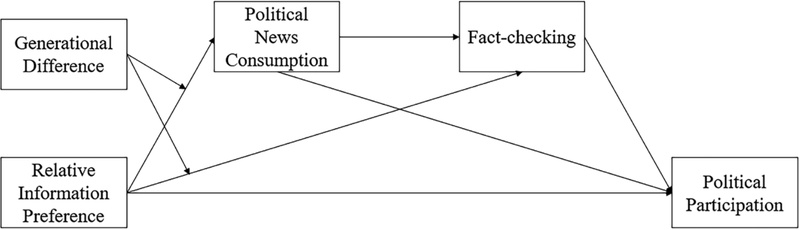
The Proposed Research Model
RQ1. To what extent do generational differences significantly moderate the mediating effect of political news consumption and fact-checking on the relationship between relative information preference for TV and YouTube and political participation?
Methods
The current research utilized the 2022 Korea Media Panel Survey, which has been conducted annually since 2010 by the Korea Information Society Development Institute (2022). As this study used publicly available secondary data, Institutional Review Board approval was not required. The total sample consisted of 9941 respondents. For the purpose of the current research, a total of 5391 respondents born between 1940 and 1999 who used both TV and YouTube were selected. The demographic characteristics of the sample were 50.7% women. By generation, there were 22.7% Baby Boomers, 52.7% Generation X, and 24.6% Generation Y. In terms of education, 4.4% have completed elementary school or less, 7.7% have completed middle school, 40% have completed high school, 46.1% have completed college, and 1.8% have completed graduate school or higher. The average monthly income of individuals consisted of 46.5% below 2 million KRW (South Korean currency), 43.4% between 2 million KRW and 4 million KRW, and 10.2% above 4 million KRW.
Media Relative Information Preference. Since the present study relies on a secondary dataset, relative information preference was assessed in an indirect manner. The inherent limitations of using secondary data to measure media preferences have already been acknowledged in the literature. As Prior (2005) noted, secondary data sources do not provide direct preference measures, but allow researchers to approximately infer respondents’ relative preferences from the type of content they report consuming. The present study follows this approach, treating relative information preference as an indirectly inferred construct derived from respondents’ reported genre choices rather than from explicit preference ratings. Referring to Yang and Song (2014), relative information preference was operationalized separately for TV and YouTube to capture manifestations of informational orientation specific to each platform. Instead of measuring absolute levels of informational use, the index reflects the behavioral prioritization of informational genres within each platform’s available choice structure.
For TV, we used the items rating three genres of TV programs (i.e., news, current affairs/discussion, documentary, education/learning, animation/children, drama, home shopping, education/life information/infotainment, show/entertainment, talk show, movie, comedy, sports, and other) in the order of their favorite over the past three months. In the analysis process, we used a rating based on how informative the genre is compared to other genres. In other words, only those genres that are considered to be information or news were scored. News and current affairs/discussion were considered highly informative genres and were given a score of 2, while documentaries, education/learning, liberal arts/lifestyle/infotainment were considered less informative genres and were given a score of 1, and other genres were given a score of 0. Also, respondents’ choices were weighted according to their ranking. The first-ranked program was weighted three times, the second-ranked program was weighted two times, and the third-ranked program was weighted one time. Then, the weights were summed with the evaluated informativeness, and finally, the relative informativeness index value was derived. For example, a participant who selected news as their first preference, drama as their second preference, and documentary as their third preference would receive a score of 7 points according to the formula: [2 (news) × 3 (first priority) + 0 (drama) × 2 (second priority) + 1 (documentary) × 1 (third priority)] (total range = 0 to 11).
While the Korean Media Survey allowed for up to three rankings when measuring TV genre preference, the YouTube genre preference measure required only one ranking. Therefore, information preference for YouTube was scored in a slightly different way than information preference for TV. It measured scores the ten genres (Drama, Entertainment/Entertainment, Movies, Educational/Documentary, Education/Learning, Animation, Sports, News, Performance, and Other) responding to the question “What genres have you been watching the most in the past three months?” with News scoring 2, Educational/Documentary scoring 1, and Other scoring 0. This is how we derived the relative information preference index values for YouTube (total range = 0 to 2). Although the number of ranked options differs across platforms due to survey design constraints, both measures identify whether informational genres occupy a central position within respondents’ primary reported viewing category. To account for the difference in scale ranges (0–11 vs. 0–2) and ensure analytic comparability, both indices were standardized (z-scores). Standardization does not imply strict measurement equivalence, but allows comparison of relative informational prioritization within each platform context.
Political News Consumption. Political news consumption was measured using two items: “I tend to watch debate broadcasts or look for relevant information” and “I regularly seek out and read news about politics.” Each item was measured on a 5-point Likert scale (1 = Not at all to 5 = Very much) and averaged to create a variable (M = 2.49, SD = = .93, Cronbach’s α = .67).
Fact-checking. Referring to the fact-checking measurment used in D. Zhang et al. (2022)’s study, we defined fact-checking behavior in this study as doubting the accuracy or authenticity of news received through the media and actively checking the facts, using four items including “I check whether the information I read is true or not,” “I check whether the information I read provides valid evidence,” “I judge whether the information I read has a political agenda” and “I search for additional information to understand different perspectives related to the information I encountered.” (1 = I never do this to 5 = I always do this). The averaged values were used as a variable (M = 2.95, SD = = .85, Cronbach’s α = .90). It should be noted that the measurement in this study reflects a broader form of critical information evaluation rather than a narrow definition of source-based fact-checking, which focuses exclusively on cross-verifying information with external sources.
Political Participation. Political participation is often operationalized in terms of participation breadth, referring to the number of different political activities in which an individual has engaged (e.g., Kitanova, 2020; Verba & Nie, 1987; Verba et al., 1995). Following this approach, the present study measured political participation using four dichotomous items capturing engagement in both electoral and discursive forms of participation. Respondents were asked whether they: (1) vote in elections, (2) attempt to visit campaign events, (3) discuss or share opinions about politics or politicians online, and (4) frequently talk about politics or politicians with people around them.
These four behaviors differ in their temporal rhythms and frequency structures. Voting is election-cycle dependent and episodic, campaign event attendance is event–contingent, whereas political discussion, both online and offline, may occur on a routine basis. Given that political participation is conceptually defined as an observable behavioral act rather than an attitudinal predisposition, the key theoretical criterion lies in whether an individual has engaged in such behavior at least once. Accordingly, each item was dichotomized such that “never engage” was coded as 0 and any other response indicating experience of participation was coded as 1. This approach emphasizes the distinction between participants and non–participants. A composite index was then constructed by summing the four items, resulting in a range from 0 to 4, with higher values indicating engagement in a greater number of political activities (M = 3.16, SD = = 1.05).
Generational Differences. The moderating variable, generational difference, is 1 for Baby Boomers, 2 for Generation X, and 3 for Generation Y. The moderating effect of generation was converted into a dummy variable when testing.
Control Variables. We controlled for demographic characteristics (i.e., gender, age, education, and monthly income), as well as political ideology strength (M = 1.73, SD = = .63), political interest was measured using two items: “I carefully read posts about politics on the Internet” and the reverse-coded item “I prefer to focus on my own life rather than paying attention to political affairs.” The two items were combined to construct a political interest index (M = 2.66, SD = = .74). Personality traits of extraversion and openness were included as control variables. Prior studies have consistently demonstrated that personality is a stable individual difference factor that influences political participation, with extraversion and openness being particularly relevant to political communication, social interaction, and engagement in public affairs (Gerber et al., 2011; Kim, Hsu, et al., 2013; Mondak & Halperin, 2008; Mondak et al., 2010). In addition, personality has been shown to shape individuals’ exposure to and use of political information in media environments (Gerber et al., 2011; Zhao, 2023), indicating its potential to confound the associations examined in the present study. Therefore, controlling for extraversion and openness enables a more precise estimation of the unique effects of media-related variables on political participation. Extraversion was measured using two items (M = 3.13, SD = = .73, Cronbach’s α = .68) and openness was measured using two items (M = 2.79, SD = = .79, Cronbach’s α = .79), with higher scores reflecting higher levels of each trait.
Results
Table 1 shows the correlations between relative information preference for TV and YouTube, political news consumption, fact-checking, and political participation. Relative information preference for TV was significantly and positively related to political news consumption (r = .21, p < .001), fact-checking (r = .03, p < .05), and political participation (r = .15, p < .001), while relative information preference for YouTube was significantly and positively related to political news consumption (r = .17, p < .001), political participation (r = .09, p < .001). In addition, political news consumption was significantly correlated with fact-checking (r = .32, p < .001) and political participation (r = .58, p < .001). Factchecking was significantly correlated with political participation (r = .22, p < .001). Finally, the two platform-specific relative information preference measures were moderately yet significantly correlated with each other (r = .22, p < .001), suggesting a common underlying informational orientation whose behavioral expression varies across media environments.

Correlation Coefficients between Media Relative Information Preference, Political News Consumption, Fact-Checking, and Political Participation
To examine the direct effects of relative information preferences for TV and YouTube on the key variables, a multiple regression analysis was conducted. Specifically, demographic variables, personality traits (i.e., extraversion, openness, political ideology strength, and political interest), relative information preferences for TV and YouTube, and dependent variables (i.e., political news consumption, fact-checking, and political participation) were entered in order. In the statistical analysis, the standardized regression coefficient was used to compare the variation between models and the influence of variables, and the F-value was statistically significant for all models in the regression analysis, confirming the goodness of fit of the analysis model.
To test H1-a/b, the current study first examined the relationship between relative information preferences for TV and YouTube and political participation. The results showed that relative information preference for TV (β = .03, p < .05) had a statistically significant positive effect on the range of political activities individuals engaged in. whereas relative information preference for YouTube did not exhibit a statistically significant effect (β = -.01, p = .57). Therefore, H1a was supported, while H1b was not supported.
In addition, Table 2, Figure 2, and Figure 3 summarize the results of analyzing the relationship between independent variables and mediators. They show that higher relative information preferences for TV (β = .07, p < .001) and YouTube (β = .10, p < .001) were associated with higher political news consumption. This suggests that the more informative content a person prefers relative to other content, whether TV or YouTube, the more likely they are to engage in political news consumption behavior.
Relationship between TV and YouTube relative information preference and key variables
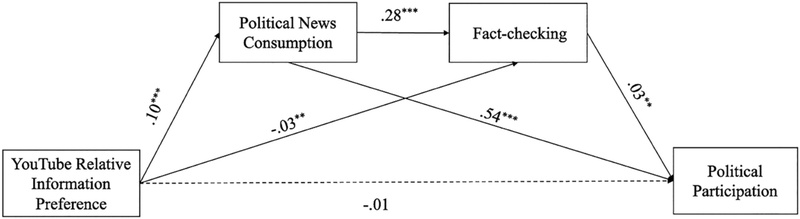
Relationship between Relative Information Preference for TV and Key Variables
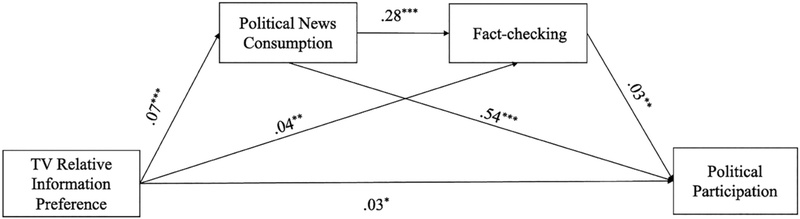
Relationship between Relative Information Preference for YouTube and Key Variables
Next, the present research examined the relationship between political news consumption and fact-checking. The results found that higher political news consumption was associated with higher fact-checking behavior (β = .28, p < .001). Then, this study tested the relationship between fact-checking and political participation and found that more fact-checking behavior was associated with engagement in a greater number of political activities (β = .03, p < .01).
To further examine whether fact-checking contributes incremental explanatory value beyond other predictors, a hierarchical regression analysis was conducted. The baseline model explained 35.8% of the variance in political participation (R2 = .358). After including fact-checking, the explained variance increased to 35.9% (R2 = .359). The change in R2 was statistically significant (ΔR2 = .001, F change = 7.736, p = .005). Although the increase in explained variance is small in magnitude, the result indicates that fact-checking provides a statistically reliable incremental contribution within the broader model.
In order to test H2-a/b and H3-a/b, this study conducted a mediation analysis using Hayes (2017) PROCESS Macro Model 6. Specifically, relative information preferences for TV and YouTube were set as an independent variable, political news consumption and fact-checking as mediators, and political participation as the dependent variable, controlling for demographic characteristics, personality traits, political ideology strength and political interest. The bootstrap sample was 5,000, and the confidence interval was 95%.
According to Table 3, TV (b = .0007, LLCI = .0001, ULCI = .0014) and YouTube (b = .0009, LLCI = .0002, ULCI = .0018) had a statistically significant indirect effect on the path from relative information preference, political news consumption, and fact-checking to political participation, with a confidence interval not including zero at the 95% confidence level.
Results of Mediation Analysis on the Relationship between TV and YouTube Relative Information Preference and Political Participation
In other words, political news consumption and fact-checking have a mediating effect on the relationship between relative information preferences for TV and YouTube and political participation. Therefore, the H2-a/b and H3-a/b were supported.
The moderated mediation model combines the mediating and moderating models. It means the mediating effect varies depending on the level of the moderating variable. Accordingly, both the mediating and moderating effects must be significant for the moderated mediation model to be significant. In this study, after confirming the significance of the mediating effect, the moderating effect of generation was analyzed next. Specifically, political news consumption and fact-checking behavior were entered as dependent variables, followed by demographic characteristics, personality characteristics, political ideology, political interest, relative information preference for TV and YouTube, generational variables, and interaction variables between relative information preferences and generational variables.
Table 4 shows the significance of the F-value to confirm the model’s goodness of fit including the interaction effects of relative information preference and generation. Firstly, regarding the interaction effects of relative information preference for TV and generation, the results showed significant interaction effects for Generation X on political news consumption (β = -.05, p = .03), and significant interaction effects for Generation X (β = -.08, p < .001) and Generation Y (β = -.05, p = .02) on fact-checking, compared to Baby Boomers (see Figure 4 and 5). These significant negative interaction terms indicate that the positive influence of TV relative information preference is attenuated among younger generations. In other words, all generations showed a positive effect of relative information preference for TV on fact-checking (Generation X (β = .13, p < .001) and Generation Y (β = .18, p < .001), but the effect sizes were smaller for Generation X and Generation Y than for Baby Boomers.
Generational Moderating Effects on the Relationship between TV and YouTube Relative Information Preferences on Political News Consumption and Fact-Checking
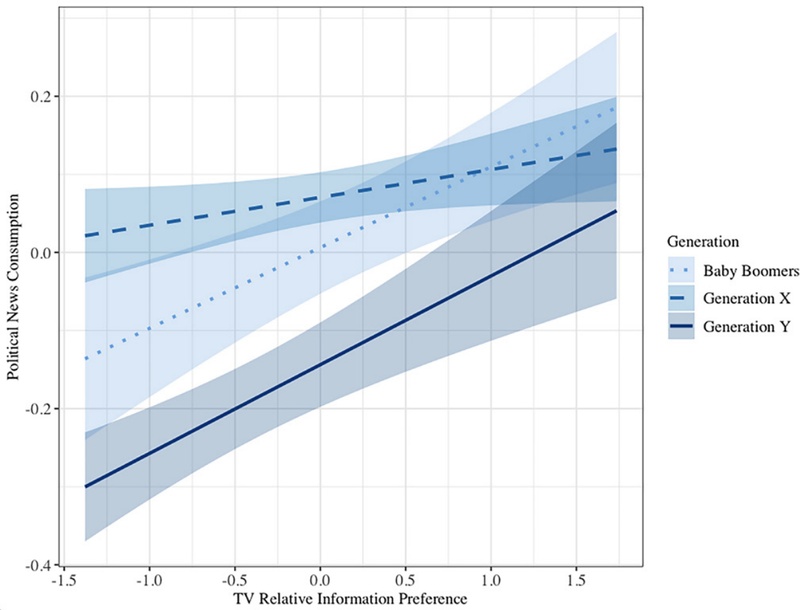
Generational Moderation of the Relationship between Relative Information Preference for TV and Political News Consumption
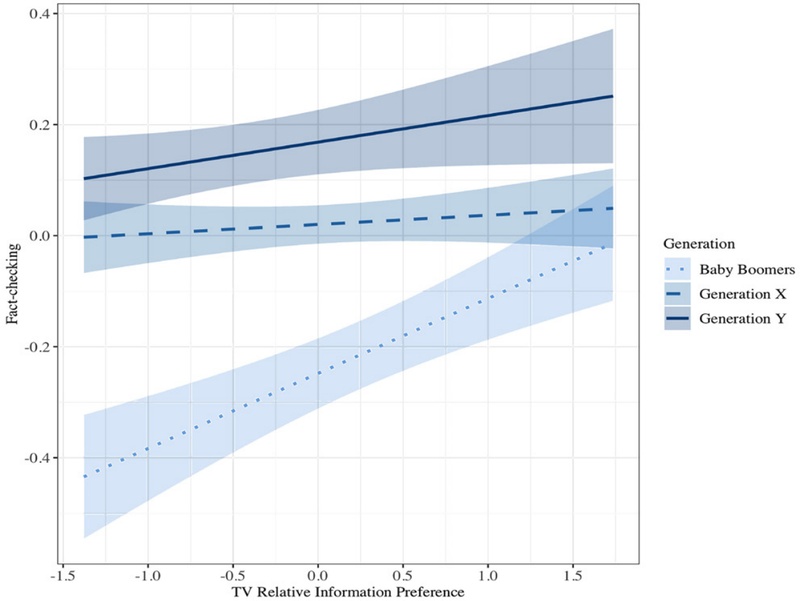
Generational Moderation of the Relationship between Relative Information Preference for TV and Fact-Checking
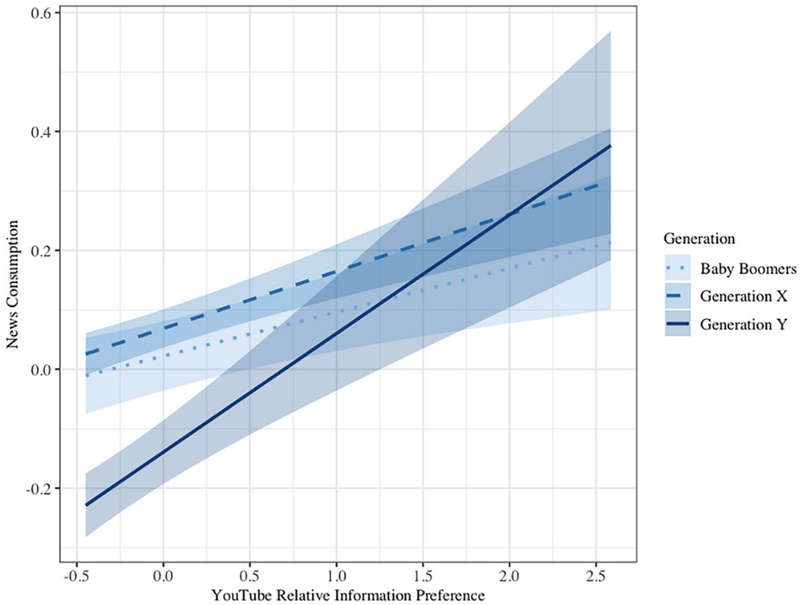
Generational Moderation Effect between Relative Information Preference for YouTube and Political News Consumption
Secondly, for the interaction effects of relative information preference for YouTube and generation, only Generation Y (β = .05, p < .01) showed statistical significance on political news consumption. As shown in Figure 5, the higher the relative information preference for YouTube, the stronger the effect on political news consumption in Generation Y compared to Baby Boomers. In other words, the greater the preference for information on YouTube compared to other genres, the stronger the tendency to consume political news in Generation Y compared to Baby Boomers.
Next, to test RQ1, a bootstrapping analysis using the SPSS process macro Model 84 (Preacher et al., 2007) was conducted. As shown in Table 5, the moderating role of Generation Y in the mediating relationship between political news consumption and fact-checking on the influence of relative information preference for YouTube (b = .0009, LLCI = .0000, ULCI = .0023) on political participation was significant. In other words, the indirect effect of the path from relative information preference for YouTube, political news consumption, and fact-checking to political participation was more prominent for Generation Y than for Baby Boomers.
Results of Mediated Moderation Analysis on the Relationship between Relative Information Preference and Political Participation
DISCUSSION
This study examined how media users’ preferences for information genres affect political participation. In particular, the current research examined the relationship between relative information preferences for TV and YouTube and political participation, tested the mediating effects of political news consumption and fact-checking on this relationship, and further explored the moderated mediation effects of generational differences.
Discussion of Results
First, the present research explored the relationship between relative information preference and political participation. The findings showed that while relative information preference for TV had a significant positive effect on political participation, relative information preference for YouTube did not exhibit a statistically significant effect, and the coefficient was even negative. This indicates that users engage in a broader repertoire of political activities when they have a higher relative preference for news and information on TV, but such a pattern does not extend to YouTube. These results suggest that the association between relative preference in news and political participation may depend on the characteristics of specific media platforms rather than being consistent across different media types.
The current study also identified a mechanism through which relative information preferences indirectly influence political participation through political news consumption and fact-checking, both on TV and YouTube. This implies that media users' higher preference for news or information over other genres may facilitate engagement in diverse political actions by actively consuming political news and verifying the truth of mis/disinformation. These findings are consistent with previous studies exploring the relationship between relative information preference for media and political news consumption (Gil de Zúñiga et al., 2017; Yang & Song, 2014). Specifically, people with stronger political ideology consume more political news and verify more suspicious news (Amazeen, 2015), and fact-checking is positively related to political engagement (D. Zhang et al., 2022). However, the remarkable point is that while previous studies have focused on the relationship between TV's relative information preference and civic engagement (Yang & Song, 2014), this study can propose a mechanism for the relationship between information preference and civic engagement that emerges from the use of YouTube as well as TV. In addition, while previous studies have demonstrated the direct relationship between relative information preference for media, political news consumption, fact-checking, and political participation variables, this study can be considered significant in that it confirms the causal relationship of these variables by shedding light on the mechanism of mediating effects that comprehensively considers these variables. Although the incremental variance explained by fact-checking is modest, its role within the sequential mediation model clarifies the cognitive process through which informational preference and political news consumption culminate in political participation. The theoretical contribution of fact-checking lies not in the magnitude of its direct effect, but in its position as an intervening evaluative step in the participation process.
Next, this research tested the moderated mediating effect of generational differences on the indirect relationship between relative information preference for media and political participation through political news consumption and fact-checking. We found a statistically significant difference between Baby Boomers and Generation Y in the influence of information preference for YouTube. Specifically, the higher the relative information preference of Generation Y compared to Baby Boomers, the greater the indirect effect of political news consumption and fact-checking on political participation. This suggests that Generation Y, with higher interest and preference for news and information on YouTube, are more likely to seek out and consume political news and actively verify information through fact-checking, finally leading to involvement in more varied forms of political participation. The moderated mediation effect of Generation Y on YouTube can also be explained in light of the characteristics of YouTube. First, as digital natives, Generation Y tends to be more proficient in utilizing YouTube. As such, they can easily access, select, and utilize diverse information and content on YouTube (Andersen et al., 2021), and the information they receive from YouTube may have a more substantial moderating effect on the pathway to political participation through political news consumption and fact-checking by real-time information updates (Westerman et al., 2014).
Next, Generation Y showed a significant moderating effect between relative information preference and political news consumption on YouTube compared to the baby boomer generation, while the moderating effect between relative information preference and fact-checking was not statistically significant. This generational divergence can be attributed to Generation Y’s distinct digital nativity and social media engagement patterns (Andersen et al., 2021). Having grown up in an information-rich digital environment, Generation Y users demonstrate more sophisticated and autonomous information evaluation strategies that appear less susceptible to traditional moderating influences. Their heightened familiarity with social media platforms may have cultivated more resilient fact-checking behaviors that remain consistent regardless of information preference variations. Furthermore, the non-significant moderated mediation effect observed between generations indicates that the hypothesized differential impact of information preferences on fact-checking behavior does not materially distinguish Generation Y from Baby Boomers in this context. This finding suggests that while generational differences exist in social media engagement levels, the underlying cognitive processes governing the relationship between information preference and verification behaviors may be more universal than initially anticipated.
In addition, compared to Baby Boomers on YouTube, Generation X had no significant moderating effect on the relationship between YouTube relative information preference and political participation through political news consumption and fact-checking. Neither of the mediated moderating effects of Generation X and Y on relative information preference for TV was statistically significant compared to Baby Boomers. These results suggest that the way Generation X uses YouTube and processes information does not differ from Baby Boomers in the relationship between relative information preference and political participation.
In addition to these findings, the analysis revealed a clear generational divergence in the relationship between TV relative information preference and fact-checking. Although the association remained positive for all generations, its magnitude varied substantially. Baby Boomers exhibited the steepest slope, indicating that their fact-checking behavior increased most noticeably as their preference for informational content on TV rose. In contrast, the effects for Generation X and Generation Y were markedly weaker, with Generation X showing almost no observable change across different levels of TV information preference.
This pattern should not be interpreted as lower overall fact-checking among younger cohorts; rather, it underscores that TV-based informational preference exerts a weaker behavioral influence on Generation X and Y. Their verification behaviors appear less contingent on television-based informational motivations, suggesting that the psychological mechanisms and informational triggers underlying fact-checking differ across cohorts.
A plausible explanation lies in generational differences in media socialization and information ecologies. Baby Boomers came of age during a period in which television was the dominant and most institutionalized source of public information (Lissitsa & Laor, 2021), and their news habits were largely formed within a broadcast-centered media environment. As a result, informational reliance on television among Baby Boomers is more likely to be accompanied by a norm of careful and responsible news use, making fact-checking a natural extension of their television news consumption. In contrast, Generation X and Generation Y operate within more diversified media environments dominated by digital and social platforms (Ghersetti & Westlund, 2018; Gulyàs, 2015). Their fact-checking practices are therefore more likely driven by online exposure, social cues, and algorithmically curated information, reducing the relative influence of television. These findings highlight the need to consider broader media ecosystems when examining how informational preferences shape political verification behaviors.
Theoretical Implications & Empirical Insight
First, the results of this study confirm that there is a positive association between users’ preferences for news or information and the diversity of their political engagement, regardless of whether they use TV or YouTube. This suggests that there is a close relationship between media information preferences and political participation. The significance of this study lies in its in-depth comparative analysis of the relationship between relative information preferences and political participation across media usage behaviors. Second, while previous studies have examined the relationship between relative genre preference for TV and political participation, they mainly focused on the direct and piecemeal effects of preferential access to news or information on TV. However, this study identified a mechanism that indirectly affects political participation through the individual attitudinal dimension of relative information preference, which is influenced by political news consumption and fact-checking on both TV and YouTube. The results show the importance of political news consumption and fact-checking behavior in the relationship between relative information preference in the media and political participation. The significance of these results is that they provide a more comprehensive understanding of the relationship between relative information preference in the media, political news consumption, fact-checking, and political participation. Third, an interesting finding of this study is that the effect of relative information preference on political participation through political news consumption and fact-checking on YouTube and TV may differ across generations, with Generation Y tending to show a stronger mediated moderation effect through YouTube. These findings contribute to our understanding of YouTube's impact and generational differences and can help shape policies and strategies that take into account the characteristics of each generation and how they use media.
Limitations and Future Research
This study has several limitations that should be acknowledged. First, the measurement of fact-checking has conceptual constraints. The items used not only capture verification of accuracy but also include the evaluation of evidence and political intent, which may reflect general information assessment rather than strict fact-checking behavior. This issue stems from the use of secondary data, which limited item selection. Future studies should develop more precise behavioral measures, such as cross-referencing information with multiple external and authoritative sources. Second, the measurement of relative information preference for media could be further refined. For example, YouTube preference was determined based on genre selection only among respondents who indicated YouTube as the most frequently used over-the-top service in the past three months. Although the resulting index was standardized, it may not fully capture content-specific preferences across different platforms. Moreover, the current measurement focused on preference for general news or informational content, but future research should differentiate specific news topics or formats to examine whether certain types of informational content exert stronger effects on political participation. Third, the study does not fully capture the multidimensional nature of political participation, such as voting, collective action, and support for political actors (Min, 2022), due to the secondary data constraints. Future research should incorporate multiple behavioral indicators to better represent the diverse forms of digitally mediated participation. Finally, this study faces a notable limitation regarding endogeneity in the attempt to disentangle platform effects from intrinsic content preferences. Specifically, there may be a systematic correlation between user reliance on YouTube (i.e., usage intensity) and a relative preference for entertainment compared with news. We speculate that high-frequency users might represent a self-selected cohort with an inherent predisposition toward light-hearted, entertainment-driven content. Consequently, model estimates of platform effects could be compromised by self-selection bias, leading to a potential misestimation of the platform’s independent impact. To address this, future inquiries should control for platform dependence and usage frequency or utilize panel data designs to alleviate endogeneity concerns and ensure more robust findings. Despite these limitations, this study contributes to the literature by highlighting the cognitive mechanisms through which media information preference ultimately shapes political participation.
Acknowledgments
This study used publicly available secondary data from the Korea Media Panel Survey of Korea Information Society Development Institute (KISD = I), which contains no personally identifiable information. Therefore, institutional review board approval was not required. The data for the 2022 Korea Media Panel Survey is available at the following link: https://stat.kisdi.re.kr/kor/contents/ContentsList.html.
Disclosure Statement
No potential conflict of interest was reported by the author.
References
-
Amazeen, M. A. (2015). Developing an ad-reporting typology: A network analysis approach to newspaper and fact-checker coverage of the 2008 presidential election. Journalism & Mass Communication Quarterly, 92(3), 617–641.
[https://doi.org/10.1177/1077699015574099]

-
Amazeen, M. A., Vargo, C. J., & Hopp, T. (2019). Reinforcing attitudes in a gatewatching news era: Individual-level antecedents to sharing fact-checks on social media. Communication Monographs, 86(1), 112–132.
[https://doi.org/10.1080/03637751.2018.1521984]
-
Andersen, K., Ohme, J., Bjarnøe, C., Bordacconi, M. J., Albæk, E., & De Vreese, C. H. (2021). Generational gaps in political media use and civic engagement: From baby boomers to generation Z. Taylor & Francis.
[https://doi.org/10.4324/9781003111498]
-
Bolton, R. N., Parasuraman, A., Hoefnagels, A., Migchels, N., Kabadayi, S., Gruber, T., Loureiro, Y. K., & Solnet, D. (2013). Understanding Generation Y and their use of social media: A review and research agenda. Journal of Service Management, 24(3), 245–267.
[https://doi.org/10.1108/09564231311326987]
-
Boulianne, S., & Shehata, A. (2022). Age differences in online news consumption and online political expression in the United States, United Kingdom, and France. The International Journal of Press/Politics, 27(3), 763–783.
[https://doi.org/10.1177/19401612211060271]
-
Brandtzaeg, P. B., Følstad, A., & Chaparro Domínguez, M. Á. (2018). How journalists and social media users perceive online fact-checking and verification services. Journalism Practice, 12(9), 1109–1129.
[https://doi.org/10.1080/17512786.2017.1363657]
-
Chia, S. C., Lu, F., & Gunther, A. C. (2024). Who fact-checks and does it matter? Examining the antecedents and consequences of audience fact-checking behaviour in Hong Kong. The International Journal of Press/Politics, 29(2), 438–458.
[https://doi.org/10.1177/19401612221142439]
-
Dilliplane, S. (2011). All the news you want to hear: The impact of partisan news exposure on political participation. Public Opinion Quarterly, 75(2), 287–316.
[https://doi.org/10.1093/poq/nfr006]
-
Edgerly, S., Mourão, R. R., Thorson, E., & Tham, S. M. (2020). When do audiences verify? How perceptions about message and source influence audience verification of news headlines. Journalism & Mass Communication Quarterly, 97(1), 52–71.
[https://doi.org/10.1177/1077699019864680]
-
Fridkin, K., Kenney, P. J., & Wintersieck, A. (2015). Liar, liar, pants on fire: How fact-checking influences citizens’ reactions to negative advertising. Political Communication, 32(1), 127–151.
[https://doi.org/10.1080/10584609.2014.914613]
-
Gerber, A. S., Huber, G. A., Doherty, D., & Dowling, C. M. (2011). Personality traits and the consumption of political information. American Politics Research, 39(1), 32–84.
[https://doi.org/10.1177/1532673X10381466]
-
Ghersetti, M., & Westlund, O. (2018). Habits and generational media use. Journalism Studies, 19(7), 1039–1058.
[https://doi.org/10.1080/1461670X.2016.1254061]
-
Gil de Zúñiga, H., Weeks, B., & Ardèvol-Abreu, A. (2017). Effects of the news-finds-me perception in communication: Social media use implications for news seeking and learning about politics. Journal of Computer-Mediated Communication, 22(3), 105–123.
[https://doi.org/10.1111/jcc4.12185]
-
Gulyàs, À. (2015). Millennials, news and social media: Is news engagement a thing of the past? Digital Journalism, 3(1), 132–133.
[https://doi.org/10.1080/21670811.2014.902645]
-
Gurău, C. (2012). A life-stage analysis of consumer loyalty profile: Comparing Generation X and Millennial consumers. Journal of Consumer Marketing, 29(2), 103–113.
[https://doi.org/10.1108/07363761211206357]
-
Han, H. R., Kim, M., Lee, H. B., Pistulka, G., & Kim, K. B. (2007). Correlates of depression in the Korean American elderly: Focusing on personal resources of social support. Journal of Cross-Cultural Gerontology, 22(1), 115–127.
[https://doi.org/10.1007/s10823-006-9022-2]
- Hayes, A. F. (2017). Introduction to mediation, moderation, and conditional process analysis: A regression-based approach. Guilford Publications.
-
Heeter, C. (1985). Program selection with abundance of choice: A process model. Human Communication Research, 12(1), 126–152.
[https://doi.org/10.1111/j.1468-2958.1985.tb00070.x]
-
Hochschild, J., & Einstein, K. L. (2015). ‘It isn’t what we don’t know that gives us trouble, it’s what we know that ain’t so’: Misinformation and democratic politics. British Journal of Political Science, 45(3), 467–475.
[https://doi.org/10.1017/S000712341400043X]
-
Jones-Jang, S. M., Kim, D. H., & Kenski, K. (2021). Perceptions of mis- or disinformation exposure predict political cynicism: Evidence from a two-wave survey during the 2018 US midterm elections. New Media & Society, 23(10), 3105–3125.
[https://doi.org/10.1177/1461444820943878]
-
Katz, E., Blumler, J. G., & Gurevitch, M. (1973). Uses and gratifications research. The Public Opinion Quarterly, 37(4), 509–523. http://www.jstor.org/stable/2747854
[https://doi.org/10.1086/268109]
-
Kenski, K., & Stroud, N. J. (2006). Connections between internet use and political efficacy, knowledge, and participation. Journal of Broadcasting & Electronic Media, 50(2), 173–192.
[https://doi.org/10.1207/s15506878jobem5002_1]
-
Kim, Y., Chen, H. T., & Gil de Zúñiga, H. (2013). Stumbling upon news on the Internet: Effects of incidental news exposure and relative entertainment use on political engagement. Computers in Human Behavior, 29(6), 2607–2614.
[https://doi.org/10.1016/j.chb.2013.06.005]
-
Kim, Y., Hsu, S. H., & Gil de Zúñiga, H. (2013). Influence of social media use on discussion network heterogeneity and civic engagement: The moderating role of personality traits. Journal of Communication, 63(3), 498–516.
[https://doi.org/10.1111/jcom.12034]
-
Kitanova, M. (2020). Youth political participation in the EU: Evidence from a cross-national analysis. Journal of Youth Studies, 23(7), 819–836.
[https://doi.org/10.1080/13676261.2019.1636951]
- Korea Information Society Development Institute. (2022). 2022 Korean Media Panel Survey [Data set]. https://stat.kisdi.re.kr/kor/contents/ContentsList.html
-
Ksiazek, T. B., Malthouse, E. C., & Webster, J. G. (2010). News-seekers and avoiders: Exploring patterns of total news consumption across media and the relationship to civic participation. Journal of Broadcasting & Electronic Media, 54(4), 551–568.
[https://doi.org/10.1080/08838151.2010.519808]
-
Lee, S., Nanz, A., & Heiss, R. (2022). Platform-dependent effects of incidental exposure to political news on political knowledge and political participation. Computers in Human Behavior, 127, 107048.
[https://doi.org/10.1016/j.chb.2021.107048]
-
Lehmann, D. R . (1971). Television show preference: Application of a choice model. Journal of Marketing Research, 8(1), 47–55.
[https://doi.org/10.1177/002224377100800106]
-
Levy, B. L., & Akiva, T. (2019). Motivating political participation among youth: An analysis of factors related to adolescents’ political engagement. Political Psychology, 40(5), 1039–1055.
[https://doi.org/10.1111/pops.12578]
-
Lim, H., Lee, J., Kim, J., Lee, J., & Kim, Y. (2021). The effect of fact-checking behavior on political polarization: Focusing on the mediating effects of like-minded and cross-cutting discussion. The Research Institute of Social Science, 28(3), 7–32.
[https://doi.org/10.46415/jss.2021.09.28.3.7]
-
Lissitsa, S., & Kol, O. (2016). Generation X vs. Generation Y–A decade of online shopping. Journal of Retailing and Consumer Services, 31, 304–312.
[https://doi.org/10.1016/j.jretconser.2016.04.015]
-
Lissitsa, S., & Laor, T. (2021). Baby Boomers, Generation X and Generation Y: Identifying generational differences in effects of personality traits in on-demand radio use. Technology in Society, 64, 101526.
[https://doi.org/10.1016/j.techsoc.2021.101526]
-
Loos, E., & Nijenhuis, J. (2020). Consuming fake news: A matter of age? The perception of political fake news stories in Facebook ads. In Q. Gao & J. Zhou (Eds.), Human aspects of IT for the aged population: Technology and society (pp. 69–88). Springer.
[https://doi.org/10.1007/978-3-030-50232-4_6]
-
Marchi, R. (2012). With Facebook, blogs, and fake news, teens reject journalistic “objectivity”. Journal of Communication Inquiry, 36(3), 246–262.
[https://doi.org/10.1177/0196859912458700]
-
Melo, D. F., & Stockemer, D. (2014). Age and political participation in Germany, France and the UK: A comparative analysis. Comparative European Politics, 12, 33–53.
[https://doi.org/10.1057/cep.2012.31]
- Min, Y. (2022). Generation-differential paths to political participation: Focusing on the effects of digital media use. Journal of Communication Research, 59(3), 64–97.
- Mitchell, A ., Gottfried, J., & Matsa, K . (2015). Millennials and political news. Pew Research Center. https://www.pewresearch.org/journalism/2015/06/01/millennials-political-news/
-
Modirrousta-Galian, A., & Higham, P. A. (2023). Gamified inoculation interventions do not improve discrimination between true and fake news: Reanalyzing existing research with receiver operating characteristic analysis. Journal of Experimental Psychology: General, 152(9), 2411.
[https://doi.org/10.1037/xge0001395]
-
Mondak, J. J., & Halperin, K. D. (2008). A framework for the study of personality and
[https://doi.org/10.1017/S0007123408000173]
- political behaviour. British Journal of Political Science, 38(2), 335–362.
-
Mondak, J. J., Hibbing, M. V., Canache, D., Seligson, M. A., & Anderson, M. R. (2010). Personality and civic engagement: An integrative framework for the study of trait effects on political behavior. American Political Science Review, 104(1), 85–110.
[https://doi.org/10.1017/S0003055409990359]
-
Pingree, R. J. (2011). Effects of unresolved factual disputes in the news on epistemic political efficacy. Journal of Communication, 61(1), 22–47.
[https://doi.org/10.1111/j.1460-2466.2010.01525.x]
-
Pingree, R. J., Hill, M., & McLeod, D. M. (2013). Distinguishing effects of game framing and journalistic adjudication on cynicism and epistemic political efficacy. Communication Research, 40(2), 193–214.
[https://doi.org/10.1177/0093650212439205]
-
Preacher, K. J., Rucker, D. D., & Hayes, A. F. (2007). Addressing moderated mediation hypotheses: Theory, methods, and prescriptions. Multivariate Behavioral Research, 42(1), 185–227.
[https://doi.org/10.1080/00273170701341316]
-
Prior, M. (2005). News vs. entertainment: How increasing media choice widens gaps in political knowledge and turnout. American Journal of Political Science, 49(3), 577–592.
[https://doi.org/10.1111/j.1540-5907.2005.00143.x]
-
Prior, M. (2007). Post-broadcast democracy: How media choice increases inequality in political involvement and polarizes elections. Cambridge University Press.
[https://doi.org/10.1017/CBO9781139878425]
-
Quintelier, E., & Hooghe, M. (2011). Television and political participation among adolescents: The impact of television viewing, entertainment and information preferences. Mass Communication and Society, 14(5), 620–642.
[https://doi.org/10.1080/15205436.2010.530383]
-
Robertson, C. T., Mourão, R. R., & Thorson, E. (2020). Who uses fact-checking sites? The impact of demographics, political antecedents, and media use on fact-checking site awareness, attitudes, and behavior. The International Journal of Press/Politics, 25(2), 217–237.
[https://doi.org/10.1177/1940161219898055]
-
Scheufele, D. A., & Nisbet, M. C. (2002). Being a citizen online: New opportunities and dead ends. Harvard International Journal of Press/Politics, 7(3), 55–75.
[https://doi.org/10.1177/1081180X0200700304]
-
Sotirovic, M., & McLeod, J. M. (2001). Values, communication behavior, and political participation. Political Communication, 18(3), 273–300.
[https://doi.org/10.1080/10584600152400347]
-
Van Der Meer, T. G., Hameleers, M., & Ohme, J. (2023). Can fighting misinformation have a negative spillover effect? How warnings for the threat of misinformation can decrease general news credibility. Journalism Studies, 24(6), 803–823.
[https://doi.org/10.1080/1461670X.2023.2187652]
-
Van Duyn, E., & Collier, J. (2019). Priming and fake news: The effects of elite discourse on evaluations of news media. Mass Communication and Society, 22(1), 29–48.
[https://doi.org/10.1080/15205436.2018.1511807]
- Verba, S., & Nie, N. H. (1987). Participation in America: Political democracy and social equality. University of Chicago Press.
-
Verba, S., Schlozman, K. L., & Brady, H. E. (1995). Voice and equality: Civic voluntarism in American politics. Harvard University Press.
[https://doi.org/10.2307/j.ctv1pnc1k7]
-
Westerman, D., Spence, P. R., & Van Der Heide, B. (2014). Social media as information source: Recency of updates and credibility of information. Journal of Computer-Mediated Communication, 19(2), 171–183.
[https://doi.org/10.1111/jcc4.12041]
- Yang, J., & Song, I. (2014). The indirect effects of relative information preference on civic participation through political news seeking behavior. Korean Journal of Broadcasting and Telecommunication Studies, 28(2), 137–175.
-
York, C., Ponder, J. D., Humphries, Z., Goodall, C., Beam, M., & Winters, C. (2020). Effects of fact-checking political misinformation on perceptual accuracy and epistemic political efficacy. Journalism & Mass Communication Quarterly, 97(4), 958–980.
[https://doi.org/10.1177/1077699019890119]
-
Zhang, D., Zhu, L., Wang, Y., & Kim, Y. (2022). How do individual fact-checking behaviors affect political participation? Focusing on the mediating effect of news involvement behavior. The Research Institute of Social Science, 29(3), 138–167.
[https://doi.org/10.46415/jss.2022.09.29.3.138]
-
Zhang, W. (2012). The effects of political news use, political discussion and authoritarian orientation on political participation: Evidences from Singapore and Taiwan. Asian Journal of Communication, 22(5), 474–492.
[https://doi.org/10.1080/01292986.2012.701313]
-
Zhao, Y. (2023). The correlation between the Big Five personality traits and political information exposure. Chinese Public Administration Review, 14(1), 39–53.
[https://doi.org/10.1177/15396754221129707]