
When Underdogs Go Viral: Emotional and Cognitive Pathways to Social Media Engagement
 ; Minsun Shim2
; Sungeun Chung1
; Minsun Shim2
; Sungeun Chung1
Copyright ⓒ 2026 by the Korean Society for Journalism and Communication Studies
Abstract
Underdog success stories, celebrated across cultures and platforms, represent a compelling form of digital narratives that drive social media engagement. Drawing on the model of inspiring media, this study investigates how such stories evoke emotional and cognitive responses that, in turn, foster social media engagement through the experience of being moved. In an online experiment, 320 participants were randomly assigned to watch one of 20 success story videos featuring either an underdog or a non-underdog protagonist. Structural equation modeling showed that underdog stories elicited stronger joy, admiration, unexpectedness, and enlightenment than non-underdog stories. Furthermore, joy, admiration, and enlightenment—but not unexpectedness—indirectly increased liking and sharing intentions via being moved. These findings highlight the mechanisms through which underdog narratives translate into social media engagement, extending research on eudaimonic media effects into digital contexts. They also offer practical implications for content creators and platform designers seeking to promote user interaction and prosocial engagement through inspiring narratives.
Keywords:
underdog success stories, social media engagement, liking, sharing, being moved, inspiring narrativesThe rise of social media has transformed how stories are disseminated and consumed, reshaping audience exposure and engagement (Zhao et al., 2022). Among the narratives that attract widespread attention are underdog success stories. These stories portray individuals who, starting from a disadvantaged position, overcome significant obstacles and achieve their goals. Unlike conventional success stories that often highlight talent or favorable circumstances, underdog narratives emphasize struggle, perseverance, and triumph against the odds. Such stories appear across history, literature, mythology, film, and sports (Vandello et al., 2007) and are widely shared on digital platforms, including social network sites, online video platforms, and outlets such as Goalcast (Oliver et al., 2012). Despite their prevalence, research remains limited regarding how audiences respond to underdog narratives and how these stories translate into social media engagement.
Underdog success stories are positive narratives that elicit both emotional and cognitive responses, which can foster the experience of being moved—a self-transcendent state associated with moral virtue and prosocial behavior (Algoe & Haidt, 2009; Oliver et al., 2021). These responses represent distinct yet complementary pathways through which underdog narratives resonate with audiences. Recent research suggests that the consumption of media content is driven not solely by hedonic motivations but also by eudaimonic motivations, such as seeking meaning and wisdom (Oliver et al., 2021). From this perspective, underdog success stories exemplify a compelling form of digital storytelling capable of eliciting meaningful and socially oriented engagement.
Yet little is known about the mechanisms through which underdog narratives drive engagement, particularly the mediating role of being moved. The present study addresses this gap by comparing underdog success stories with non-underdog stories, examining their effects on liking and sharing on social media. Drawing on Oliver et al.’s (2021) model of inspiring media, we examine whether specific emotional responses—joy and admiration—and cognitive responses—unexpectedness and enlightenment—serve as pathways to influence engagement through being moved. By elucidating these mechanisms, this study contributes to understanding how digital narratives shape online behavior and offers insights into the psychological processes underlying engagement with inspiring stories on social media.
Characteristics of Underdog Success Stories
Underdog success stories are characterized by several key features. First, the protagonist epitomizes the virtues of an underdog, facing adversity without harming others or acting unethically. These qualities foster audience support and a sense of unity (Kim et al., 2008). Second, the protagonist exhibits socially admirable qualities, such as determination, perseverance, resilience, and an unwavering spirit to confront obstacles (McGinnis & Gentry, 2009). People support underdogs because they compensate for initial deficits through sustained effort and dedication to tackling adversity (Prestin, 2013). Third, underdog stories highlight a substantial gap between the protagonist’s starting point and ultimate achievement, showcasing a reversal in which formidable barriers are overcome (Park, 2009; Prestin, 2013).
While all success stories may involve effort or obstacles, underdog success stories differ in focus. They center on the protagonist’s physical, economic, or situational disadvantages and the significant obstacles they face, making eventual success especially striking. In contrast, non-underdog success stories often highlight inherent talents, strengths, or privileged backgrounds. Although non-underdogs may also encounter and overcome challenges through effort, their struggles are typically less central to the narrative.
Engagement with Underdog Success Stories on Social Media
Beyond their defining features, it is important to consider how underdog success stories operate within the social media environment. Social media platforms offer affordances that facilitate social sharing, thereby increasing the visibility and interactive circulation of positive media portrayals (Oliver, 2022). YouTube, in particular, has become a prominent venue for underdog success stories, combining video content with interactive features that allow viewers to engage directly with narratives (Khan, 2017). These affordances function as social signals, enabling users to express identity, show support, and build social connections (Ronzhyn et al., 2023).
Engagement, described by Hollebeek et al. (2016) as the “willingness to invest in the undertaking of focal interactions with particular engagement objects” (p. 393), typically manifests on social media through behaviors such as sharing, commenting, and liking/disliking (Ma et al., 2023). In the present study, we focus on liking and sharing because they represent two theoretically distinct, content-driven forms of engagement that differ in expressive cost and social visibility, whereas commenting often involves additional interactional and linguistic processes that extend beyond the narrative-elicited emotional and cognitive responses examined here (Wang & Sundar, 2022).
Accordingly, we conceptualize liking and sharing as distinct behavioral expressions of engagement (Piksa et al., 2023). Liking serves multiple purposes, including acknowledging receipt of content, expressing interest, and showing empathy toward a story’s theme or character; it may also function as a habitual response to attention-getting content (Oeldorf-Hirsch & Sundar, 2015; Tenenboim, 2022). Liking thus represents a quick yet meaningful signal of positive response or connection with valued content (Guo & Sun, 2020). In contrast, sharing is a more active and public form of engagement with content on social media. Sharing not only communicates personal support but also amplifies a story’s reach by influencing which narratives gain broader visibility (Tenenboim, 2022).
Underdog success stories encompass elements prone to trigger psychological affinity and support for underdogs (Kim et al., 2008). When encountered on social media, such stories are therefore expected to motivate users to demonstrate endorsement through available affordances, particularly liking and sharing. We thus posit the following hypothesis:
- H1. Exposure to underdog success stories on social media will increase the likelihood of (a) liking and (b) sharing, compared to non-underdog success stories.
Underlying Mechanisms for Social Media Engagement with Underdog Success Stories
Our next inquiry examines the mechanisms through which underdog success stories garner liking and sharing, building on Oliver et al.’s (2021) model of inspiring media. This model synthesizes prior literature on how media inspires self-betterment by identifying five components: “exposure, media messages, responses, outcomes, and person/situation variables” (p. 192). In this study, we focus on message exposure and behavioral outcomes (e.g., social sharing), with emotional and cognitive responses serving as intervening mechanisms.
Regarding positive narratives, Oliver et al. (2012) highlight meaning-oriented, or eudaimonic, motivations that extend beyond hedonic pursuits such as pleasure and satisfaction. Individuals are attracted to narratives that emphasize fundamental life values, including perseverance, patience, and resilience (Oliver & Raney, 2011). Such narratives evoke self-transcendent emotions grounded in valuing others’ well-being above oneself (Oliver et al., 2021). They create transcendent encounters where individuals recognize moral beauty, empathize with protagonists, and get inspired by their efforts. Underdog success stories are prime examples, capable of inspiring and moving audiences (Oliver et al., 2021).
In this research, being moved is conceptualized as the central psychological mechanism linking exposure to social media engagement. It emerges from discrete emotional and cognitive responses to a protagonist’s achievement and subsequently motivates engagement behaviors. Although the precise temporal sequence remains empirically unconfirmed, our proposed sequence draws on Oliver et al.’s (2021) model, Zickfeld et al.’s (2019) conceptual explication of being moved, and prior research on underdog success stories (Kang & Chung, 2023). The following section elaborates on its conceptual foundations and relevance to underdog narratives.
Being moved is a key response to inspiring media (Oliver et al., 2021). It encompasses empathic elements, including sympathy, compassion, and tenderness, that arise from witnessing others’ actions or emotions (Zickfeld et al., 2019). Importantly, being moved is not a single discrete emotion but an integrative response emerging from multiple affective and cognitive reactions(Menninghaus et al., 2015). It is typically triggered by witnessing moral virtues in others (Algoe & Haidt, 2009), including self-transcending values such as altruism as well as effortful striving under adversity (Oliver et al., 2012). Individuals may therefore feel moved both by acts of kindness and by accomplishments achieved through overcoming obstacles.
Empirical evidence supports this association. Silvers and Haidt (2008) found that exposure to morally inspiring videos increased feelings of elevation and being moved—as well as physiological responses such as tears or goosebumps—compared to exposure to entertaining videos. Affective disposition theory further suggests that audience responses to narratives depend on character liking and moral approval, which in turn shape subsequent emotional and behavioral outcomes (Grizzard et al., 2023; Zillmann, 2013).
This account of being moved is particularly relevant to underdog success stories. Underdog narratives foreground resilience, sustained effort, and overcoming adversity—qualities that reflect self-improvement efforts and moral virtue while fostering a sense of shared humanity that transcends individual achievements (Pan & Jiang, 2024). These narratives are likely to elicit being moved or elevation, a self-transcendent state associated with prosocial action and admiration for moral excellence (Algoe & Haidt, 2009). In social media contexts, this prosocial orientation may manifest in expressive endorsement behaviors, such as liking and sharing, that reinforce the stories’ reach and impact. Accordingly, we posit the following hypothesis:
- H2. Underdog success stories will elicit higher levels of being moved, which in turn increase (a) liking and (b) sharing on social media, compared to non-underdog success stories.
As precursors to being moved, underdog success stories can elicit discrete emotional and cognitive responses central to inspiring media experiences (Oliver et al., 2021). In this study, these responses are conceptualized as reactions to the story protagonist and their success rather than to the narrative as an abstract artifact. Although these responses may co-occur, they are not assumed to unfold sequentially; rather, they are treated as distinct reactions that jointly contribute to the integrative experience of being moved.
This study examines two emotional responses—admiration and joy—and two cognitive responses—unexpectedness and enlightenment. These responses were selected based on prior research on inspiring media and the defining characteristics of underdog success stories. Admiration and enlightenment have been widely examined in past research as responses to moral excellence and reflective meaning-making (Algoe & Haidt, 2009; Nurmohamed et al., 2021; Oliver et al., 2012). Building on this foundation, this study further considers joy and unexpectedness as theoretically salient in the context of underdog narratives. Joy may function as vicarious or empathetic joy when audiences identify with a disadvantaged protagonist; unexpectedness reflects the expectation reversal that structurally defines underdog success. Together, these responses explain how underdog narratives give rise to being moved.
Joy. Joy is a positive emotion experienced in response to meaningful success. It has been defined as an emotion elicited by positive outcomes resulting from personal effort or good fortune (Fredrickson, 1998). Notably, joy may also arise when witnessing others’ achievements (Lee & Lang, 2009). Royzman and Rozin (2006) term this other-oriented joy symhedonia, suggesting that just as people experience sympathy in adverse circumstances, they may also experience sympathetic joy toward others’ success when they feel emotionally connected.
In narrative contexts, joy often takes the form of empathic or vicarious joy toward others’ achievements rather than self-focused pleasure (Royzman & Rozin, 2006; Watkins et al., 2018). Identification with a protagonist—through emotional empathy, cognitive understanding, and goal alignment—can foster vicarious joy (Cohen, 2001). Although Algoe and Haidt (2009) characterize joy as primarily self-centered, their discussion does not distinguish between real-life events and narrative engagement, nor between talent-based success and effortful achievement under adversity. Because underdog success stories foreground perseverance and moral striving, they strengthen identification and emotional bonding, thereby increasing the likelihood of vicarious joy. Accordingly, individuals are likely to feel greater joy in response to underdog success stories than to non-underdog success stories. This heightened joy may develop into the broader experience of being moved, which in turn promotes social media engagement (Oliver et al., 2021). Prior research further suggests that emotionally intense experiences are more likely to be socially transmitted, as stronger emotional responses increase individuals’ motivation to express and share content (Berger & Milkman, 2012; Heath et al., 2001). Taken together, joy elicited by underdog stories may indirectly increase liking and sharing through being moved.
- H3. Compared to non-underdog success stories, underdog success stories will elicit stronger joy, which increases being moved, thereby increasing (a) liking and (b) sharing on social media.
Admiration. Admiration arises when individuals witness others achieving remarkable outcomes through skill, talent, or effort (Algoe & Haidt, 2009). It may also occur when one observes someone exemplifying moral virtues beyond the norm, such as kindness, perseverance, and self-control. As an other-praising emotion, admiration is shaped by the perceived magnitude and difficulty of achievement (Algoe & Haidt, 2009). Hence, accomplishing more challenging goals tends to garner greater admiration.
Underdog success stories, which emphasize overcoming substantial challenges, therefore have greater potential to evoke admiration than non-underdog success stories. In terms of narrative structure, underdog success stories often begin at a disadvantage but culminate in significant achievement, whereas non-underdog success stories tend to align with audience expectations from beginning to end (Nurmohamed et al., 2021). This reversal of expectation is especially conducive to admiration, as audiences are particularly likely to admire those who defy the odds to succeed.
As an emotional response to excellence under adversity, admiration can move audiences beyond simple recognition of competence toward appreciation of exceptional human striving. This response may deepen into the experience of being moved (Oliver et al., 2012), a self-transcendent state associated with prosocial orientation
(Algoe & Haidt, 2009). Through this pathway, admiration is expected to influence liking and sharing indirectly via being moved.
- H4. Compared to non-underdog success stories, underdog success stories will elicit stronger admiration, which increases being moved, thereby increasing (a) liking and (b) sharing on social media.
Unexpectedness. Unexpectedness refers to deviation from anticipated narrative development and constitutes a key cognitive response to underdog success stories. In this study, unexpectedness is defined as outcome-based expectation violation within the narrative, rather than the novelty or unfamiliarity of the underdog narrative form itself. When expectation violation exceeds a certain threshold, it may evolve from an implicit cognitive jolt to conscious realization, commonly known as surprise (Izard et al., 1993; Skavronskaya et al., 2021).
In success stories, unexpectedness emerges when someone presumed likely to fail triumphs against the odds. While remarkable achievements by highly talented individuals can also elicit surprise, witnessing those with inherent disadvantages overcome obstacles through unwavering determination and effort may generate even greater expectation violation and astonishment (Nurmohamed et al., 2021). Such expectation-defying outcomes may intensify the perceived significance of the protagonist’s success, thereby contributing to the subsequent experience of being moved (Oliver et al., 2021). Unexpected events in narratives are also more memorable and socially transmissible (Heath et al., 2001). Prior research suggests that surprising information carries communicative value by affording opportunities for individuals to signal insight and knowledge to others, a process Berger (2014, 2016) describes as social currency. Expectation violations in underdog success stories therefore may enhance the perceived communicative value of the story. However, unexpectedness alone does not necessarily translate into expressive engagement. Rather, consistent with research on inspiring media, unexpectedness is expected to influence liking and sharing insofar as it evokes being moved.
- H5. Compared to non-underdog success stories, underdog success stories will elicit stronger perceived unexpectedness, which increases being moved, thereby increasing (a) liking and (b) sharing on social media.
Enlightenment. Enlightenment refers to reflective insight or lessons derived from narratives and has been identified as a core cognitive outcome of inspiring and eudaimonic media experiences (Oliver et al., 2012). When audiences derive wisdom, valuable lessons, or psychological insight from a story, they experience heightened gratification and a sense of meaningful understanding (Oliver et al., 2012). Igartua et al. (2025) further argue that such realizations or inner revelations gained from narratives may foster personal growth and new perspectives.
Underdog success stories, which portray perseverance, resilience, and moral striving, are particularly likely to prompt enlightenment. Observing protagonists demonstrate unwavering commitment to surmount challenges and glean life lessons inspires individuals to internalize virtues such as kindness and honesty in their own lives (Thrash & Elliot, 2003). When this insight highlights the moral and personal significance of the protagonist’s achievement, it may extend beyond cognitive recognition and deepen into the experience of being moved (Oliver et al., 2012). Stories that convey useful knowledge or moral lessons are also more likely to circulate within social networks (Heath et al., 2001). In Berger’s (2014, 2016) notion of social currency, content that signals meaningful insight enhances the sharer’s social image. Enlightening stories may therefore carry social value, as sharing them allows individuals to present themselves as thoughtful and perceptive. Importantly, consistent with our theoretical framework, enlightenment is not expected to directly produce expressive behaviors on social media. Instead, its influence on liking and sharing is theorized to operate indirectly through the experience of being moved.
- H6. Compared to non-underdog success stories, underdog success stories will elicit greater enlightenment, which increases being moved, thereby increasing (a) liking and (b) sharing on social media.
The research model of this study is presented in Figure 1.
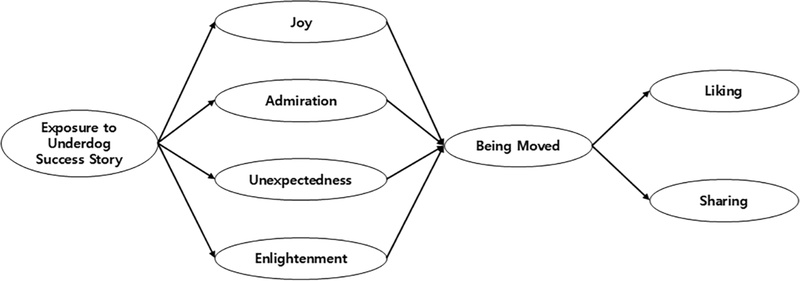
A Research Model for the Effect of Underdog Success Stories
METHOD
Participants and Procedure
To test the proposed hypotheses, we conducted an online experiment in which participants were randomly assigned to either the underdog or the non-underdog success story condition. Data collection was carried out by a professional research company in South Korea. A total of 320 participants were recruited from this company’s online research panel. Eligible participants were individuals aged 18 to 65 who had shared content on social media at least once in the past month. Gender was evenly distributed among participants (160 males and 160 females), and the average age was 39.94 years (SD = 10.36).
Data collection was conducted for six days between August 24 and 29, 2023. The experiment took approximately ten minutes to complete on average. After providing informed consent, participants first responded to questions about demographics and social media use. They were then shown a randomly assigned success story video. Following the viewing, they answered questions assessing their intentions to like and share, emotional and cognitive responses, and being moved. At the end, a manipulation check was administered, and participants were debriefed. The study protocol was approved by the Institutional Review Board (IRB) at Sungkyunkwan University (IRB No. 2022-07-010).
Design and Stimulus Construction
A between-subjects design comparing two conditions (underdog vs. non-underdog success stories) was employed. Multiple messages were used for the experimental manipulation, with each participant viewing a single video. Specifically, ten underdog success stories and ten non-underdog stories were included, and 320 participants were randomly assigned to watch one of these twenty videos (i.e., each video was viewed by 16 participants).
The 20 videos used in this study were drawn from a pool of 40 videos identified in a previous study on underdog success stories (see Kang & Chung, 2023, for details). In that study, the researchers initially identified 65 videos containing success narratives on YouTube using keywords such as “success story,” “life turnaround,” “patience and effort,” “challenge,” and “never giving up.” After confirming the availability of Korean subtitles and securing copyright permission from the creators, 40 videos were retained. The videos were selected for their inspiring narratives, whereas content primarily intended for entertainment was excluded. Although originally produced by various media outlets, including YouTube motivational channels, terrestrial broadcasting, and cable television, they were all accessed via the YouTube platform. The selected stimuli featured a range of formats, such as speeches, interviews, and produced content. Based on participants’ perceptions, this set of 40 videos was subsequently classified as underdog (N = 27) or non-underdog (N = 13) success stories.1
For the present study, the ten highest-rated and the ten lowest-rated videos within each previously classified category were selected to further refine the stimulus set (see Appendix).2 Video lengths ranged from 1 minute 31 seconds (Zen Breaker’s story) to 5 minutes 30 seconds (Hyojin Choi’s story), with an average length of 3 minutes 43 seconds (SD = 1 minute 10 seconds).
Measurements
All main study variables were assessed on 7-point Likert-type scales (1 = Not at all to 7 = Very much).
Liking expression and sharing intention on social media were measured with a single item for each variable, adapted from Piksa et al. (2023). Piksa et al. (2023) measured liking expression for news articles on social media by asking individuals to self-report the likelihood that they would click the “like” button for such articles. In the present study, we adapted their items by specifying platforms (Facebook and YouTube) and by replacing “news articles” with “videos.” For liking expression, participants were asked, “If you were to actually watch this video on social media such as Facebook or YouTube, how likely is it that you would click the “like” button for the video?” (M = 5.29, SD = 1.51). For sharing intention, participants were asked, “If you were to actually watch this video on social media, how likely is it that you would share it with your family, friends, or acquaintances via social media platforms such as KakaoTalk or other SNSs?” (M = 4.50, SD = 1.61).
Joy and admiration were measured by asking participants, “How did you feel about the protagonist achieving their goal in the video?” They were then prompted to rate the extent to which they felt each emotion. To measure joy, we used three items based on PANAS-joy (Watkins et al., 2018)3: “I felt happy,” “I felt joyful,” and “I felt delighted about their success.4 The reliability of these three items was tested with McDonald’s ω (Hayes & Coutts, 2020; McDonald, 1999) and was found acceptable, ω = .90. For admiration, participants responded to three statements: “I felt admiration,” “I felt amazed,” and “I felt it was remarkable.” These items were created based on Algoe and Haidt (2009). The reliability of the three items was acceptable, McDonald’s ω = .93.
To measure unexpectedness, participants were asked “ What do you think about the protagonist’s achievement in the video?” and then prompted to rate three items. These items were adapted from the surprise subscale of Izard et al.’s Differential Emotions Scale (DES), as surprise closely aligns conceptually with unexpectedness in the context of the present study: “It was surprising,” “It was unexpected,” and “It was incredible.” The reliability of the three items was acceptable, McDonald’s ω = .90. To measure enlightenment, participants indicated the degree of agreement with three statements adapted from Igartua et al. (2025), whose scale captures reflective insights and cognitive gains from media exposure: “After watching the video, I gained enlightenment,” “I gained insight,” and “I learned a lesson.” The reliability was found acceptable, McDonald’s ω = .90.
Being moved was assessed by asking participants to indicate the extent to which they experienced the following after watching the video. Three items were adapted from the kama muta label index among the emotion labels identified by Zickfeld et al. (2019): “I was moved,” “I was elevated,” and “I felt warmth in my chest.” The reliability was acceptable, McDonald’s ω = .91.
To assess participants’ perception of the video as an underdog success story, we asked them to rate the extent to which they viewed the video as such. Response options were: 1 = Definitely not an underdog success story at all, 2 = Difficult to view as an underdog success story, 3 = Not sure if it is an underdog success story, 4 = Can be viewed as an underdog success story, and 5 = Definitely an underdog success story.
RESULTS
Descriptive Statistics
The means, standard deviations, and zero-order correlations among the measurement items are reported in Table 1.

Descriptive Statistics and Zero-Order Correlations Among Measurement Items
Data Analysis Strategy
The data had a nested structure, with Level-1 variables (joy, admiration, unexpectedness, enlightenment, being moved, liking expression, and sharing intention) nested within message groups (16 participants in each of the 20 groups). Story type (1 = Non-underdog success story, 2 = Underdog success story) was specified as a Level-2 variable. Multilevel modeling would typically be preferred to account for non-independence in such data (Raudenbush & Bryk, 2002; Snijders & Bosker, 2011). However, when between-group variability is small (i.e., when the intraclass correlation coefficient [ICC] is below .05), observations can be treated as nearly independent, and single-level analyses provide unbiased estimates of parameters and standard errors (Heck, 2001).
Accordingly, we first examined ICCs for the main dependent variables using composite scores. Because theoretical differences were expected between non-underdog and underdog success stories, we calculated ICCs for each story type. As shown in Table 2, ICC values were below .05 for most variables, indicating minimal between-group variance. Therefore, subsequent analyses were conducted using single-level models.
Intraclass Correlation Coefficients for Main Variables
Manipulation Check
A manipulation check was conducted using the 5-point perceived underdog story rating. The t-test result showed that the videos classified as underdog stories received significantly higher ratings (M = 3.99, SD = 1.00) than those classified as non-underdog stories (M = 3.22, SD = 0.91), t(318) = 7.26, Cohen’s d = 0.96, p < .001. This result confirms that the manipulation was successful.
Structural Equation Modeling Analysis
To test the hypotheses, structural equation modeling (SEM) was conducted in Mplus Version 8.1 (Muthén & Muthén, 1998–2017) using maximum likelihood estimation. We first tested the measurement model, which included latent variables of joy, admiration, unexpectedness, enlightenment, and being moved (each measured with three indicators). Modification indices from the initial model suggested allowing the residuals of the second and third indicators of unexpectedness to covary. The modified measurement model demonstrated good fit to the data, χ²(79, N = 320) = 267.50, p < .001, CFI = .97, TLI = .96, RMSEA = .07 (90% CI [.06, .09]), and SRMR = .03 (Bentler & Raykov, 2000; Browne & Cudeck, 1993).
We then estimated the full structural model, including story type (1 = underdog story, 0 = non-underdog story), the five latent variables, and single-indicator variables for liking expression and sharing intention. A direct path from story type to being moved was specified to test the proposed mediation in H2. The model fit the data well, χ²(119, N = 320) = 363.92, p < .001, CFI = .96, TLI = .96, RMSEA = .07 (90% CI [.06, .08]), and SRMR = .04 (Bentler & Raykov, 2000; Browne & Cudeck, 1993). Standardized path coefficients are presented in Figure 2. Indirect effects were estimated using bootstrapping (5,000 samples) and are reported with 95% confidence intervals in brackets.
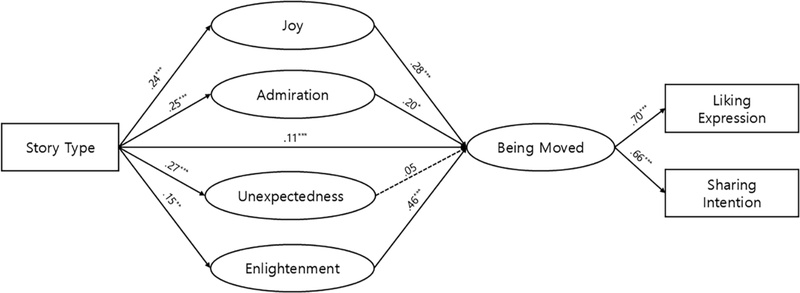
Results of Structural Equation Modeling AnalysisNote. Standardized path coefficients are presented. * p < .05, ** p < .01, *** p < .001. Story type is either typical non-under-dog success stories (= 0) or underdog success stories (= 1). Joy, admiration, unexpectedness, enlightenment, and being moved are latent variables and each latent variable has three indicators (standardized factor loadings are .90, .96, and .85 for joy, .90, .94, and .93 for admiration, .89, .87, and .59 for unexpectedness, .92, .94, and .85 for enlightenment, and .93, .91, and .92 for being moved. Residuals of joy, admiration, unexpectedness, and enlightenment were allowed to covary ([.65, .83]). Residuals of liking expression and sharing intention were also to covary (.55) and two indicators of unex-pectedness were allowed to covary (.35).
Hypothesis Testing
H1 examined whether exposure to underdog success stories would increase social media engagement: (a) liking expression and (b) sharing intention. H1a and H1b were tested with t-tests. Liking expression was significantly higher for underdog success stories (M = 5.50, SD = 1.44) than for non-underdog success stories (M = 5.09, SD = 1.56), t(318) = 2.46, p = .014, supporting H1a. In contrast, sharing intention did not differ significantly between the underdog (M = 4.62, SD = 1.59) and non-underdog conditions (M = 4.38, SD = 1.63), t(318) = 1.32, p = .188. Thus, H1b was not supported.
H2 predicted that underdog success stories would elicit a stronger sense of being moved, which would in turn enhance social media engagement, compared to non-underdog success stories. SEM results indicated that story type significantly predicted being moved (b = 0.29, SE = 0.07, β = .11, p < .001), such that underdog success stories elicited higher levels of being moved (M = 5.65, SD = 1.20) than non-underdog success stories (M = 4.83, SD = 1.33). Being moved was positively associated with both liking expression (b = 0.82, SE = 0.05, β = .70, p < .001) and sharing intention (b = 0.81, SE = 0.06, β = .66, p < .001). Bootstrapping analyses revealed a significant indirect effect of story type on liking expression via being moved (b = 0.23 [0.12, 0.36], β = .08, p < .001), supporting H2a. A similar indirect effect was observed for sharing intention (b = 0.23 [0.13, 0.35], β = .07, p < .001), supporting H2b.
H3 concerned whether underdog success stories would generate greater joy than non-underdog stories and whether this heightened joy would indirectly promote social media engagement through being moved. Story type had a significant effect on joy (b = 0.57, SE = 0.14, β = .24, p < .001), with underdog success stories generating greater joy (M = 5.36, SD = 1.11) than non-underdog success stories (M = 4.79, SD = 1.31). Joy was, in turn, positively associated with being moved (b = 0.31, SE = 0.06, β = .28, p < .001). The indirect effect of story type on being moved via joy was significant (b = 0.17 [0.06, 0.28], β = .07, p = .001). Furthermore, the sequential indirect effect of story type on liking expression through joy and being moved was significant (b = 0.14 [0.06, 0.28], β = .05, p = .009). H3a was thus supported. Likewise, the sequential indirect effect of story type on sharing intention via joy and being moved was significant (b = 0.14 [0.06, 0.27], β = .04, p = .009), supporting H3b.
H4 examined whether admiration would serve as a mediating mechanism linking story type to engagement via being moved. Story type had a significant effect on admiration (b = 0.58, SE = 0.13, β = .25, p < .001), indicating that underdog success stories evoked greater admiration (M = 6.04, SD = 1.07) than non-underdog stories (M = 5.47, SD = 1.23). Admiration was positively associated with being moved (b = 0.22, SE = 0.09, β = .20, p = .014). The indirect effect of story type on being moved via admiration was significant (b = 0.13 [0.02, 0.24], β = .05, p = .033). Sequential indirect effects through admiration and being moved were also significant for liking expression (b = 0.11 [0.01, 0.20], β = .04, p = .032) and sharing intention (b = 0.10 [0.01, 0.20], β = .03, p = .033), supporting H4a and H4b.
H5 tested unexpectedness as an additional pathway linking story type to social media engagement via being moved. As expected, underdog stories significantly increased unexpectedness (M = 6.04, SD = 0.93) compared to non-underdog stories (M = 5.51, SD = 1.02) (b = 0.51, SE = 0.11, β = .27, p < .001). However, unexpectedness was not significantly associated with being moved (b = 0.07, SE = 0.10, β = .05, p = .506). Accordingly, sequential indirect effects on liking expression (b = 0.03 [−0.09, 0.16], β = .01, p = .509) and sharing intention (b = 0.03 [−0.08, 0.15], β = .01, p = .510) were not significant. Therefore, H5a and H5b were not supported.
Finally, H6 examined whether enlightenment would act as a mediator through which story type influences social media engagement via being moved. The effect of story type on enlightenment was statistically significant (b = 0.35, SE = 0.13, β = .15, p = .008), such that underdog success stories elicited greater enlightenment (M = 5.19, SD = 1.25) than non-underdog success stories (M = 4.82, SD = 1.21). In turn, enlightenment was positively associated with being moved (b = 0.51, SE = 0.06, β = .46, p < .001). The indirect effect of story type on being moved via enlightenment was statistically significant (b = 0.18 [0.09, 0.32], β = .07, p = .009). Sequential indirect effects via enlightenment and being moved were also significant for liking expression (b = 0.15 [0.04, 0.28], β = .05, p = .010) and sharing intention (b = 0.15 [0.03, 0.27], β = .04, p = .012). These findings supported H6a and H6b.
Additional Analyses Using Perceived Underdog Ratings
Given variability in participants’ perceptions of the underdog nature of the stories, we conducted additional analyses using perceived underdog ratings as a continuous predictor rather than the manipulated story-type variable. The overall pattern of findings remained consistent with the primary analyses. For H2 through H6, the indirect effects observed in the full model were substantively unchanged. One exception emerged for H1; when perceived underdog ratings were used as the predictor, both liking expression and sharing intention were significantly associated with perceived underdog status, whereas in the manipulated-condition analysis only liking expression was significant. These results suggest that the main mediational pathways are robust to individual differences in perceived underdog status, alleviating concerns about potential ambiguity in the categorical classification of the stimuli.
DISCUSSION
Social media affordances have amplified the frequency and intensity of interaction with uplifting media content, offering a substantial opportunity for eudaimonic and self-transcendent experiences (Oliver, 2022). Despite this, the mechanisms through which underdog narratives drive engagement—particularly the role of being moved—have remained unclear. Addressing this gap, this study examined how underdog (versus non-underdog) success stories influence social media engagement, particularly liking and sharing. Building on Oliver et al.’s (2021) model of inspiring media, as well as research on self-transcendent experience in social media contexts (e.g., Dale et al., 2020) and social media affordances (Ronzhyn et al., 2023), we proposed that exposure to underdog success stories elicits distinct emotional (joy and admiration) and cognitive (unexpectedness and enlightenment) responses, which foster being moved and ultimately shape the inclination to like and share content on social media.
Implications of Findings
One of the most notable findings underscores the crucial role of being moved in motivating engagement with underdog success stories on social media. While the concept of being moved has been widely discussed in the context of eudaimonic motivations, as opposed to hedonic ones, in positive media psychology (Oliver & Raney, 2011; Oliver et al., 2012), its behavioral implications in social media environments have remained underexplored. Our findings position being moved as a central integrative mechanism that translates discrete emotional and cognitive responses into observable engagement behaviors. The deeper resonance of underdog stories tends to prompt audiences to express their engagement through liking and sharing. Therefore, the universal appeal of underdog stories, combined with the experience of elevation, may account for their widespread virality on social media (Jang et al., 2019; Oliver, 2022).
This research also contributes to our understanding of positive digital narratives by clarifying how self-transcendent experiences translate into social media engagement (Dale et al., 2020). In the SEM, story type showed significant indirect effects on both liking and sharing through being moved, whereas direct comparisons of story type showed effects on liking but not on sharing intention. This divergence suggests that although liking and sharing remain behaviorally and socially distinct, they share a common emotional foundation. Sharing typically entails greater perceived endorsement and higher social costs than liking, leading users to apply stricter standards when deciding what to share publicly (Ma et al., 2023; Tenenboim, 2022). Being moved, however, may provide emotional justification that encourages audiences to express their resonance, even across behaviors that differ in social visibility. Thus, the findings do not imply that liking and sharing are interchangeable; rather, they suggest that self-transcendent emotional experiences can motivate multiple forms of engagement while preserving their qualitative differences. Uplifting content may therefore foster not only individual meaning but also social interaction, contributing to digital prosocial dynamics (Beelen & Karsay, 2024). In this sense, the present findings offer insights into how people engage with underdog narratives on platforms like YouTube, with implications for content creation and distribution strategies (Berger, 2025; Heath & Heath, 2007; Khan, 2017).
Furthermore, the present findings clarify the conceptual relationship among joy, admiration, and being moved. Consistent with our theoretical framing, joy and admiration did not function as competing or sequential emotions; instead, both emerged as distinct yet complementary pathways to being moved. Although joy is often characterized as self-focused (Algoe & Haidt, 2009), our findings suggest that in narrative contexts—especially those involving identification with an underdog protagonist—joy may take the form of empathic or vicarious joy grounded in psychological alignment (Royzman & Rozin, 2006). Admiration, by contrast, reflected moral appraisal of the protagonist’s perseverance and effort under adversity. Being moved, in turn, appears to arise when these affective responses converge within a meaningful narrative frame. Thus, the findings help resolve the apparent tension between self-focused and other-praising emotions by showing how narrative identification can transform joy into a socially oriented response that coexists with admiration. More broadly, this highlights the importance of narrative context in shaping emotional responses to others’ achievements on social media.
Regarding the specific mediators, all emotional and cognitive factors in the proposed model, except for unexpectedness, significantly contributed to being moved and, indirectly, to engagement outcomes. Unexpectedness was not statistically associated with being moved when included alongside the other emotional and cognitive variables in the structural model. Additional analyses revealed a high correlation between unexpectedness and admiration (r = .74), suggesting that unexpectedness may be closely related to emotional responses by influencing the appraisal of message content. From an appraisal perspective, expectation violation may intensify admiration or elevation by amplifying the perceived difficulty and improbability of success. In this sense, unexpectedness may function less as a distinct pathway and more as a catalyst that strengthens morally evaluative responses. Further research is needed to investigate the temporal and causal ordering of these processes.
A potential concern is whether underdog success narratives can genuinely elicit unexpectedness given their familiarity as cultural tropes. Underdog stories are widely recognizable in both Western and South Korean media contexts. However, the unexpectedness examined in this study reflects outcome-based expectation violation within specific narrative instances rather than the novelty of the narrative form itself. Even when audiences recognize the broader trope, the perceived improbability of success in a particular story can still generate meaningful expectation violation. Thus, familiarity with the underdog template does not preclude experienced unexpectedness; rather, unexpectedness is shaped by the degree of perceived narrative reversal within each story, with success remaining improbable rather than entirely unforeseen. Together with the robustness analyses using perceived underdog ratings, these findings alleviate concerns that cultural familiarity or ambiguity in classification undermines the interpretation of unexpectedness and the mediation model.
This research holds methodological significance as well. Whereas many media psychology studies tend to employ a restricted number of messages or stories to investigate psychological responses to a specific message type, our approach was different. We meticulously curated a collection of twenty videos available on YouTube to reduce case-category confounding and enhance generalizability. By combining experimental manipulation with perceived-rating robustness checks and a full structural mediation model, this study offers a more comprehensive examination of how underdog narratives operate in naturalistic digital contexts.
Limitations and Future Directions
This study has several limitations. First, although the manipulation check confirmed that underdog stories were perceived as more underdog-like than non-underdog stories, the distinction between the two categories was not always clear-cut, as both types often depicted protagonists overcoming challenges. Participants’ subjective perceptions may therefore have attenuated the comparative effects between conditions. Notably, additional analyses using perceived underdog ratings yielded largely consistent results, suggesting that the primary mediation patterns were robust. Nevertheless, future research should employ more clearly differentiated stimuli to strengthen experimental contrasts and test the proposed hypotheses.
Second, although stimulus videos were randomly assigned to participants and drawn from a previously validated pool, they varied in duration, format (e.g., speeches, interviews, produced videos), and protagonist characteristics (e.g., gender). Video lengths ranged from 1:31 to 5:30 minutes. Because controlling duration without editing the original content was not feasible, we conducted additional analyses to examine whether video length influenced liking expression or sharing intention. The results indicated no significant effects (liking: β = .08, t = 1.48, p = .141; sharing: β = .02, t = 0.30, p = .762), and video length was not included in subsequent analyses. Although these message-level features were not systematically associated with experimental condition and between-message variance was minimal, they may still have influenced emotional responses. Future research should more systematically control or manipulate such characteristics to isolate their independent and interactive effects on engagement.
Third, the assumed causal order of variables in our serial mediation model warrants caution. Although our model is informed by previous research (Kang & Chung, 2023; Oliver et al., 2021; Zickfeld et al., 2019), the conceptual proximity among joy, admiration, and being moved makes their precise causal sequence difficult to establish definitively. Future studies should refine the measurement of being moved to further clarify its role in emotional responses to inspirational media. Experimental or longitudinal designs that manipulate specific emotional appraisals may help clarify the dynamic interplay among these constructs.
Fourth, our study focused primarily on positive emotional and cognitive responses. Yet, it is worth noting that underdog success stories could also trigger ambivalent or negative reactions, such as disappointment, jealousy, or skepticism. Therefore, future research should explore these mixed emotional responses more comprehensively to capture the full spectrum of audience reactions. Further exploration of both eudaimonic and hedonic responses to inspirational content will also be essential to fully understand their combined effects on audience engagement and content virality in digital environments.
Finally, although this study applied multilevel analyses for selected tests, the limited number of messages precluded multilevel SEM. Given that between-message variance in the main variables was minimal, the analytic approach adopted here was appropriate. Nonetheless, future research incorporating a larger and more diverse set of stimuli would allow for more rigorous multilevel modeling and deeper examination of how message-level characteristics and cultural context shape audience responses to underdog narratives.
Conclusion
In conclusion, this study underscores the significant impact of underdog success stories on emotional and behavioral engagement on social media, particularly through joy, admiration, enlightenment, and being moved. By identifying being moved as a central integrative process, the findings advance understanding of how self-transcendent experiences translate into observable digital behaviors. Beyond its theoretical contributions, the study also offers practical implications for content creators and platform designers. Stories that effectively elicit emotional and cognitive responses—especially those emphasizing effort and perseverance— may promote both individual meaning and socially visible engagement. This highlights the strategic potential of positive digital narratives to foster eudaimonic experiences and encourage prosocial behaviors within social media ecosystems.
Acknowledgments
This work was supported by the 2025 Early Career Research Grant from the Korean Association for Broadcasting & Telecommunication Studies, with funding provided by GS Retail. This study was approved by the Institutional Review Board (IRB) at Sungkyunkwan University (IRB No. 2022-07-010).
Disclosure Statement
No potential conflict of interest was reported by the authors.
Notes
References
-
Algoe, S. B., & Haidt, J. (2009). Witnessing excellence in action: The ‘other-praising’ emotions of elevation, gratitude, and admiration. The Journal of Positive Psychology, 4(2), 105–127.
[https://doi.org/10.1080/17439760802650519]

-
Beelen, E., & Karsay, K. (2024). “The future is bright! Is it?”: Investigating effects of hopeful mental health content and endorsement cues on social media. Social Media + Society, 10(3), 20563051241277603.
[https://doi.org/10.1177/20563051241277603]
-
Bentler, P. M., & Raykov, T. (2000). On measures of explained variance in nonrecursive structural equation models. Journal of Applied Psychology, 85(1), 125–131.
[https://doi.org/10.1037/0021-9010.85.1.125]
-
Berger, J. (2014). Word of mouth and interpersonal communication: A review and directions for future research. Journal of Consumer Psychology, 24(4), 586–607.
[https://doi.org/10.1016/j.jcps.2014.05.002]
- Berger, J. (2016). Contagious: Why things catch on. Simon and Schuster.
-
Berger, J. (2025). What gets shared, and why? Interpersonal communication and word of mouth. Annual Review of Psychology, 76, 559–581.
[https://doi.org/10.1146/annurev-psych-013024-031524]
-
Berger, J., & Milkman, K. L. (2012). What makes online content viral? Journal of Marketing Research, 49(2), 192–205.
[https://doi.org/10.1509/jmr.10.0353]
- Browne, M. W., & Cudeck, R. (1993). Alternative ways of assessing model fit. In K. A. Bollen & J. S. Long (Eds.), Testing structural equation models (pp. 136–162). Sage.
-
Cohen, J. (2001). Defining identification: A theoretical look at the identification of audiences with media characters. Mass Communication & Society, 4(3), 245–264.
[https://doi.org/10.1207/S15327825MCS0403_01]
-
Dale, K. R., Raney, A. A., Ji, Q., Janicke-Bowles, S. H., Baldwin, J., Rowlett, J. T., Wang, C., & Oliver, M. B. (2020). Self-transcendent emotions and social media: Exploring the content and consumers of inspirational Facebook posts. New Media & Society, 22(3), 507–527.
[https://doi.org/10.1177/1461444819865720]
-
Fredrickson, B. L. (1998). What good are positive emotions? Review of General Psychology, 2(3), 300–319.
[https://doi.org/10.1037/1089-2680.2.3.300]
-
Grizzard, M., Francemone, C. J., Frazer, R., Fitzgerald, K., Monge, C. K., & Henry, C. (2023). A comprehensive experimental test of the affective disposition theory of drama. Journal of Communication, 73(4), 289–303.
[https://doi.org/10.1093/joc/jqac053]
-
Guo, M., & Sun, F.-S. (2020). Like, comment, or share? Exploring the effects of local television news Facebook posts on news engagement. Journal of Broadcasting & Electronic Media, 64(5), 736–755.
[https://doi.org/10.1080/08838151.2020.1851125]
-
Hayes, A. F., & Coutts, J. J. (2020). Use omega rather than Cronbach’s alpha for estimating reliability. But…. Communication Methods and Measures, 14(1), 1–24.
[https://doi.org/10.1080/19312458.2020.1718629]
-
Heath, C., Bell, C., & Sternberg, E. (2001). Emotional selection in memes: The case of urban legends. Journal of Personality and Social Psychology, 81(6), 1028–1041.
[https://doi.org/10.1037/0022-3514.81.6.1028]
- Heath, C., & Heath, D. (2007). Made to stick: Why some ideas survive and others die. Random House.
-
Heck, R. H. (2001). Multilevel modeling with SEM. In New developments and techniques in structural equation modeling (pp. 109–148). Psychology Press.
[https://doi.org/10.4324/9781410601858-9]
-
Hollebeek, L. D., Conduit, J., & Brodie, R. J. (2016). Strategic drivers, anticipated and unanticipated outcomes of customer engagement. Journal of Marketing Management, 32(5–6), 393–398.
[https://doi.org/10.1080/0267257X.2016.1144360]
-
Igartua, J. J., Oliver, M. B., González-Vázquez, A., Piñeiro-Naval, V., Marcos-Ramos, M., & Rodríguez-Contreras, L. (2025). Psychological insight as an effect of inspiring narratives: Validating the psychological insight self-report scale. Human Communication Research, 51(2), 93–111.
[https://doi.org/10.1093/hcr/hqae023]
-
Izard, C. E., Libero, D. Z., Putnam, P., & Haynes, O. M. (1993). Stability of emotion experiences and their relations to traits of personality. Journal of Personality and Social Psychology, 64(5), Article 847.
[https://doi.org/10.1037/0022-3514.64.5.847]
-
Jang, W. E., Lee, J. S., Kwak, D. H., & Ko, Y. J. (2019). Meaningful vs. hedonic consumption: The effects of elevation on online sharing and information searching behaviors. Telematics and Informatics, 45, Article 101298.
[https://doi.org/10.1016/j.tele.2019.101298]
-
Kang, K., & Chung, S. (2023). Emotional and cognitive responses to underdog success stories and user engagement on social media. Korean Journal of Journalism and Communication, 67(2), 117–152.
[https://doi.org/10.20879/kjjcs.2023.67.2.004]
-
Khan, M. L. (2017). Social media engagement: What motivates user participation and consumption on YouTube? Computers in Human Behavior, 66, 236–247.
[https://doi.org/10.1016/j.chb.2016.09.024]
-
Kim, J., Allison, S. T., Eylon, D., Goethals, G. R., Markus, M. J., Hindle, S. M., & McGuire, H. A. (2008). Rooting for (and then abandoning) the underdog. Journal of Applied Social Psychology, 38(10), 2550–2573.
[https://doi.org/10.1111/j.1559-1816.2008.00403.x]
- Korean Psychological Association (n.d.). Psychological terms. https://www.koreanpsychology.or.kr/eng/psychology/term.html
-
Lee, S., & Lang, A. (2009). Discrete emotion and motivation: Relative activation in the appetitive and aversive motivational systems as a function of anger, sadness, fear, and joy during televised information campaigns. Media Psychology, 12(2), 148–170.
[https://doi.org/10.1080/15213260902849927]
-
Ma, Z., Ma, R., Zhao, X., & Wang, X. (2023). Stories that engage the audience: An investigation of popular breast cancer narratives on social media. Telematics and Informatics, 85, Article 102048.
[https://doi.org/10.1016/j.tele.2023.102048]
- McDonald, R. P. (1999). Test theory: A unified treatment. Lawrence Erlbaum.
-
McGinnis, L. P., & Gentry, J. W. (2009). Underdog consumption: An exploration into meanings and motives. Journal of Business Research, 62(2), 191–199.
[https://doi.org/10.1016/j.jbusres.2008.01.026]
-
Menninghaus, W., Wagner, V., Hanich, J., Wassiliwizky, E., Kuehnast, M., & Jacobsen, T. (2015). Towards a psychological construct of being moved. PloS ONE, 10(6), Article e0128451.
[https://doi.org/10.1371/journal.pone.0128451]
- Muthén, L. K., & Muthén, B. O. (2017). Mplus statistical analysis with latent variables: User’s guide (8th ed.). Muthén & Muthén (Original work published 1998).
-
Nurmohamed, S., Kundro, T. G., & Myers, C. G. (2021). Against the odds: Developing underdog versus favorite narratives to offset prior experiences of discrimination. Organizational Behavior and Human Decision Processes, 167, 206–221.
[https://doi.org/10.1016/j.obhdp.2021.04.008]
-
Oeldorf-Hirsch, A., & Sundar, S. S. (2015). Posting, commenting, and tagging: Effects of sharing news stories on Facebook. Computers in Human Behavior, 44, 240–249.
[https://doi.org/10.1016/j.chb.2014.11.024]
-
Oliver, M. B. (2022). Social media use and eudaimonic well-being. Current Opinion in Psychology, 45, Article 101307.
[https://doi.org/10.1016/j.copsyc.2022.101307]
-
Oliver, M. B., Hartmann, T., & Woolley, J. K. (2012). Elevation in response to entertainment por trayals of moral v ir tue. Human Communication Research, 38(3), 360–378.
[https://doi.org/10.1111/j.1468-2958.2012.01427.x]
-
Oliver, M. B., & R aney, A . A . (2011 ). Entertainment as pleasurable and meaningful: Identifying hedonic and eudaimonic motivations for entertainment consumption. Journal of Communication, 61(5), 984–1004.
[https://doi.org/10.1111/j.1460-2466.2011.01585.x]
-
Oliver, M. B., Raney, A. A., Bartsch, A., Janicke-Bowles, S., Appel, M., & Dale, K. (2021). Model of inspiring media. Journal of Media Psychology, 33(4), 191–201.
[https://doi.org/10.1027/1864-1105/a000305]
-
Pan, X., & Jiang, T. (2025). A tale of self-transcendence: Awe fosters optimism. The Journal of Positive Psychology, 20(4), 616-630.
[https://doi.org/10.1080/17439760.2024.2394458]
-
Park, S. R. (2009). The characters as the last born found in the tales handed down orally and the cultural meaning of them. The Studies in Korean Literature, 37, 133–177.
[https://doi.org/10.20881/skl.2009..37.005]
-
Piksa, M., Noworyta, K., Gundersen, A. B., Kunst, J., Morzy, M., Piasecki, J., & Rygula, R. (2023). Are we willing to share what we believe is true? Factors influencing susceptibility to fake news. Frontiers in Psychiatry, 14, Article 1165103.
[https://doi.org/10.3389/fpsyt.2023.1165103]
-
Prestin, A. (2013). The pursuit of hopefulness: Operationalizing hope in entertainment media narratives. Media Psychology, 16(3), 318–346.
[https://doi.org/10.1080/15213269.2013.773494]
- Raudenbush, S. W., & Bryk, A. S. (2002). Hierarchical linear models: Applications and data analysis methods (Vol. 1). Sage.
-
Ronzhyn, A., Cardenal, A. S., & Rubio, A. B. (2023). Defining affordances in social media research: A literature review. New Media & Society, 25(11), 3165–3188.
[https://doi.org/10.1177/14614448221135187]
-
Royzman, E. B., & Rozin, P. (2006). Limits of symhedonia: The differential role of prior emotional attachment in sympathy and sympathetic joy. Emotion, 6(1), 82–93.
[https://doi.org/10.1037/1528-3542.6.1.82]
-
Silvers, J. A., & Haidt, J. (2008). Moral elevation can induce nursing. Emotion, 8(2), 291.
[https://doi.org/10.1037/1528-3542.8.2.291]
-
Skavronskaya, L., Moyle, B., Scott, N., & Schaffer, V. (2021). Novelty, unexpectedness and surprise: A conceptual clarification. Tourism Recreation Research, 46(4), 548–552.
[https://doi.org/10.1080/02508281.2020.1828556]
- Snijders, T. A., & Bosker, R. J. (2011). Multilevel analysis: An introduction to basic and advanced multilevel modeling. Sage.
-
Tenenboim, O. (2022). Comments, shares, or likes: What makes news posts engaging in different ways. Social Media + Society, 8(4).
[https://doi.org/10.1177/20563051221130282]
-
Thrash, T. M., & Elliot, A. J. (2003). Inspiration as a psychological construct. Journal of Personality and Social Psychology, 84(4), 871–889.
[https://doi.org/10.1037/0022-3514.84.4.871]
-
Vandello, J. A., Goldschmied, N. P., & Richards, D. A. (2007). The appeal of the underdog. Personality and Social Psychology Bulletin, 33(12), 1603–1616.
[https://doi.org/10.1177/0146167207307488]
-
Wang, J., & Sundar, S. S. (2022). Liking versus commenting on online news: Effects of expression affordances on political attitudes. Journal of Computer-Mediated Communication, 27(6), Article zmac018.
[https://doi.org/10.1093/jcmc/zmac018]
-
Watkins, P. C., Emmons, R. A., Greaves, M. R., & Bell, J. (2018). Joy is a distinct positive emotion: Assessment of joy and relationship to gratitude and well-being. The Journal of Positive Psychology, 13(5), 522–539.
[https://doi.org/10.1080/17439760.2017.1414298]
-
Zhao, X., Wang, X., Ma, Z., & Ma, R. (2022) Primacy effect of emotions in social stories: User engagement behaviors with breast cancer narratives on Facebook. Computers in Human Behavior, 137, Article 107405.
[https://doi.org/10.1016/j.chb.2022.107405]
-
Zickfeld, J. H., Schubert, T. W., Seibt, B., & Fiske, A. P. (2019). Moving through the literature: What is the emotion often denoted being moved? Emotion Review, 11(2), 123–139.
[https://doi.org/10.1177/1754073918820126]
- Zillmann, D. (2013). Moral monitoring and emotionality in responding to fiction, sports, and the news. In R. Tamborini (Ed.), Media and the moral mind (pp. 132–151). Routledge.