
Effects of Content Consumption and Group Norm Conformity on Xenophobia Toward Chinese: Evidence from Politically Oriented Korean Online Communities

Copyright ⓒ 2026 by the Korean Society for Journalism and Communication Studies
Abstract
This study examines how online content exposure relates to xenophobic attitudes toward Chinese individuals within politically oriented Korean online communities. Drawing on the Social Identity Model of Deindividuation Effects and media exposure research, the study investigates both direct and indirect pathways linking content consumption, group norm conformity, and xenophobia. Survey data were collected from users of seven major Korean online communities identified as either conservative or progressive. Structural equation modeling results indicate that online content exposure is positively associated with xenophobia both directly and indirectly through conformity to defensive norms and heterogeneity norms. Multigroup analyses reveal that the normative mechanisms underlying xenophobia differ by political orientation. Conformity to heterogeneity norms appears to play a more prominent role among users in conservative communities, whereas conformity to defensive norms appears to be more influential among users in progressive communities. These findings suggest that passive exposure to community discourse may not be neutral but may enhance norm-based pathways to xenophobic attitudes. By integrating content consumption and norm conformity processes within a politically polarized context, this study contributes to understanding how online spaces structure intergroup attitudes in contemporary Korean society.
Keywords:
xenophobia, online communities, group norm conformity, structural equation modelIn recent years, anti-Chinese sentiment has become a notable global phenomenon, with increasingly negative views observed not only in Western nations but also across Asia and other regions. Public opinion research conducted by the Sinophone Borderlands project1 between 2020 and 2022 further underscores the severity of anti-Chinese sentiment in South Korea. Among 56 countries surveyed, South Korea reported the highest proportion of negative views toward China, with 81 percent of respondents expressing negative or very negative attitudes. Notably, unlike many Western societies where respondents tend to distinguish between the Chinese state and Chinese people, 77 percent of South Koreans also reported negative or very negative views toward Chinese people.2 This convergence of negative evaluations of both the country and its people suggests that anti-Chinese sentiment in South Korea extends beyond geopolitical criticism and may reflect deeper intergroup hostility.
These attitudes have been shaped by long-standing historical grievances and contemporary tensions, including disputes over cultural heritage, economic competition, and environmental issues such as transboundary air pollution, which remains a prominent public concern in South Korea (Song, 2023a, 2023b). Negative portrayals of Chinese characters in popular culture have further reinforced these sentiments (Han & Shin, 2019a; Kim, 2016). However, structural tensions alone cannot fully explain why xenophobic attitudes persist and intensify within everyday communicative environments, particularly in digital spaces.
South Korea is increasingly characterized as a multicultural society, with individuals from multicultural backgrounds comprising more than five percent of the population. Yet xenophobia remains a persistent social challenge with significant implications for social cohesion, economic integration, and psychological well-being (Han & Shin, 2019b; Mansouri, 2023). Negative attitudes toward Chinese individuals have led to exclusion and discrimination, particularly against Korean Chinese communities (ethnic Koreans with Chinese citizenship), despite shared ethnic heritage and linguistic familiarity. Understanding how such attitudes are socially reproduced and amplified is therefore not only academically important but also socially consequential.
As a socially constructed phenomenon, hatred is transmitted within ingroups that share common norms and emotional orientations (Jung & Kim, 2024). Digital communication environments may intensify this process. The anonymity and reduced accountability of online interaction can strengthen conformity to perceived group norms and facilitate the expression of hostile sentiments (Lee & Kim, 2016). Online communities in South Korea, including forums and social media platforms, have become key spaces where anti-Chinese discourse spreads and is reinforced. Studies have shown that discussions surrounding issues such as fine dust pollution and the COVID-19 pandemic have contributed to the spread of negative attitudes toward both the Chinese government and Chinese people (Chen et al., 2021; Song, 2023a, 2023b).
While prior research has documented the existence of anti-Chinese discourse online, less attention has been paid to the psychological and normative mechanisms through which routine content consumption within online communities translates into xenophobic attitudes. It remains unclear whether xenophobia is driven solely by exposure to explicitly China-related content, or whether broader patterns of content consumption within polarized communities can also cultivate hostility through heightened conformity to group norms.
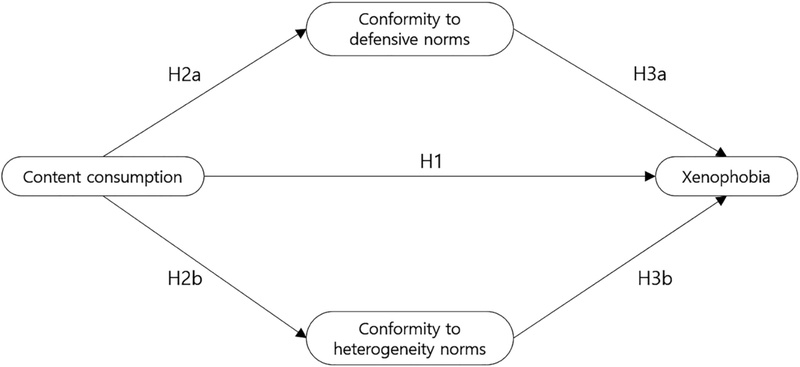
To address this gap, this study draws on the Social Identity Model of Deindividuation Effects (SIDE), which posits that in anonymous or deindividuated contexts, individuals are more likely to align their attitudes and behaviors with salient group norms (Finn, 2016; Gazan, 2009; Keipi et al., 2016; Lee, 2007; Melchiori et al., 2023; Postmes et al., 2000; Reicher et al., 1995). Building on SIDE, this study conceptualizes xenophobia as a normatively structured outcome shaped by two forms of group norm conformity: conformity to defensive norms and conformity to heterogeneity norms. Rather than treating media exposure as a direct cause of prejudice, the study examines whether content consumption operates through these normative pathways.
Specifically, this study examines whether content consumption within Korean online communities directly and indirectly influences xenophobia toward Chinese individuals through group norm conformity. Using survey data from users of selected conservative and progressive online communities, the study tests a structural equation model to assess both direct and mediated relationships among content consumption, conformity to defensive norms, conformity to heterogeneity norms, and xenophobia. In addition, by comparing users in conservative and progressive communities, the study explores whether the normative pathways linking content consumption to xenophobia differ across politically distinct communicative environments. The findings offer a clearer picture of how everyday engagement with online communities may be linked to xenophobic attitudes through norm-based processes, particularly within politically polarized environments.
LITERATURE REVIEW
Online Content Exposure and Xenophobia
Online communities provide structured environments in which users are repeatedly exposed to shared narratives, discussions, and evaluative frames (Boyd & Ellison, 2007). Although participation in such communities may involve a range of activities from posting and commenting to more interactive exchanges, a substantial proportion of users primarily engage through passive content exposure. Prior research has consistently shown that many community members “lurk,” regularly reading posts and following discussions without actively contributing (Nonnecke, 2000; Nonnecke et al., 2004). This form of engagement allows users to remain informed and socially connected while minimizing direct interaction.
Passive exposure, however, is not merely observational. Repeated browsing of posts, comments, and shared materials situates users within a patterned communicative environment in which certain themes and interpretations may recur (Stroud, 2010). Over time, such exposure can contribute to the formation of shared meanings and expectations within the community. Earlier studies on computer-mediated communication suggest that even without active contribution, accumulated exposure to group discourse can shape perceptions of norms, boundaries, and group identities (Haythornthwaite, 2007; Rafaeli & Sudweeks, 1997). From a media-effects perspective, repeated exposure to consistent narratives may gradually influence attitudes toward social groups. Cultivation research demonstrates that long-term exposure to stable media patterns can shape individuals’ perceptions of social reality (Gerbner et al., 2002; Morgan & Shanahan, 2010). In digitally mediated environments, where users often encounter ideologically homogeneous discussions shaped by competing collective narratives (Bliuc et al., 2021), recurring evaluative frames may normalize particular interpretations of outgroups. Empirical research indicates that exposure to politically aligned online discussions can reinforce stereotypes and prejudicial attitudes, even when users are not actively participating in the production of content (Costello et al., 2020; Wojcieszak & Mutz, 2009).
In Korean society, online discourse concerning China-related issues has frequently involved negative framing, particularly in politically oriented communities. Recent empirical studies provide support for the presence of recurring negative representations in China-related discourse within Korean online environments. Analyses of discussions surrounding issues such as fine dust pollution, COVID-19, and geopolitical tensions show that China is often framed as a source of responsibility or threat in online communication (Hwang, 2025; Jung & Kim, 2024; Noh & Sim, 2026; Song, 2023a, 2023b). Although such framing may be more prominent in politically conservative communities, it is not entirely confined to them (Chau & Xu, 2007; Hwang, 2025; Koo et al., 2024). Major national issues that receive extensive media attention tend to generate cross-community discussion, allowing similar evaluative frames to circulate across spaces with different political orientations (Karolidou & Matsiola, 2025). As a result, even in communities where explicitly anti-Chinese discourse is less dominant, users may still encounter recurring narratives that emphasize responsibility, difference, or competition.
Given the self-selective and heterogeneous nature of online environments, users may encounter different types of content depending on their interests and browsing patterns. Rather than assuming that all content encountered within online communities is uniformly anti-Chinese or that users are consistently exposed to explicitly xenophobic discourse, this study conceptualizes the volume and nature of such content as varying across communities, sub-communities, and individual usage patterns. From this perspective, content exposure is understood as engagement with the broader communicative environment of an online community. It functions as a pathway through which individuals become embedded in a community’s normative climate, rather than as a direct measure of exposure to specific anti-Chinese discourse. Through this process, sustained exposure to community-level frames and norms may contribute to the reinforcement of unfavorable evaluations of Chinese individuals.
Prior research suggests that even when specific content varies, users can be repeatedly exposed to dominant narratives, evaluative frames, and patterns of interpretation that characterize the community (Bliuc et al., 2021; Steinfeld & Lev-on, 2024; Wojcieszak & Mutz, 2009). In the Korean context, studies have documented that online discussions surrounding China-related issues often contain recurring negative framings, particularly in politically oriented spaces (Hwang, 2025; Noh & Sim, 2026; Song, 2023b). Continuous exposure to such discourse may shape perceptions of what viewpoints are typical, acceptable, or normative within that environment.
At the same time, participation in online communities is inherently selective, as users tend to choose environments that align with their existing beliefs and preferences, a pattern commonly described as selective exposure (Dvir-Gvirsman et al., 2016; Weeks et al., 2017). This raises the possibility that observed associations between content exposure and xenophobic attitudes may partially reflect the influence of self-selection rather than exposure alone (Hwang, 2025). However, prior research suggests that continued engagement with ideologically consistent content not only reflects pre-existing attitudes but also reinforces and intensifies them over time (Stroud, 2010; Wojcieszak & Mutz, 2009).
Integrating cultivation and norm-based perspectives, repeated exposure to stable patterns of discourse may both strengthen evaluative orientations toward social reality and increase the perceived salience of existing group norms. In other words, content exposure may function as a mechanism that stabilizes and amplifies norm-consistent attitudes rather than solely initiating them. Accordingly, this study focuses on the association between online content exposure and xenophobic attitudes toward Chinese individuals within Korean online communities, while recognizing that this relationship may reflect both reinforcement of existing orientations and alignment with perceived community norms.
- Hypothesis 1. Content consumption positively (+) influences xenophobia toward Chinese individuals
Group Norm Conformity in Online Communities
Online communities are not only spaces for information exchange but also environments in which shared norms gradually emerge. In these environments, norms are not limited to behavioral rules but also include shared interpretive frameworks through which social groups and issues are understood (Bliuc et al., 2021; Postmes et al., 2000). Through repeated exposure to discussions, reactions, and patterns of approval or sanction, users develop an understanding of what attitudes are acceptable within the group (Cialdini et al., 1990; Norris, 2002; Rajadesingan et al., 2020). Norms and rules, whether formal or informal, function as organizing principles that shape how individuals interpret, evaluate, and respond within the community (De Souza & Preece, 2004). Although some norms are formally articulated in community guidelines, many are conveyed implicitly through recurring narratives and collective responses. Over time, these patterns shape a normative climate that influences how members interpret social issues and evaluate outgroups.
The Social Identity Model of Deindividuation Effects (SIDE) provides a useful theoretical framework for understanding this process. SIDE proposes that when group identity becomes salient in computer-mediated settings, individuals tend to align their attitudes with perceived group norms (Postmes et al., 2000; Reicher et al., 1995). In politically oriented online communities where members often share similar ideological positions, repeated exposure to consistent evaluative frames may heighten the salience of particular normative orientations (Bliuc et al., 2021; Wojcieszak & Mutz, 2009). Conformity in such environments reflects not only adherence to explicit rules but also alignment with collectively constructed meanings. As these meanings are repeatedly expressed and reinforced within the group, they can become normative references that guide how members interpret outgroups and evaluate intergroup relations (Ivaturi & Chua, 2019).
In politically oriented communities, norms may center on how outgroups are interpreted. Some communities may cultivate defensive narratives that frame outgroups as threatening or competitive. Others may emphasize perceived differences between “us” and “them,” reinforcing social distance. Drawing from social identity and self-categorization perspectives, defensive responses are likely to emerge when ingroup is perceived as challenged (Tajfel & Turner, 1986), while emphasizing intergroup differences strengthens ingroup cohesion and psychological boundaries (Brewer, 1999; Turner, 2010). These processes are closely linked to prejudice and xenophobia, as perceiving an outgroup as threatening or fundamentally different increases social distance, negative evaluation, and exclusionary attitudes (Stephan & Stephan, 2013; Stephan et al., 2009). Prior research has also shown that threat-based and differentiation-based perceptions are key psychological antecedents of intergroup hostility in both offline and online contexts (Bliuc et al., 2021; Costello et al., 2017). These processes suggest that conformity to community norms can take distinct forms, including defensive framing and perceived heterogeneity toward an outgroup.
In the present study, group norm conformity is operationalized through two sub-dimensions: conformity to defensive norms and to heterogeneity norms. Conformity to defensive norms refers to alignment with norms that interpret the outgroup in defensive or competitive terms. Conformity to heterogeneity norms refers to alignment with norms that emphasize fundamental differences between ingroup and outgroup members. These two dimensions are selected because they represent theoretically grounded and empirically supported pathways through which intergroup perceptions translate into exclusionary attitudes, capturing both threat-based and differentiation-based mechanisms of prejudice. Both dimensions reflect ways in which normative climates within online communities may structure intergroup evaluations. Accumulated exposure to community narratives may reinforce these normative orientations. As users repeatedly encounter defensive or differentiation-based discourse, such perspectives can be perceived as dominant or expected within the community. In this way, online content exposure may strengthen conformity to prevailing norms. When individuals internalize norms that frame an outgroup as threatening or fundamentally distinct, such perceptions are more likely to translate into xenophobic attitudes, as they legitimize negative evaluations and social exclusion.
- Hypothesis 2a. Content consumption positively (+) influences conformity to defensive norms.
- Hypothesis 2b. Content consumption positively (+) influences conformity to heterogeneity norms.
- Hypothesis 3a. Conformity to defensive norms positively (+) influences xenophobia toward Chinese individuals.
- Hypothesis 3b. Conformity to heterogeneity norms positively (+) influences xenophobia toward Chinese individuals.
Prior research indicates that prejudicial attitudes are highly sensitive to perceived social norms. Individuals are more likely to express or internalize prejudice when such attitudes are perceived as socially approved within their group (Crandall et al., 2002). In computer-mediated environments, intra-group discussions can consolidate shared evaluative positions and intensify intergroup hostility, particularly when dominant perspectives go unchallenged (Smith & Postmes, 2009). When members deviate from dominant normative positions (e.g., expressing favorable views toward an outgroup), they may encounter social sanction or disapproval from other group members. Such feedback mechanisms can reinforce alignment with prevailing attitudes and discourage norm violation, thereby strengthening exclusionary orientations over time. Norms in online communities are constructed and reinforced through repeated interaction and exposure to consistent narratives (Postmes et al., 2000). As users observe which positions receive approval and which are criticized, perceptions of what constitutes acceptable intergroup evaluation become increasingly salient. These processes suggest that exposure to community discourse may influence xenophobic attitudes indirectly by strengthening conformity to prevailing group norms. Accordingly, the present study examines whether group norm conformity mediates the relationship between online content exposure and xenophobia.
- Research question 1. How does content consumption indirectly influence xenophobia toward Chinese through group norm conformity?
Ideological Context and Political Orientation
Political orientation plays a particularly salient role in Korean online communities. Unlike more loosely structured social media environments, many Korean discussion forums are widely recognized for their distinct ideological leanings. Prior research has identified clear political tendencies across major communities, with some platforms consistently associated with conservative orientations and others with progressive positions (Koo et al., 2024; Seok & Chang, 2017; Shin et al., 2022). In the present study, Ilbe, FM Korea, DC Inside, and MLB Park were categorized as conservative communities, while Clien, Today Humor, and Ppomppu were categorized as progressive communities, reflecting established scholarly classifications and public recognition of their ideological stances. Ideological homogeneity within such communities shapes both normative climates and patterns of interaction. Research suggests that individuals with stronger or more extreme political orientations tend to form more homogeneous networks, reinforcing shared beliefs and evaluative frames (Boutyline & Willer, 2017). Online discussions on politically salient issues are frequently clustered among ideologically aligned users, contributing to the consolidation of group narratives (Barberá et al., 2015). In such environments, collective interpretations of social issues may become more polarized, particularly when dissenting perspectives are limited.
These dynamics are particularly noteworthy in the Korean context, where political polarization is increasingly structuring online discourse. Earlier studies have associated communities with pronounced ideological orientations with intensified group cohesion, perceived threat, and the amplification of exclusionary rhetoric (Cloudy et al., 2023; Seok & Chang, 2017). When ideological identity becomes central to group belonging, conformity to community norms may operate differently across political contexts. Norms emphasizing threat sensitivity or intergroup differentiation may be more salient in some communities than in others, thereby shaping how exposure to community discourse translates into intergroup attitudes. Given these considerations, the present study examines whether the relationships among online content exposure, group norm conformity, and xenophobia differ between users in conservative and progressive online communities.
- Research question 2. How do the relationships among main variables differ between users of conservative and progressive online communities?
RESEARCH METHOD
This study focuses on online communities as bounded communicative environments in which shared norms and group identities are more salient, consistent with conditions under which SIDE-based processes are expected to operate. Accordingly, the research design centers on politically oriented Korean online communities, where normative climates are relatively stable and observable.
Participants
The participants in this study comprised users of at least one of seven major Korean online communities selected for their distinct conservative and progressive orientations: Ilbe (일베), FM Korea (에펨코리아), DC Inside (DC인사이드), MLB Park (엠엘비파크), Clien (클리앙), Today Humor (오늘의유머), and Ppomppu (뽐뿌). These communities had been identified in prior research as influential platforms for political discourse in South Korea (Koo et al., 2024; Park, 2022; Shim, 2015), and were therefore suited for examining the study’s main variables.
Based on previous content analyses and survey-based classifications, Ilbe, FM Korea, DC Inside, and MLB Park were categorized as conservative-leaning communities, whereas Clien, Today Humor, and Ppomppu were classified as progressive-leaning communities (Koo et al., 2024). All selected communities are independent of government or corporate control and primarily rely on user-generated content, allowing for relatively naturalistic observation of political discussion. By sampling from communities with contrasting ideological orientations, the study aimed to capture a broad range of political perspectives while minimizing confounding differences attributable to community type (e.g., fan communities vs. news communities).
To be eligible, participants had to be current users of at least one of the seven communities and to have engaged with the community within the past month. Participants were recruited through the online access panel of Hankook Research, a professional survey research firm in South Korea. A total of 400 respondents were initially collected, with equal quotas set for conservative and progressive community users. After excluding responses that were incomplete, inconsistent, or failed attention checks, 345 valid cases remained for analysis. The final sample included users from both ideological groups in roughly comparable proportions, enabling meaningful comparative analyses between conservative and progressive community users.
Procedure
In this study, data were collected through a web-based survey. The survey consisted of three main sections: filtering questions, substantive questions, and demographic questions. Filtering questions were used to screen and ensure that participants met the study’s criteria. Substantive questions explored participants’ perceptions and experiences related to the main variables. Demographic questions were included to gather participants’ background information such as age, gender, education level, political tendency, and other relevant characteristics.
The survey was active from September 20 to September 30, 2024, during which participants were invited to complete the questionnaire. All responses were kept anonymous and confidential to protect participant privacy.
Sociodemographic Characteristics
The final sample consisted of 345 participants, including 241 males (69.9%) and 104 females (30.1%). In terms of age, respondents were relatively evenly distributed across age groups: 22.9% were aged 20–29, 23.5% were 30–39, 31.0% were 40–49, and 22.6% were 50–59. Regarding education, most participants (76.5%) were either currently enrolled in or had graduated from a university, while 14.5% had completed high school and 8.4% had attended or graduated from graduate school.
Participants represented a range of occupational backgrounds. The largest group worked in clerical or technical positions (46.7%), followed by those in professional or freelance occupations (10.1%). Homemakers and those employed in the service industry each accounted for 7.2% of the sample. With respect to place of residence, the largest proportion lived in the Gyeonggi/Incheon area (30.4%), followed by Seoul (28.7%) and the Gyeongsang/Busan/Ulsan/Daegu region (25.8%). Political orientation was reported as progressive by 27.8% of participants, neutral by 45.2%, and conservative by 27.0%.
Participants were also asked to indicate the online community they used most frequently. Among the listed communities, DCinside (DC인사이드), a conservative-leaning forum, was reported most often (32.2%), followed by Ppomppu (뽐뿌), a progressive-leaning community (24.9%), and Today Humor (오늘의유머), another progressive community (22.3%).
Table 1 presents the detailed sociodemographic characteristics of the participants.

Sociodemographic Characteristics of Participants
Measurement
Content consumption was assessed with respect to participants’ most frequently used online community. The items were adapted from prior research on media and technology use (Rosen et al., 2013) and focused on the frequency with which participants read or browsed community content. Participants responded to the items using a 7-point Likert scale ranging from 1 (Never) to 7 (Always). Higher scores indicated more frequent consumption of content in the selected online community. An index score was computed by averaging the items, following factor analysis to confirm the scale’s reliability and validity.
Group norm conformity was defined as the extent to which individuals in an online community align with the collective norm of holding hostile attitudes toward Chinese people. Rather than measuring individuals’ personal attitudes directly, this construct captures the degree to which individuals perceive and conform to community-level normative orientations toward an outgroup. This construct was measured using items developed for this study to capture two theoretically relevant dimensions: conformity to defensive norms toward Chinese people and conformity to heterogeneity norms toward Chinese people.
To better capture conformity rather than direct endorsement of threat-based beliefs, the measurement items were designed to assess perceived normative tendencies and individuals’ alignment with those tendencies. For conformity to defensive norms, participants responded to two items: “Users of [community name] tend to show defensive attitudes toward Chinese people” and “As a user of [community name], I tend to be defensive toward Chinese people.” For conformity to heterogeneity norms, participants responded to two items: “Users of [community name] tend to think Chinese people are culturally or socially different from themselves” and “As a user of [community name], I think I am culturally or socially different from Chinese people.” All items were rated on a 7-point Likert scale ranging from 1 (strongly disagree) to 7 (strongly agree).
Group norm conformity was conceptualized as the degree of alignment between individuals’ self-reported responses and their perceptions of group-level norms. For each subfactor, an alignment score was computed based on the absolute difference between self score and perceived group score, with higher scores indicating greater alignment. Identical responses for the self score and perceived group score were coded as the highest alignment, whereas larger discrepancies resulted in lower alignment scores.
To account for the perceived strength and direction of group norms, the alignment score was then weighted by multiplying it by the perceived group score. This multiplicative approach reflects the theoretical assumption that the influence of alignment is contingent on the perceived strength of group norms, such that conformity effects are amplified when both alignment and perceived norm strength are high. The resulting norm-weighted conformity scores represent conformity to group-level normative orientations rather than individual attitudinal tendencies. All analyses were conducted using these norm-weighted conformity scores. The full scoring scheme and weighting procedure are presented in Table 2.
Scoring System for Group Norm Conformity
Research Model
Xenophobia toward Chinese people was defined as an irrational state of discomfort or hostility, including derogatory attitudes and hostile dispositions toward Chinese individuals (Hjerm, 1998; Pain, 2007). Ten items adapted from Choi and Kim (2013) were modified to better align with the context and social background. Participants responded to these items using a 7-point Likert scale ranging from strongly disagree (1) to strongly agree (7). The index score for xenophobia was calculated by averaging the ratings, with higher score indicating stronger xenophobic attitudes.
At the beginning of the survey, filtering questions were used to ensure that respondents met the study’s eligibility criteria. Participants were required to be between 20 and 59 years old and to be users of at least one of the designated online communities: Ilbe (일베), FM Korea (에펨코리아), DC Inside (디시인사이드), MLB Park (엠엘비파크), Clien (클리앙), Today Humor (오늘의유머), or Ppomppu (뽐뿌). Participants who indicated that they used at least one of these communities were asked to identify the one they used most frequently. Throughout the survey, the name of the selected community was inserted into relevant items (e.g., “Users of [community name] tend to show defensive attitudes toward Chinese people.”). This procedure ensured that the data were collected from participants who met the study’s criteria regarding age and online community usage.
Measurement Scales for Main Variables
The questionnaire also included a set of demographic questions to collect background information about the participants. These items asked about income, region of residence, education level, occupation, and political orientation. This information was used to describe the sample and to provide contextual background for interpreting the study’s findings.
Analysis Approach
To evaluate the validity of of the measurement structure, exploratory factor analysis (EFA) was conducted using SPSS 29.0. Reliability analyses, descriptive statistics, and bivariate correlations were subsequently computed to examine the internal consistency of the scales and the preliminary relationships among the main variables.
Exploratory Factor Analysis Results for Xenophobia and Content Consumption
Proposed hypotheses and research questions were tested through structural equation modeling (SEM) using AMOS 23.0. The model estimated both direct and indirect effects among content consumption, conformity to defensive norms and to heterogeneity norms, and xenophobia. In addition, multigroup analysis was conducted to compare structural relationships between users classified by their primary engagement with progressive and conservative online communities.
This study did not require formal Institutional Review Board (IRB) approval under applicable institutional guidelines. All participants voluntarily participated in the survey, and informed consent was obtained prior to data collection. The study was conducted in accordance with standard ethical principles for research involving human participants, including confidentiality and anonymity of responses.
RESULTS
Exploratory Factor Analysis
An exploratory factor analysis (EFA) was conducted to examine the validity of the proposed measurement model. Conformity to defensive norms and to heterogeneity norms were excluded from the analysis because each was operationalized as a single composite item, calculated from two indicators measuring participants’ self-perceptions and their perceptions of others, respectively. Given that EFA is intended for multi-item constructs, these two variables were not included in the factor extraction procedure.
The results of the EFA indicated that the measurement items loaded strongly onto their intended factors, clearly distinguishing between xenophobia and content consumption. The eigenvalues for both factors exceeded 1, indicating adequate explanatory power. All primary factor loadings exceeded .74, suggesting strong associations between the items and their respective constructs. Moreover, the two factors jointly accounted for 71.29% of the total variance, demonstrating satisfactory explanatory power and supporting the construct validity of the measurement model. Overall, the EFA results indicate that the measurement structure is robust and suitable for subsequent analyses.
Descriptive Statistics
Table 5 presents the descriptive statistics and group comparisons for the main variables. The measures showed satisfactory internal consistency, with Cronbach’s alpha values of .87 for content consumption and .95 for xenophobia.
Descriptive Statistics and ANOVA Results for Main Variables
Analysis of variance (ANOVA) results indicated group differences between progressive and conservative communities. Content consumption was higher among users of conservative communities (M = 4.86, SD = 1.34) than progressive communities (M = 4.59, SD = 1.09), although this difference only marginally approached statistical significance (F = 4.25, p = .08). Significant group differences were observed for conformity to defensive norms (F = 5.45, p = .02) and conformity to heterogeneity norms (F = 13.50, p < .001), with conservative community users scoring higher on both measures. No significant group difference was found for xenophobia.
Correlation Matrix
Table 6 presents the correlations among the main variables. Content consumption was positively correlated with conformity to defensive norms (r = .22, p < .001) and conformity to heterogeneity norms (r = .27, p < .001). Conformity to defensive norms and to heterogeneity norms were also strongly and positively correlated (r = .52, p < .001). Xenophobia showed significant positive correlations with content consumption (r = .33, p < .001), conformity to defensive norms (r = .30, p < .001), and conformity to heterogeneity norms (r = .32, p < .001). These results indicate that higher levels of xenophobia are associated with greater content consumption and stronger conformity to defensive and heterogeneity norms toward Chinese people.
Correlation Results between Main Variables
Hypothesis Testing
A structural equation model was estimated to examine both the direct and indirect effects of content consumption on xenophobia, with conformity to defensive norms and to heterogeneity norms specified as mediators. Prior to evaluating the structural paths, the overall model fit was assessed. The fit indices are reported in Table 7.
Model Fit Indices
The results indicate that the model fits the data well. Specifically, the chi-square statistic was significant (CMIN = 149.27, p < .001), while the ratio of chi-square to degrees of freedom was within an acceptable range (CMIN/df = 2.13). The RMSEA value was .06, indicating a satisfactory level of approximation. In addition, the incremental fit indices showed excellent fit (GFI= .94, NFI = .96, RFI = .94, IFI = .98, TLI = .97, CFI = .98). Taken together, these indices suggest that the proposed model demonstrates a good fit to the data and is appropriate for testing the hypothesized relationships.
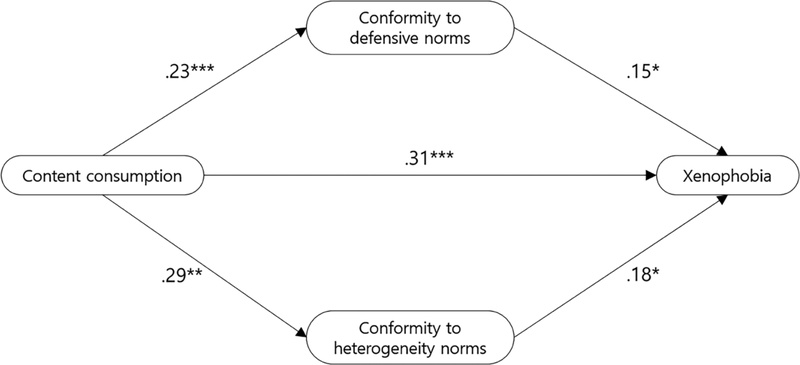
Figure 2 presents the standardized direct effects among content consumption, conformity to defensive norms, conformity to heterogeneity norms, and xenophobia for the full sample (N = 345).
Standardized Direct Effects Between Main Variables (N = 345)
Content consumption had significant positive effects on both conformity to defensive norms (β = .23, p < .001) and conformity to heterogeneity norms (β = .29, p < .01), indicating that higher levels of content consumption are associated with stronger conformity to defensive norms and heterogeneity norms toward Chinese people. In addition, content consumption exerted a significant direct effect on xenophobia (β = .31, p < .001), suggesting that greater content consumption is directly related to stronger xenophobic attitudes.
Consistent with expectations, group norm conformity also showed significant positive effects on xenophobia. Specifically, conformity to defensive norms (β = .15, p < .05) and heterogeneity norms (β = .18, p < .05) were both positively associated with xenophobia. Taken together, these results indicate that content consumption influences xenophobia both directly and indirectly through these normative pathways.
Table 8 reports the standardized indirect effects of content consumption on xenophobia through conformity to defensive norms and heterogeneity norms. The results show that content consumption had a significant indirect effect on xenophobia via conformity to defensive norms (β = .04, p < .05) and via conformity to heterogeneity norms (β = .06, p < .05). In addition, the total indirect effect, combining both mediators, was significant (β = .10, p < .01).
Standardized Indirect Effects of Content Consumption on Xenophobia(N = 345)
Taken together with the significant direct effect of content consumption on xenophobia, these findings indicate partial mediation through group norm conformity. Specifically, content consumption contributes to xenophobia both directly and indirectly by reinforcing conformity to defensive and heterogeneity norms toward Chinese people.
Model Fit for Multigroup Comparison
To examine differences between users in progressive and conservative communities, a multigroup analysis was conducted. Table 9 reports the model fit indices for the final model after dividing the sample into the two groups based on community type. The results indicate that the model shows a good fit to the data. The ratio of chi-square to degrees of freedom was 1.67, which is below the recommended threshold of 3.00. The RMSEA value was .04, indicating a satisfactory level of approximation. In addition, the incremental fit indices all exceeded conventional cutoff values (GFI = .91, NFI = .93, RFI = .92, IFI = .97, TLI = .96, CFI = .97), suggesting an overall good model fit. Overall, these results indicate that the proposed model fits the data well and is suitable for subsequent multigroup comparisons.
Model Fit Indices for the Multigroup Analysis by Community Type
Direct Effects Analysis
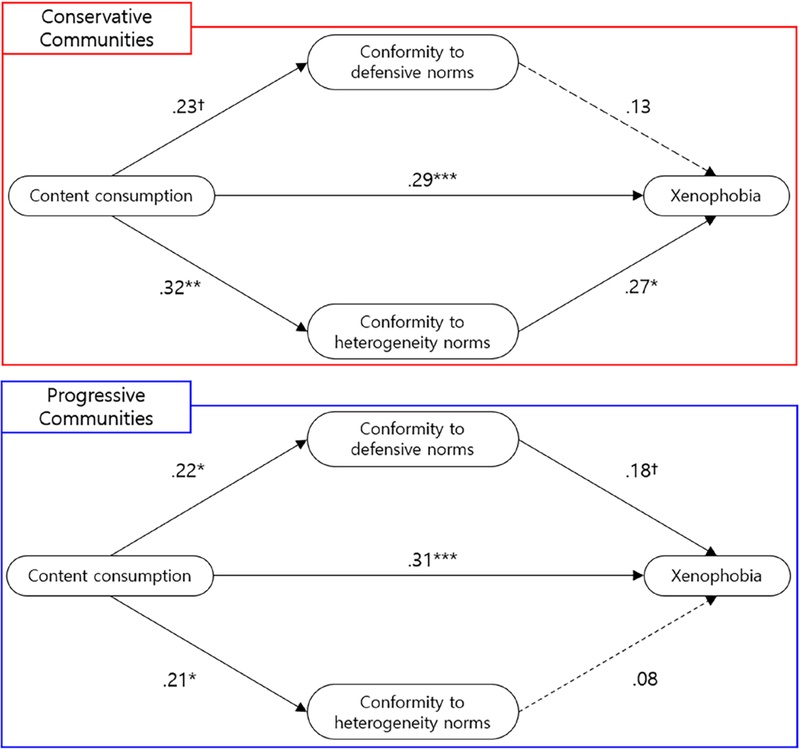
Figure 3 present the standardized direct effects for users in conservative and progressive communities. In both groups, content consumption showed significant positive effects on conformity to defensive norms, heterogeneity norms and xenophobia, indicating that greater content consumption is consistently associated with stronger group norm conformity and higher levels of xenophobia.
Standardized Direct Effects among users in Conservative and Progressive Communities
Important group differences were found in the paths from the mediators to xenophobia. For users in conservative communities, conformity to heterogeneity norms had a significant positive effect on xenophobia (β = .27, p < .05), whereas the effect of conformity to defensive norms was not significant (β = .13, p > .05). In contrast, in progressive communities, conformity to defensive norms was positively associated with xenophobia (β = .18, p < .10), while the effect of heterogeneity norms was not significant (β = .08, p > .05).
Taken together, these results suggest that although content consumption directly predicts xenophobia in both groups, the underlying mechanisms differ across user groups. Conformity to heterogeneity norms appears to play a more salient role among users in conservative communities, whereas conformity to defensive norms is more relevant among users in progressive communities.
Indirect Effects Analysis
Table 10 presents the standardized indirect effects for users of conservative and progressive communities. Among users in conservative communities, content consumption had a significant indirect effect on xenophobia through conformity to heterogeneity norms (β = .09, p < .01), whereas the indirect path through conformity to defensive norms was not significant (β = .03, p > .05). The total indirect effect was significant (β = .12, p < .01), indicating that heterogeneity-based conformity constitutes the primary mediating pathway in this group.
Standardized Indirect Effects by Community Type
Among users in progressive communities, the indirect effect through conformity to defensive norms was significant (β = .05, p < .10), while the indirect effect through heterogeneity norms was not (β = .02, p > .05). The total indirect effect remained significant (β = .08, p < .05), suggesting that defensive norms conformity plays the more central mediating role in this group.
DISCUSSION
The primary objective of this study was to examine the mechanisms through which content consumption within Korean online communities is associated with xenophobia toward Chinese people. Grounded in the Social Identity Model of Deindividuation Effects (SIDE), the study examined whether routine content consumption strengthens conformity to community norms, specifically defensive norms and heterogeneity norms, and whether these norm-based processes contribute to xenophobia. The study also examined whether these relationships differ between users in conservative and progressive online communities.
To address these aims, a structural equation model was estimated to test both the direct effect of content consumption on xenophobia and its indirect effects through conformity to defensive and heterogeneity norms. A multigroup analysis was then conducted to compare the differences in path coefficients between users in conservative and progressive communities.
The results suggest that content consumption was positively associated with conformity to both defensive and heterogeneity norms, and predicted xenophobia both directly and indirectly. These findings suggest that even routine engagement with online community content may be associated with xenophobia not only through a direct relationship but also through stronger conformity to negative community norms and greater perceptions of outgroup difference. Importantly, the multigroup findings indicate that the normative mechanisms linking content consumption to xenophobia may vary across community types. Among users in conservative communities, conformity to heterogeneity norms significantly predicted xenophobia and mediated the relationship between content consumption and xenophobia, whereas conformity to defensive norms did not show a significant direct effect. In progressive communities, conformity to defensive norms was positively associated with xenophobia and served as the primary mediating pathway, whereas heterogeneity norms did not significantly predict xenophobia. These patterns suggest that political orientation may shape which normative process becomes more salient in translating content consumption into xenophobic attitudes, although such differences should be interpreted with caution.
These findings provide important insight into how routine content consumption within online communities may relate to xenophobic attitudes through both direct and norm-based pathways. Content consumption was positively associated with conformity to defensive norms, conformity to heterogeneity norms, and xenophobia, even when users did not actively participate through posting or commenting. This suggests that passive engagement with community content is not neutral but may be linked to stronger conformity to prevailing community norms and more negative evaluations of outgroups.
The direct association between content consumption and xenophobia is particularly noteworthy. Although indirect effects through conformity to defensive and heterogeneity norms were observed, the magnitude of the direct pathway suggests that repeated exposure to community content itself may be related to exclusionary attitudes. This pattern aligns with cultivation theory (Gerbner et al., 2002), which posits that sustained exposure to a stable media environment gradually shapes perceptions of social reality. In online communities where certain narratives about China and Chinese people circulate, routine exposure may contribute to the normalization of particular interpretations and evaluations over time.
Importantly, content consumption in this study referred to general engagement with community content rather than exposure to explicitly anti-Chinese material. The finding that such general browsing behavior predicts xenophobia suggests that attitudes toward outgroups may be shaped through repeated exposure to broader communicative environments in which certain evaluative frames and narratives are prevalent. Prior research similarly indicates that exposure to consistent ideological or narrative environments can influence perceptions of social groups, even when individuals are not directly engaging with explicitly targeted content (Bliuc et al., 2021; Stroud, 2010).
While the overall relationship between content consumption and xenophobia was observed among users in both conservative and progressive communities, the mechanisms linking norm conformity to xenophobia differed. Among users in conservative communities, conformity to heterogeneity norms appeared to be more strongly associated with xenophobia, whereas among users in progressive communities, conformity to defensive norms appeared to play a more prominent role. Descriptive patterns further highlight meaningful differences between user groups. Users in conservative communities exhibited higher baseline levels of both conformity to defensive and heterogeneity norms, which may suggest that these environments are associated with stronger normative climates emphasizing outgroup threat and distinctiveness (Yang, 2010). These differences suggest that ideological context may shape not only the strength of norm endorsement but also which dimension of conformity is more closely linked to xenophobic attitudes.
These patterns may be understood in relation to differences in how group identity and intergroup boundaries are constructed across ideological contexts. In politically conservative environments, prior research suggests that group cohesion is often reinforced through clearer distinctions between ingroup and outgroup (Brewer, 1999; Tajfel & Turner, 1986), which may increase the salience of perceived differences and social distance. In such contexts, conformity to heterogeneity norms may more readily translate into negative evaluations of outgroups. By contrast, in more progressive environments, where overt boundary drawing may be less emphasized, defensive interpretations of outgroups may emerge in more situational or issue-specific ways. In these settings, conformity to defensive norms may be influential in shaping xenophobic responses. From a SIDE perspective, these patterns suggest that the specific content of salient group norms may vary across ideological environments, even when the underlying process of norm conformity remains similar (Reicher et al., 1995). Together, these findings suggest that content consumption, group norm conformity, and ideological environment may operate in interaction rather than isolation. Digital polarization does not uniformly intensify hostility, instead, it may structure the specific pathways through which community norms influence intergroup attitudes.
This study also contributes to the Social Identity Model of Deindividuation Effects (SIDE) by clarifying how group norm conformity functions in politically differentiated online spaces. SIDE proposes that when group identity becomes salient in mediated environments, individuals align their attitudes with perceived group norms. The present findings are consistent with this framework, as conformity to defensive and heterogeneity norms was associated with xenophobia, indicating that negative evaluations towards Chinese people may be embedded within community-specific normative background. At the same time, the significant direct association between content consumption and xenophobia suggests that norm alignment may be reinforced not only through anonymity and identity salience, but also through accumulated exposure to dominant narratives. In this respect, the findings extend SIDE by suggesting that passive content consumption can operate alongside identity-based processes in shaping norm-consistent attitudes. Norm conformity in online communities may therefore emerge through both deindividuation dynamics and exposure-based reinforcement.
The findings of this study have several practical implications that can be applied across different fields. First, the significant role of group norm conformity in shaping xenophobic attitudes highlights the importance of normative climates within online communities. Platform providers may benefit from focusing solely on individual instances of harmful content and instead pay attention to broader patterns of interaction that signal emerging norm structures. Monitoring sustained patterns of exclusionary framing or repeated emphasis on outgroup difference may help identify environments in which xenophobic norms are becoming normalized.
Second, the strong association between routine content consumption and xenophobia underscores that passive engagement is not inconsequential. Interventions may need to extend beyond moderating active posting behavior but should also address the cumulative influence of repeated exposure to homogeneous narratives. Platforms may consider incorporating design features that increase exposure to diverse viewpoints or contextual information, thereby reducing the likelihood that dominant narratives go unchallenged. Media literacy initiatives may also emphasize how repeated exposure to consistent community narratives may gradually shape perceptions of outgroups, even in the absence of deliberate intent.
Third, the observed differences between users in conservative and progressive communities suggest that interventions could be sensitive to ideological context. Because conformity to heterogeneity norms played a more central role among users in conservative communities while defense-oriented norms were more influential in progressive communities, strategies aimed at reducing xenophobia may need to account for distinct normative mechanisms. In communities where boundary differentiation is salient, efforts to highlight shared identities and reduce exaggerated perceptions of difference may be particularly relevant. In communities where defensive framing is more prominent, interventions that reduce perceived threat and promote constructive intergroup dialogue may be more appropriate. Similar dynamics may also operate in algorithm-driven social media environments. Recommendation systems often amplify content that aligns with users’ prior preferences, potentially reinforcing dominant narratives within ideologically homogeneous networks. When repeated exposure strengthens particular normative frames, whether emphasizing outgroup difference or defensive threat perceptions, algorithmic curation may indirectly contribute to the consolidation of those norms. Accordingly, social media platforms that rely on personalized recommendation systems should consider how algorithmic amplification interacts with community-level norm dynamics, especially in politically polarized contexts.
Despite its contributions, this study has several limitations. First, the measurement of group norm conformity should be interpreted with caution. Although the construct was intended to capture individuals’ alignment with perceived group-level norms, the items used in this study may not fully reflect the substantive content of those norms. In particular, the items assessing conformity to defensive norms relied on general expressions such as “defensive attitudes,” rather than directly measuring perceptions of threat or competition. As a result, this operationalization may not fully capture the specific mechanisms through which defensive norms are linked to xenophobia. In addition, the measures were developed specifically for this study and consisted of a limited number of items, which may constrain their validity and reliability. While the alignment-based and norm-weighted scoring approach was theoretically grounded, it may still oversimplify the complex and multidimensional nature of normative processes in online communities. Future research could benefit from developing and validating multi-item scales that more directly capture specific normative contents, such as perceived threat, competition, and intergroup boundaries, to provide a more precise measurement of group norm conformity.
Second, the cross-sectional and time-bound nature of the data constrains causal and temporal inference. The data were collected during a relatively stable social and political period. However, xenophobic attitudes are often sensitive to major events such as elections, public health crises, or international conflicts. As a result, the findings may not fully capture how shifts in the broader sociopolitical environment reshape online norm dynamics over time. In addition, the cross-sectional design limits the ability to separate causal effects from possible selection effects. It is possible that individuals who already hold stronger attitudes toward Chinese people may be more likely to engage with communities that reflect those views, rather than such attitudes being shaped through exposure alone. Longitudinal or experimental designs would help clarify how the causal relationships among content consumption, norm conformity, and xenophobia evolve under changing contextual conditions.
Third, the analysis focused on politically oriented Korean online communities and xenophobic attitudes toward Chinese individuals, which constrains generalizability. Given the specific historical and sociopolitical dynamics between Korea and China, the mechanisms identified here may not operate identically in other cultural settings or with different outgroups. Replication across diverse national contexts and online environments would help assess the broader applicability of the proposed framework.
Another limitation concerns the measurement of community engagement. Participants were classified based on their self-reported most frequently used online community, which may not fully capture the complexity of users’ engagement patterns. This approach does not distinguish between individuals who use multiple communities at similar levels and those whose usage is concentrated in a single community. As a result, the categorization may oversimplify users’ exposure to different normative environments. Future research could explore the influence of multi-community engagement to better capture the diversity of users’ online experiences.
Finally, future research could include several potentially relevant variables in the model. Individual-level factors such as age, gender, education, socioeconomic background, and pre-existing political attitudes may influence both content consumption and xenophobia but were not explicitly included in the present analysis. Broader variables such as exposure to China-related discourse on other platforms (e.g., social media or video-sharing platforms) and direct offline interactions with Chinese individuals may also shape intergroup attitudes. In addition, engagement was operationalized solely as content consumption, which may not fully capture the diverse ways individuals participate in and influence online community dynamics. Environmental characteristics, including perceived anonymity or platform affordances, were also not explicitly examined. Future research should incorporate more nuanced measures of individual and contextual variables to provide a more comprehensive understanding of online norm dynamics.
Acknowledgments
This work is based on the author’s doctoral dissertation submitted to Sogang University. This work was supported by the Ministry of Education of the Republic of Korea and the National Research Foundation of Korea (NRF-2022S1A3A2A02089938).
Disclosure Statement
No potential conflict of interest was reported by the author.
Notes
References
-
Barberá, P., Jost, J. T., Nagler, J., Tucker, J. A., & Bonneau, R. (2015). Tweeting from left to right: Is online political communication more than an echo chamber? Psychological Science, 26(10), 1531–1542.
[https://doi.org/10.1177/0956797615594620]

-
Bliuc, A. M., Bouguettaya, A., & Felise, K. D. (2021). Online intergroup polarization across political fault lines: An integrative review. Frontiers in Psychology, 12.
[https://doi.org/10.3389/fpsyg.2021.641215]
-
Boutyline, A., & Willer, R. (2017). The social structure of political echo chambers: Variation in ideological homophily in online networks. Political Psychology, 38(3), 551–569.
[https://doi.org/10.1111/pops.12337]
-
Boyd, D. M., & Ellison, N. B. (2007). Social network sites: Definition, history, and scholarship. Journal of Computer-Mediated Communication, 13(1), 210–230.
[https://doi.org/10.1111/j.1083-6101.2007.00393.x]
-
Brewer, M. B. (1999). The psychology of prejudice: Ingroup love and outgroup hate? Journal of Social Issues, 55(3), 429–444.
[https://doi.org/10.1111/0022-4537.00126]
-
Chau, M., & Xu, J. (2007). Mining communities and their relationships in blogs: A study of online hate groups. International Journal of Human-Computer Studies, 65(1), 57–70.
[https://doi.org/10.1016/j.ijhcs.2006.08.009]
- Chen, V. H. H., Ahmed, S., & Chib, A. (2021). The role of social media behaviors and structural intergroup relations on immigrant stereotypes. International Journal of Communication, 15, 24.
-
Choi, J. H., & Kim, Y. H. (2013). The effects of family factors on the xenophobia of primary school students. Multicultural Education Studies, 6(4), 79–105.
[https://doi.org/10.14328/MES.2013.12.31.79]
-
Cialdini, R. B., Reno, R. R., & Kallgren, C. A. (1990). A focus theory of normative conduct: Recycling the concept of norms to reduce littering in public places. Journal of Personality and Social Psychology, 58(6), 1015.
[https://doi.org/10.1037/0022-3514.58.6.1015]
-
Cloudy, J., Gotlieb, M. R., & McLaughlin, B. (2023). Online political networks as fertile ground for extremism: The roles of group cohesion and perceived group threat. Journal of Information Technology & Politics, 1–10.
[https://doi.org/10.1080/19331681.2023.2193580]
-
Costello, M., Hawdon, J., & Ratliff, T. N. (2017). Confronting online extremism: The effect of self-help, collective efficacy, and guardianship on being a target for hate speech: The effect of self-help, collective efficacy, and guardianship on being a target for hate speech. Social Science Computer Review, 35(5), 587–605.
[https://doi.org/10.1177/0894439316666272]
-
Crandall, C. S., Eshleman, A., & O'brien, L. (2002). Social norms and the expression and suppression of prejudice: The struggle for internalization. Journal of Personality and Social Psychology, 82(3), 359.
[https://doi.org/10.1037/0022-3514.82.3.359]
-
De Souza, C. S., & Preece, J. (2004). A framework for analyzing and understanding online communities. Interacting with Computers, 16(3), 579–610.
[https://doi.org/10.1016/j.intcom.2003.12.006]
-
Dvir-Gvirsman, S., Tsfati, Y., & Menchen-Trevino, E. (2016). The extent and nature of ideological selective exposure online: Combining survey responses with actual web log data from the 2013 Israeli elections. New Media & Society, 18(5), 857–877.
[https://doi.org/10.1177/1461444814549041]
- Finn, E. M. (2016). Negatively disinhibited online communication: The role of visual anonymity and public self-awareness [Doctoral dissertation, The Ohio State University].
-
Gazan, R. (2009). When online communities become self-aware. 2009 42nd Hawaii International Conference on System Sciences (pp. 1–10). IEEE.
[https://doi.org/10.1109/HICSS.2009.509]
-
Gerbner, G., Gross, L., Morgan, M., Signorielli, N., & Shanahan, J. (2002). Growing up with television: Cultivation processes. In Media effects (pp. 53–78). Routledge.
[https://doi.org/10.4324/9781410602428-7]
-
Han, H. J., & Shin, J. A. (2019a). Are films simply cinematic representations of imaginary scenarios? -Focusing on the first judgment in the action for damages resulting from anti-Chosunjoks hate speech in midnight runners-. Contemporary Cinema Studies, 36, 109–135.
[https://doi.org/10.15751/cofis.2019.15.3.109]
- Han, H. J., & Shin, J.-A. (2019b). Representations of Chosun-jok in Korean TV dramas and Chosun-jok’s reception of the representations. Journal of Speech, Media and Communication Research, 18(1), 227–262.
- Haythornthwaite, C. (2007). Social networks and online community. The Oxford handbook of Internet psychology (pp. 121–137).
-
Hjerm, M. (1998). National identities, national pride and xenophobia: A comparison of four Western countries. Acta Sociologica, 41(4), 335-347.
[https://doi.org/10.1177/000169939804100403]
-
Hwang, Y. J. (2025). Who endorses online hate? The roles of ideology and knowledge in South Korean perceptions of anti-Chinese slurs. Online Media and Global Communication, 4(3), 459–486.
[https://doi.org/10.1515/omgc-2025-0004]
-
Ivaturi, K., & Chua, C. (2019). Framing norms in online communities. Information & Management, 56(1), 15–27.
[https://doi.org/10.1016/j.im.2018.05.015]
-
Jung, S., & Kim, D. (2024). Digital echoes of discrimination: Investigating the reception of hate speech against Korean Chinese in online communities. Korean Journal of Communication, 1(2), 110–138.
[https://doi.org/10.1353/kjc.2024.a932422]
-
Karolidou, E., & Matsiola, M. (2025). The role of online communities in transforming news production: Challenges and opportunities. Online Information Review, 50(1), 153–170.
[https://doi.org/10.1108/OIR-02-2025-0064]
-
Keipi, T., Näsi, M., Oksanen, A., & Räsänen, P. (2016). Online hate and harmful content: Cross-national perspectives (p. 154).
[https://doi.org/10.4324/9781315628370]
-
Taylor & Francis. Kim, J.-S. (2016). A study on Korean-Chinese characters represented in Korean films. Cross-Cultural Studies, 44, 191–209.
[https://doi.org/10.21049/ccs.2016.44..191]
-
Koo, J. W., Suh, C. S., Chung, J. W., Sohn, K. A., & Han, K. (2024). The hatred of all against all evidence from online community platforms in South Korea. PLoS One, 19(5), e0300530.
[https://doi.org/10.1371/journal.pone.0300530]
-
Lee, E. J. (2007). Deindividuation effects on group polarization in computer-mediated communication: The role of group identification, public-self-awareness, and perceived argument quality. Journal of Communication, 57(2), 385–403.
[https://doi.org/10.1111/j.1460-2466.2007.00348.x]
-
Lee, H., & Kim, M. (2016). The informative function of disgust in rumor transmission and behavioral change. The Korean Journal of Advertising and Public Relations, 18(2), 213–236.
[https://doi.org/10.16914/kjapr.2016.18.2.213]
-
Mansouri, F. (2023). The future of migration, multiculturalism and diversity in Australia's post-COVID-19 social recovery. Social Sciences & Humanities Open, 7(1), 100382.
[https://doi.org/10.1016/j.ssaho.2022.100382]
-
Melchiori, F. M., Martucci, S., Destro, C. L., & Benvenuto, G. (2023). Hate speech recognition: The role of empathy and awareness of social media influence. Journal of Educational, Cultural and Psychological Studies (ECPS Journal), 28, 101–115.
[https://doi.org/10.7358/ecps-2023-028-melc]
-
Morgan, M., & Shanahan, J. (2010). The state of cultivation. Journal of Broadcasting & Electronic Media, 54(2), 337–355.
[https://doi.org/10.1080/08838151003735018]
-
Noh, H., & Sim, R. (2026). Constructing the “other”: Online racialized hate speech and perceived threats in South Korea. Ethnic and Racial Studies, 1–20.
[https://doi.org/10.1080/01419870.2026.2622421]
- Nonnecke, B. (2000). Lurking in email-based discussion lists (Doctoral dissertation, South Bank University).
- Nonnecke, B., Preece, J., Andrews, D., & Voutour, R. (2004). Why lurkers lurk. Proceedings of the Americas Conference on Information Systems (AMCIS).
-
Norris, P. (2002). The bridging and bonding role of online communities. Harvard International Journal of Press/Politics, 7(3), 3–13.
[https://doi.org/10.1177/1081180X0200700301]
-
Pain, E. A. (2007). Xenophobia and ethnopolitical extremism in post-soviet Russia: Dynamics and growth factors. Nationalities Papers, 35(5), 895-911.
[https://doi.org/10.1080/00905990701651851]
-
Park, S. N. (2022). The origin and development of South Korean young men’s right-wing radicalization. Georgetown Journal of International Affairs, 23(2), 153–160.
[https://doi.org/10.1353/gia.2022.0026]
-
Postmes, T., Spears, R., & Lea, M. (2000). The formation of group norms in computer-mediated communication. Human Communication Research, 26(3), 341–371.
[https://doi.org/10.1111/j.1468-2958.2000.tb00761.x]
-
Rafaeli, S., & Sudweeks, F. (1997). Networked interactivity. Journal of Computer-Mediated Communication, 2(4), JCMC243.
[https://doi.org/10.1111/j.1083-6101.1997.tb00201.x]
-
Rajadesingan, A., Resnick, P., & Budak, C. (2020, May). Quick, community-specific learning: How distinctive toxicity norms are maintained in political subreddits. International AAAI Conference on Web and Social Media, 14, 557–568.
[https://doi.org/10.1609/icwsm.v14i1.7323]
-
Reicher, S. D., Spears, R., & Postmes, T. (1995). A social identity model of deindividuation phenomena. European Review of Social Psychology, 6(1), 161–198.
[https://doi.org/10.1080/14792779443000049]
-
Rosen, L. D., Whaling, K., Carrier, L. M., Cheever, N. A., & Rokkum, J. (2013). The media and technology usage and attitudes scale: An empirical investigation. Computers in Human Behavior, 29(6), 2501–2511.
[https://doi.org/10.1016/j.chb.2013.06.006]
- Seok, S., & Chang, A. S. (2017). Frame of right-wing extremism and emotional politics: Analysis of Ilbe community through language network methodology. Journal of Social Research, 18(1), 3–42.
- Shim, K. (2015). Hardcore subcultures for law-abiding citizens and online Nationalism: Case study on the Korean internet community ILBE Jeojangso. In Panorama: Insights into Asian and European affairs (pp. 165–715).
- Shin, J., Oh, Y., & Hong, S. K. (2022). Female subject of online nationalism: a case study on the cancellation of ‘Chosun Exorcist’. Journal of Communication Research, 59(3), 195–238.
-
Smith, L. G., & Postmes, T. (2009). Intra-group interaction and the development of norms which promote inter-group hostility. European Journal of Social Psychology, 39(1), 130–144.
[https://doi.org/10.1002/ejsp.464]
-
Song, E. E. (2023a). COVID-19, Anti-Chinese sentiment, and foreign policy attitudes in South Korea. Asian Survey, 63(5), 823–850.
[https://doi.org/10.1525/as.2023.2008558]
-
Song, E. E. (2023b). Air pollution coverage, anti-Chinese sentiment, and attitudes towards foreign policy in South Korea. Journal of Chinese Political Science, 28(4), 571–592.
[https://doi.org/10.1007/s11366-023-09849-z]
-
Steinfeld, N., & Lev-on, A. (2024). Exposure to diverse political views in contemporary media environments. Frontiers in Communication, 9, 1384706.
[https://doi.org/10.3389/fcomm.2024.1384706]
- Stephan, W. G., & Stephan, C. W. (2013). An integrated threat theory of prejudice. In Reducing prejudice and discrimination (pp. 23–45). Psychology Press.
- Stephan, W. G., Ybarra, O., & Morrison, K. R. (2009). Intergroup threat theory. In T. Nelson (Ed.), Handbook of prejudice, stereotyping, and discrimination (pp. 43–59). Psychology Press.
-
Stroud, N. J. (2010). Polarization and partisan selective exposure. Journal of Communication, 60(3), 556–576.
[https://doi.org/10.1111/j.1460-2466.2010.01497.x]
- Tajfel, H., & Turner, J. C. (1986). The social identity theory of intergroup behavior. In S. Worchel & W. G. Austin (Eds.), Psychology of intergroup relations (pp. 7–24). Nelson-Hall.
- Turner, J. C. (2010). Social categorization and the self-concept: A social cognitive theory of group behavior. In T. Postmes & N. R. Branscombe (Eds.), Rediscovering social identity (pp. 243–272). Psychology Press.
-
Weeks, B. E., Lane, D. S., Kim, D. H., Lee, S. S., & Kwak, N. (2017). Incidental exposure, selective exposure, and political information sharing: Integrating online exposure patterns and expression on social media. Journal of Computer-Mediated Communication, 22(6), 363–379.
[https://doi.org/10.1111/jcc4.12199]
-
Wojcieszak, M. E., & Mutz, D. C. (2009). Online groups and political discourse: Do online discussion spaces facilitate exposure to political disagreement? Journal of Communication, 59(1), 40–56.
[https://doi.org/10.1111/j.1460-2466.2008.01403.x]
-
Yang, K. M. (2010). The influence of realistic conflict perception and perceived economic level on the attitudes of immigrant employees: Focusing on the interaction effect of subjective well-being. Korean Journal of Social and Personality Psychology, 24(1), 111–128.
[https://doi.org/10.21193/kjspp.2010.24.1.008]