
South Korean V-Tuber Visual Conventions within Korea–Japan Cultural Circuits
 ; Sungbin Youk
Copyright ⓒ 2026 by the Korean Society for Journalism and Communication Studies
Abstract
Virtual YouTubers (V-Tubers) are avatar-based digital content creators whose performances rely heavily on visual design. Although V-Tubers have become increasingly prominent across national contexts, less attention has been paid to how their visual conventions are shaped through transnational cultural circulation. This research examines South Korean V-Tuber design through the lens of Korea–Japan cultural circuits, using a mixed-methods approach. Study 1 manually analyzes 45 South Korean V-Tubers using four Japanese Vocaloid characters as visual references, and Study 2 computationally analyzes 1,539 detected avatar heads and faces from livestream videos. Study 1 finds recurring anime-associated facial morphology, greater variation in color and identity markers, and culturally situated uses of costume and performance markers that situate established visual conventions within South Korean contexts. Study 2 similarly finds greater regularity in facial proportions and skin tone, whereas hair color and on-screen composition show greater variability. These findings suggest that cultural hybridity operates unevenly across visual conventions and can coexist with Japanese visual dominance. The study extends research on Korea–Japan cultural circuits by showing how established visual conventions can persist while selected elements acquire different cultural meanings and performance functions.
Keywords:
virtual YouTubers, visual conventions, cultural hybridity, Korea–Japan cultural circuits, mixed methodsVirtual YouTubers (V-Tubers) are digital content creators who perform through animated avatars using real-time motion capture and voice synthesis technologies. These creators have gained increasing attention by leveraging visually engaging avatars in the popular contexts of livestreaming and gaming (Jeong & Youk, 2023). Although V-Tubers initially accounted for a niche proportion of the entertainment genre in Japan, they are now globally recognized as a distinct category of content creators (Big Games Machine, 2025). The V-Tuber market has since diversified beyond livestreaming to encompass music production, merchandise sales, and AI-generated content, attracting millions of subscribers worldwide. Consequently, what began as subcultural media content has evolved into a global industry, with its market projected to grow from $6.28 billion in 2023 to $117.16 billion by 2032 (Zion Market Research, 2025).
The cultural significance of V-Tubers extends beyond their commercial impact because their development is embedded in the transnational circulation of visual conventions. The contemporary V-Tuber format was popularized by Kizuna AI following her 2016 debut and is rooted in Japanese anime and idol subcultures (Vita et al., 2023). Similar forms of transnational visual circulation have been observed in other media forms, including manhwa (Korean comics), webtoons, and animation, in which Japanese-origin aesthetics have been selectively adapted within Korean cultural production. However, V-Tubers extend existing understandings of Korea–Japan cultural circuits because their avatars are not simply fictional characters situated within entertainment narratives. The avatars function as creator-selected appearances that mediate audience interaction, sustain recognizable platform identities, and influence perceived authenticity (Lu et al., 2021; Schmieder, 2024; Wan & Lu, 2024). Because these avatars can differ substantially from creators’ offline appearances, their design constitutes digital self-presentation rather than merely the visual styling of fictional characters. This distinction makes South Korean V-Tubers a theoretically informative case for examining how creators select and reconfigure Japanese-origin visual conventions when constructing platform identities in a Korean cultural context.
Although this identity-bearing function makes visual design central to V-Tuber performance, existing communication research has primarily examined fan communities, authenticity, and the relationship between virtual and offline identities (e.g., Ahn et al., 2025), while giving limited attention to the visual features through which V-Tuber identities are constructed and recognized. This gap is significant because V-Tuber creators can modify facial proportions, hair and eye colors, costumes, and accessories with few physical constraints. These design choices function as semiotic resources that communicate cultural meanings related to fantasy construction and affective engagement. Because creators can design appearances largely independent of their offline bodies, recurring similarities reveal which visual conventions persist despite this flexibility. In the South Korean context, the continued use of Japanese-origin conventions may indicate their continued dominance, while variation provides an opportunity to examine whether and how these conventions are rearticulated.
This research uses a mixed-methods design to examine how Japanese-origin visual conventions are retained, differentiated, and rearticulated in South Korean V-Tuber design. Study 1 manually analyzes 45 South Korean V-Tubers, using four Japanese Vocaloid characters as visual references, to examine how facial morphology, color, clothing, accessories, and identity markers reflect retention, differentiation, or rearticulation. Study 2 then uses computational analysis of 1,539 detected heads and faces from V-Tuber livestreams to examine how consistently selected measurable visual features recur and where greater variability occurs across V-Tubers. Study 1 provides the cultural interpretation needed to distinguish differentiation from culturally meaningful rearticulation, whereas Study 2 assesses whether selected measurable visual conventions identified in the qualitative analysis recur across a broader set of V-Tuber images. This approach allows us to examine whether cultural hybridity and Japanese visual dominance coexist in South Korean V-Tuber design.
Literature Review
Although V-Tubers are a relatively novel form of digital content creation, their emergence and visual conventions are best understood within broader Korea–Japan cultural circuits. Japanese popular culture has circulated across East Asia through localization rather than uniform replication, producing regional cultural resonance while taking different forms across national contexts (Iwabuchi, 2002; Otmazgin, 2008). South Korea provides a particularly informative context for examining this circulation because its popular culture has repeatedly incorporated imported forms through selective appropriation rather than direct imitation or rejection (Ryoo, 2009; Shim, 2006). Because the V-Tuber format developed through Japanese anime, idol, and virtual-character traditions, examining South Korean V-Tubers allows us to identify which Japanese-origin visual conventions are retained and how they are reconfigured.
Transnational cultural circulation can involve both continuity and reconfiguration, as cultural forms are selectively appropriated and recombined while established conventions remain comparatively stable (Kraidy, 2002; Nederveen Pieterse, 1994). Reconfiguration involves not simply adding new cultural elements, but altering the relationships among existing ones, such that a recognizable convention can acquire different meanings, functions, or associations in a new cultural context (Grossberg, 1986). Accordingly, hybridity is better understood by examining which conventions persist, which are modified, and how those modifications reflect the cultural context in which they occur. Importantly, such modifications do not necessarily alter existing relations of cultural power. Hybridity can range from mimicry to counter-hegemonic forms (Nederveen Pieterse, 1994), meaning that local reconfiguration may coexist with the continued dominance of established cultural conventions (Kraidy, 2002). Therefore, distinctions must be made among retention, in which an established convention remains largely intact; differentiation, in which variation occurs within that convention; and rearticulation, in which an established convention is connected to a different locally situated sign, practice, or function.
These distinctions are particularly relevant to manga and anime, central forms of Japanese visual culture (MacWilliams, 2008), because their visual conventions have circulated extensively across East Asian media and shaped transnational character aesthetics. Manga refers not only to Japanese comics as a medium but also to a distinctive visual style composed of recurring graphic conventions, such as stylized facial features, exaggerated emotional expressions, and flexible bodily proportions (Cohn, 2010). While often associated with conventions such as large eyes and simplified facial structures, manga visual design encompasses a wide range of stylistic variations and has undergone significant historical and technological transformations (Ito, 2005). Importantly, these conventions themselves emerged through earlier processes of cultural hybridity, as exemplified by Osamu Tezuka’s synthesis of Disney-influenced Western animation techniques with Japanese narrative sensibilities (Gravett, 2004), producing designs that are distinct yet in part resonant with American comics traditions (McCloud, 1993). Thus, describing these conventions as Japanese-origin identifies the visual tradition through which they became recognizable and circulated rather than implying that manga or anime constitutes a culturally pure form.
South Korean manhwa and webtoons provide a precedent for distinguishing retention, differentiation, and rearticulation. Japanese manga circulated extensively in South Korea, and locally produced manhwa adopted Japanese manga styles and techniques, reflecting a long history of transnational skill and stylistic transfer (Lent, 2022; Wong, 2006). As Korean comics moved online, webtoons introduced differentiation through features such as full-color presentation, which departed from the predominantly monochrome format of print manhwa (Jin, 2019). More substantially, vertical scrolling reorganized sequential comics around portal-based publication and later smartphone use, distinguishing webtoons from the page-based layouts of traditional Japanese manga (Jang & Song, 2017; Jin, 2015, 2019). This shift demonstrates rearticulation because the comics form was reorganized around different technological affordances and reading practices rather than simply restyled. At the character level, however, retention remains evident. Korean webtoon characters continue to exhibit recognizable manga- and anime-associated features, including large eyes, small mouths, and non-realistic bodily proportions (Kim, 2021). Similar stylized features, such as rounded forms and exaggerated proportions, were also prevalent in earlier South Korean animations (Chu et al., 2014).
South Korea is not only a recipient of Japanese visual influence. Korean digital media practices have also circulated outward and influenced media production in other national contexts. In Japan, for example, Korean webtoon platform designs have influenced how manga is distributed and marketed online (Oh & Koo, 2018). This movement in both directions makes Korea–Japan cultural exchange better understood as a circuit of adaptation and recirculation rather than a one-way transfer of Japanese conventions to Korea. V-Tubers provide a particularly informative case because a Japanese-origin media form is being adapted within a Korean media environment that is itself an active source of transnational cultural influence.
V-Tubers, digital content creators who perform through avatars typically animated in real time using facial- or motion-tracking technologies, extend Korea–Japan cultural circuits into a new form of avatar-based digital performance. The format emerged in Japan and became closely associated with Japanese anime, gaming, idol, and virtual-character cultures before expanding into other national contexts, including South Korea. Unlike characters in manga, anime, or webtoons, V-Tuber avatars are not confined to fictional narratives but function as stable visual identities through which creators perform, remain recognizable, and sustain relationships with audiences across platform interactions (Ahn et al., 2025; Lu et al., 2021; Schmieder, 2024). Because creators can construct avatars without being constrained by their offline appearance, avatar design functions as a form of digital self-presentation (Wan & Lu, 2024). This flexibility makes recurring similarities across avatars theoretically informative because they indicate which visual conventions persist despite creators’ considerable freedom to construct different appearances. Recurring similarities across avatars can reveal how established visual conventions shape the choices through which creators construct recognizable identities despite substantial flexibility in avatar design. Thus, V-Tubers extend the study of Korea–Japan cultural circuits from fictional media conventions to their use in creator self-presentation.
The distinctions among retention, differentiation, and rearticulation provide a more precise way to examine cultural hybridity in South Korean V-Tuber design. Anime-associated facial and bodily conventions can be retained with little modification, while variation in color, hairstyle, clothing, or accessories can differentiate individual creators without changing the underlying visual convention. Rearticulation requires a different relationship among visual elements, such as when an inherited character convention is connected to locally situated identity markers, clothing, props, or performance functions. Conversely, extensive continuity with anime-associated conventions provides a basis for considering whether Japanese visual conventions remain dominant even when other aspects of the avatar vary. The relevant question is therefore not simply whether South Korean V-Tubers combine Japanese and Korean elements, but which visual conventions persist, which are differentiated, and which are rearticulated within South Korean V-Tuber design.
Prior research suggests that V-Tuber design combines recognizable anime-derived conventions with considerable flexibility in how creators construct and present their avatars. V-Tubers commonly draw on cute and feminized anime-associated character designs, while avatar-mediated performance also provides creators with flexibility in identity presentation (Bredikhina & Giard, 2022; Wan & Lu, 2024). In South Korea, V-Tubers additionally operate within a media environment that includes virtual-idol and K-pop practices, as illustrated by groups such as PLAVE (Ahn et al., 2025). Consequently, the circulation of V-Tubing across cultural contexts can involve continuity in established visual conventions alongside variation in how avatars are styled and positioned.
STUDY 1: MANUAL CONTENT ANALYSIS
Despite the growing cultural prominence of V-Tubers within transnational digital media, systematic analysis of their visual design remains limited. Existing V-Tuber research has focused primarily on performance and self-presentation, audience engagement, and avatar-mediated livestreaming (Ahn et al., 2025; Lu et al., 2021; Wan & Lu, 2024), while visual design itself remains comparatively understudied. One exception is Zhou’s (2020) analysis of Kizuna AI, which links her design to Japanese kawaii and moe aesthetics. However, its single-case focus does not provide a basis for identifying recurring visual conventions across V-Tubers or examining how those conventions vary across cultural contexts. For South Korean V-Tubers, this leaves unclear which visual conventions associated with the Japanese-origin format persist and which take different forms within a Korean cultural context.
Visual conventions involve more than the presence of individual design features because visual meaning also depends on how those features are configured within an image. Visual social semiotics provides a framework for examining this relationship by treating visual characteristics as communicative resources and considering how represented figures and their attributes are constructed within an image (Harrison, 2003; Kress & van Leeuwen, 2020). Applied to V-Tubers, facial morphology, color, hairstyle, clothing, accessories, and other identity markers can be examined both as individual characteristics and in relation to one another. These relationships are important because recurring features can establish a recognizable visual form, while other attributes distinguish individual characters or situate them within particular identities and performance contexts. In other words, visual social semiotics provides a basis for examining how different aspects of avatar design remain stable or change in relation to one another.
Japanese Vocaloid characters provide a useful historical visual reference because they preceded contemporary V-Tubers as recognizable virtual performers within Japanese digital culture. Hatsune Miku provides a prominent example. Her long blue-green pigtails and futuristic, school-uniform-inspired costume established a distinctive visual identity (Lam, 2016), while her character design also reflects visual conventions associated with Japanese idol culture (Anderson, 2021). Vocaloids are particularly relevant to the present study because their visual identities are organized through characteristics that can also be examined in V-Tuber avatars, including facial stylization, color, hairstyle, costume, and recurring identity markers. As an earlier Japanese virtual-performance reference, these designs make it possible to examine whether South Korean V-Tubers retain recognizable conventions of Japanese virtual-character design, differentiate those conventions through other aspects of avatar styling, or reconfigure their relationships within a Korean cultural and performance context.
Methods
To manually analyze the visual characteristics of V-Tubers, this study employed a stratified sampling approach to ensure representation across varying levels of popularity. Using SOFTCONEVIEWERSHIP’s database of the top 300 South Korean V-Tubers as of October 2024, the sample was divided into three tiers based on viewership and subscriber count: high (ranks 1-32), mid (ranks 33-166), and low (ranks 167-300). From each tier, 15 V-Tubers were randomly selected, resulting in a total of 45 cases (see Table 1). Representative images were collected directly from their respective channels. For comparison, four Japanese Vocaloid characters (i.e., Hatsune Miku, Kagamine Rin, Kagamine Len, and KAITO) were included as reference figures. Standardized images of the Vocaloid characters were collected from the Piapro Character Listing website1 (see Figure 1).

Summary of V-Tubers (Study 1)

Visual Reference Images of Vocaloid Characters Used in Study 1Note. This figure presents the official character visuals of the four Vocaloids used for comparative analysis in Study 1: Hatsune Miku, Kagamine Rin, Kagamine Len, and KAITO (left to right).
The visual analysis combined manual measurement with qualitative content analysis. The eye-to-head size ratio was calculated as the combined size of the left and right eyes relative to head size using a digital ruler. Images were then coded for hairstyle, hair and eye color, character color, clothing, fantastical or nonhuman features, accessories, and recurring identity markers. Clothing realism was coded on a five-point scale, from highly fantastical (1) to closely resembling everyday fashion (5), with the midpoint indicating a mix of realistic and fantastical elements rather than cultural hybridity itself. Following qualitative content-analysis procedures (Mayring, 2000; Schreier, 2012), images were reviewed and annotated in multiple rounds using inductive category development to identify salient characteristics and to group related observations into broader categories, which were refined through iterative comparison across cases.
The authors subsequently examined all 45 V-Tuber images case by case to analyze how the coded visual characteristics were configured within individual avatars. This analysis considered garment type and layering, the placement of fantastical features on the body or on accessories, performance-related props and settings, and other recurring identity markers. The authors then examined whether these configurations reflected retention, differentiation, or rearticulation. Rearticulation was interpreted when an inherited visual convention was connected to a different visible identity or performance function through its relationship with clothing, props, text, setting, group identity, or platform role.
Results
Facial morphology showed the strongest continuity between the South Korean V-Tubers and the Japanese Vocaloid reference figures. Across the 45 V-Tubers, the mean eye-to-head size ratio was 0.15 (SD = 0.03), closely matching the Vocaloid mean of 0.14 (SD = 0.05) (see Table 2). Hatsune Miku and Kagamine Rin exhibited similarly large-eye, youthful proportions, while male V-Tubers showed somewhat lower ratios that were closer to KAITO, whose facial proportions were more mature. Overall, these similarities indicate substantial retention of the stylized facial morphology associated with earlier Japanese virtual characters, with comparatively little evidence of reconfiguration.
Visual Characteristics of Vocaloids and V-Tubers (Study 1)
Color varied considerably across the South Korean V-Tubers, but the way color organized character identity remained similar to the Vocaloid reference figures. Each Vocaloid used a stable character-specific palette, such as the mint tones associated with Hatsune Miku and the blue associated with KAITO. South Korean V-Tubers followed the same organizing principle while selecting different colors. For example, GOSEGU combined white and light blue, and Ayatsuno Yuni centered her design on light purple. Lavender, red, pink, light blue, mint, and yellow also appeared repeatedly across the sample. Thus, the particular colors varied across characters, but the use of a coherent palette to establish a recognizable character identity remained consistent. In this respect, color represents differentiation within an inherited virtual-character convention.
Other recurring identity markers followed the same pattern. Hatsune Miku’s twin-tail hairstyle and the Kagamine characters’ headsets provide stable identity markers among the Vocaloid references, while the South Korean V-Tubers used distinctive hairstyles, accessories, fantasy features, and costume elements to differentiate individual characters. Ayatsuno Yuni, for example, combines a horn, wings, and a large tail to establish a humanoid unicorn character. Yang_ doki uses a captain’s hat and officer-like clothing to establish the character's fictional identity as the commander of a spacecraft. These features make the individual avatars visually distinct, but they remain compatible with established anime and virtual-character repertoires. In other words, substantial variation occurs without altering the broader visual convention through which the character is constructed.
Cultural hybridity was more clearly visible through the rearticulation of costume and performance markers. Costume design varied substantially across the South Korean V-Tubers: 46.7% wore mostly or fully realistic clothing, while another 22.2% combined realistic and fantastical elements. This variation contrasted with the relative consistency in facial morphology. The qualitative analysis showed that rearticulation was clearest when clothing and accessories worked with performance-related markers to connect the retained anime-associated character form to streamer, gamer, or virtual-idol roles.
U_bomnyang illustrates this rearticulation through everyday Korean styling and gaming. The avatar retains the large-eyed, anime-associated facial morphology while pairing it with common casual attire in Korea, including an off-shoulder T-shirt, short athletic shorts (commonly called dolphin pants in Korea), and black three-stripe slide sandals (samseon slippers). These features connect the retained character form to a casual Korean fashion style. Another example is ONYU, whose avatar combines anime-associated character design with black-and-green techwear styled as stage-performance attire, along with headphones and a visible Revolution Heart group label on the coat. The group marker connects the costume to a Korean virtual-idol identity and performance role, rearticulating the inherited virtual-character form within the South Korean V-Tuber context.
Discussion
Study 1 indicates that cultural hybridity is uneven across South Korean V-Tuber visual conventions, with some features remaining comparatively stable while others are differentiated or rearticulated. Importantly, the findings locate hybridity in rearticulation rather than visual difference itself. An inherited convention can remain recognizable while its relationship to identity or performance is reorganized within the South Korean V-Tuber context. This perspective moves beyond treating hybridity as the simple combination of Japanese and Korean elements, instead characterizing South Korean V-Tuber design as selective reconfiguration rather than either direct replication or complete localization (Shim, 2006).
The persistence of stylized facial morphology also adds nuance to broad descriptions of Japanese character aesthetics. Prior work on kawaii aesthetics in Japan identifies infantile characteristics, including large eyes, as part of a visual repertoire associated with cuteness (Lieber-Milo & Nittono, 2019). However, describing V-Tuber avatars simply as kawaii or anime-associated does not explain how different visual conventions operate within the same character design. Stable color palettes, hairstyles, and recurring identity markers can differentiate individual V-Tubers while preserving the broader virtual-character convention, whereas costume and performance markers can rearticulate that convention through different cultural and performance contexts. At the same time, rearticulation occurs alongside substantial continuity in anime-associated facial morphology rather than replacing the inherited visual grammar.
However, Study 1 cannot establish how broadly these visual patterns extend beyond the 45 manually analyzed V-Tubers. The qualitative analysis identifies characteristics relevant to retention, differentiation, and rearticulation and explains how their relationships can express cultural hybridity, but it cannot assess whether these patterns generalize across a broader range of V-Tuber representations. Study 2 addresses this limitation by examining the recurrence and variability of selected measurable visual conventions at scale.
STUDY 2: COMPUTATIONAL ANALYSIS
Study 2 complements the visual analysis in Study 1 by using computational methods to examine selected V-Tuber design patterns across a larger dataset. Whereas Study 1 interprets how visual elements acquire meaning within Korea–Japan cultural circuits, Study 2 assesses how consistently measurable features recur and where greater variability occurs across V-Tubers. Such distributional patterns establish which measurable visual conventions recur consistently and which vary more substantially across South Korean V-Tubers, providing the broader empirical context for interpreting retention, differentiation, and rearticulation.
The selection of computational features is guided by visual social semiotics, particularly its emphasis on viewer relations and visual composition. Visual proximity and spatial positioning shape how represented figures are presented in relation to viewers, while placement, salience, size, framing, and color organize the visual composition of an image (Kress & van Leeuwen, 2020). These concepts are particularly relevant to V-Tuber livestreaming because avatars are presented within a larger video frame, where their position, scale, facial proportions, and color can vary. Accordingly, Study 2 uses computer vision techniques to measure the spatial position of the avatar’s head within the video frame, the relative proportions of the head, face, and eyes, and dominant color attributes, including skin tone, hair color, and eye color.
Methods
To construct a robust dataset of V-Tuber visual representations, we identified 500 top-ranked V-Tuber channels using publicly available analytics data provided by SOFTCONEVIEWERSHIP. Channels were filtered to include only those active within the past year and broadcasting on the SOOP streaming platform. The ranking algorithm utilized a weighted composite metric based on topicality, popularity, and viewership activity. For each of these 500 V-Tuber channels, we accessed their live-stream archives (Videos on Demand; VODs) via the SOOP platform and selected the top five full-length videos. To ensure consistency in screen format and aspect ratio, short-form videos were excluded.
From each selected video, a single frame was captured at a randomly sampled time point to ensure non-biased temporal representation. A Python script utilizing the Selenium automation framework was developed to streamline this process. In total, 2,100 images were collected, constituting the raw image dataset used for subsequent visual analysis.
To analyze the visual elements of the V-Tuber characters, we employed a multi-step computer vision pipeline. A pilot analysis using a small sample of 10 images with conventional face detection models designed for human faces, such as MediaPipe, demonstrated poor performance due to the stylized nature of V-Tuber avatars. Consequently, face detection was performed using Python-Animeface version 2.0.3, a tool specifically developed for detecting anime-style faces. This tool provided coordinates for the face bounding box, eye positions, and color features such as skin tone, eye color, and hair color.
Although Animeface successfully detected the face regions for V-Tubers, it did not identify the full boundary of the character’s head, including the hair. To address this limitation, we employed a YOLOv8-based object detection model trained on 8,037 annotated images from anime and manga.2 This model accurately identified bounding boxes for the entire head. The combined use of these two models enabled a comprehensive analysis of both faces and heads.
A manual verification of 50 randomly selected images confirmed high accuracy for this combined detection pipeline (see Figure 2 for an example). Images in which no V-Tuber character was detected were excluded from further analysis. The final dataset comprised 1,539 successfully detected heads and faces from 1,352 unique video frames.
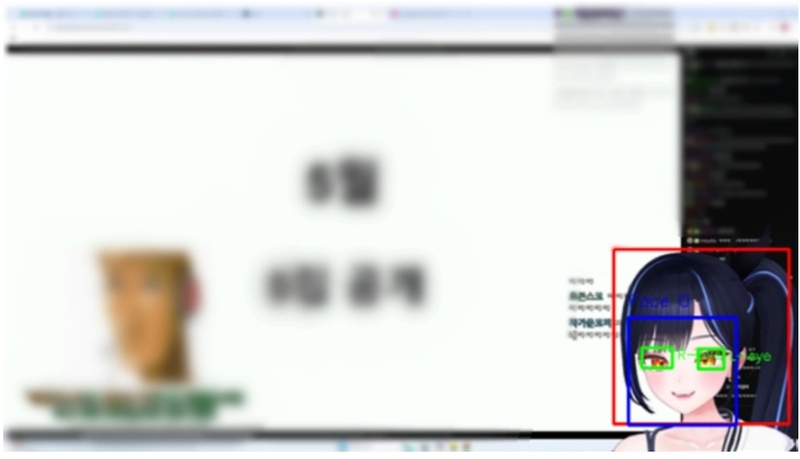
Example of Computational Extraction of V-Tuber’s Head, Face, and EyesNote. This figure illustrates the automated detection pipeline used in Study 2, highlighting the extraction of head (red box), face (blue box), and eye regions (green box) from a single frame of recorded V-Tuber livestream footage.
To investigate the spatial positioning of the V-Tubers during their livestreaming, we examined the distribution of head placements across the collected screenshots. Each head bounding box was projected onto a standardized frame of 411 × 710 pixels, corresponding to the normalized screen resolution used during data collection. A two-dimensional heatmap was generated by incrementing the pixel values within each bounding box’s area to produce a composite density map. The resulting heatmap was normalized so that higher intensity values represented regions where heads were more frequently positioned.
We also computed a series of ratios to quantify stylization in V-Tuber character design. These included the ratio of head area to total screen area (head-to-screen), face area to head area (face-to-head), eye area to face area (eyes-to-face), and eye area to head area (eyes-to-head). These metrics were compared to baseline human measurements derived from portrait images provided by the South Korean Ministry of Foreign Affairs. Comparative one-sample t-tests were conducted to determine whether V-Tuber proportions deviated significantly from those of humans.
To examine aesthetic conventions and variation in V-Tuber character design, particularly in color schemes, we analyzed dominant RGB values associated with skin, eye, and hair colors. K-means clustering (k = 15) was applied to skin tones, eye colors, and hair colors to identify dominant color centroids and their proportional distributions. Cluster proportions were visualized using stacked bar charts, with each segment colored according to its RGB centroid, displayed in hexadecimal format.
Results
The analysis of V-Tuber character placement on-screen revealed three predominant spatial configurations during livestreaming (see Figure 3). The most common positioning was in the lower-right quadrant of the screen, where character heads consistently appeared with the highest normalized spatial density score of 1.0. On average, V-Tuber heads in this region occupied 10.7% of the total screen area. A second, less frequent positioning was observed in the upper-central portion of the frame, with a maximum normalized density score of 0.49. V-Tubers placed in this region had an average head size occupying approximately 32.1% of the screen area, reflecting a design style that prioritized central visibility and possibly greater prominence. A third and comparatively infrequent spatial cluster emerged in the lower-left corner, which exhibited a maximum normalized density of 0.15 and an average head size accounting for just 3.6% of the screen. These findings suggest that while most V-Tubers adopt peripheral framing in the lower-right quadrant, some variation in spatial stylization exists.
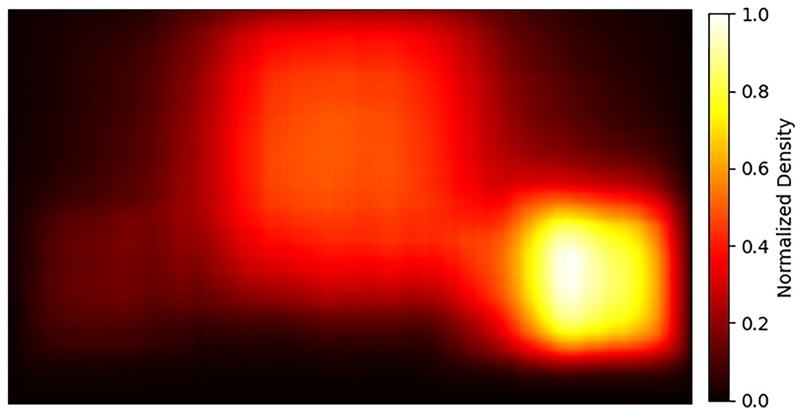
Heat Map of Normalized Spatial Density of V-Tuber Avatar PlacementNote. This figure displays the aggregated spatial distribution of V-Tuber head positions across 1,352 livestream frames. Warmer colors indicate a higher frequency of avatar placement within that screen region. The lower-right quadrant shows the highest density, suggesting a dominant framing convention in the V-Tuber streaming layout that optimizes visual presence while preserving space for gameplay or chat overlays.
The analysis of facial proportions among V-Tuber characters revealed consistent stylized deviations from typical human facial structures. The average head-to-screen ratio was 0.12 (SD = 0.10), indicating that V-Tuber heads occupied approximately 11.5% of the total screen area. The mean face-to-head ratio was 0.35 (SD = 0.11), suggesting that V-Tuber faces occupied a relatively small portion of the head area, emphasizing expansive hair or headgear designs. Regarding ocular proportions, the average eyes-to-face ratio was 0.11 (SD = 0.02), and the eyes-to-head ratio was 0.04 (SD = 0.01), confirming that the eyes are disproportionately large visual features compared to natural human anatomy.
To contextualize these findings, comparative analyses were conducted using anthropometric benchmarks from four human subgroups: children, adult men, adult women, and elderly males. The analyses revealed statistically significant differences in facial feature ratios following Bonferroni correction (smallest absolute t-value = 13.41, p < .001). V-Tubers showed a reduced face-to-head ratio (M = 0.35) compared to all human reference groups, with differences ranging from Δ = −0.039 (smallest difference relative to children) to Δ = −0.29 (largest difference relative to elderly males). In contrast, V-Tubers displayed notably larger eyes relative to both face and head size. The average eye-to-face ratio among V-Tubers exceeded that of adult women by 9 percentage points (Δ = 0.09). In comparison, the eye-to-head ratio exceeded that of this group by 2.3 percentage points (Δ = 0.023). These results indicate that V-Tuber designs emphasize larger eyes and smaller facial areas relative to typical human proportions.
Color clustering analysis revealed consistent aesthetic patterns across skin tone, eye color, and hair color among Korean V-Tubers (see Figure 4). Skin tone showed minimal variation, as the color clusters were predominantly composed of pale peach hues. These lighter tones accounted for 88.7% of all detected avatars. A small number of outliers exhibited non-natural tones, such as lavender or violet, while darker skin tones, including brown or black, were largely absent from the dataset.
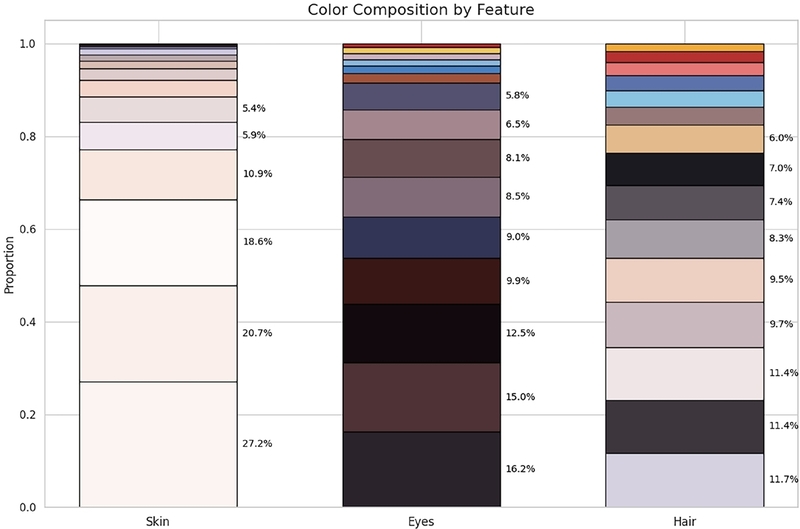
Color Composition of V-Tuber Skin, Eye, and Hair TonesNote. This figure displays the dominant color centroids for skin, eye, and hair color among V-Tuber avatars, identified using K-means clustering (k = 15). Each bar segment represents a cluster proportion and is labeled with its relative percentage. Only color clusters exceeding 5% are labeled.
Eye color exhibited greater variation than skin tone but remained concentrated within a limited range. Dark colors, primarily black and dark brown, comprised 53.6% of the sample. Lighter shades of brown accounted for 15.0%, followed by navy blue at 14.8%. Less frequently observed eye colors included blue, yellow, and red, each representing fewer than 5% of the avatars.
Hair color displayed the widest diversity among the three features. Dark shades, such as black and grey, accounted for 25.8% of the sample, while lighter and non-natural colors comprised a larger proportion. In particular, shades such as lavender, peach, and silver together accounted for 56.6% of all detected hair colors. Additional hues, including blue, pink, red, and yellow, each appeared in fewer than 5% of cases. Taken together, these distributions indicate a prevailing visual pattern characterized by light skin tones, dark eye colors, and a preference for light or vividly colored hair.
Discussion
Study 2 indicates that visual regularity is unevenly distributed across the measurable features of South Korean V-Tubers. Spatial positioning shows a recurring but not fixed convention in how V-Tuber avatars are organized within livestream frames. The lower-right configuration was the most common, and avatars in this position occupied a relatively small portion of the screen, leaving substantial screen space available for other visual content. In contrast, the less frequent upper-central configuration occupied a considerably larger portion of the screen, giving the avatar greater visual salience. These patterns indicate a common peripheral configuration alongside less frequent alternatives that make the avatar more prominent within the livestream frame.
Facial proportions showed stronger regularity, whereas color features varied more unevenly. Relative to the human reference groups, V-Tubers consistently displayed smaller facial areas relative to head size and larger eyes relative to both the face and head. The recurrence of these proportions indicates that stylization involves the relationship among facial and cranial features rather than enlarged eyes alone. Skin tone was highly concentrated and eye color remained relatively limited, while hair color showed substantially greater variation. This asymmetry suggests different degrees of constraint across color features, with hair color providing greater room for character differentiation than skin or eye color. Such variability indicates differentiation rather than cultural hybridity by itself. These distributions identify recurrence and variation, but cultural hybridity cannot be inferred from frequency or variability alone.
GENERAL DISCUSSION
The two studies suggest that cultural hybridity is not best understood as a property of a V-Tuber design as a whole. Different components of the same avatar can exhibit different patterns of retention, differentiation, and rearticulation, with some conventions remaining widely recurrent while others vary or acquire different cultural and performance functions. South Korean V-Tuber design reflects uneven retention and rearticulation within an inherited visual structure rather than a full transformation from Japanese to Korean visual forms.
This pattern extends the Korea–Japan cultural-circuit argument from the circulation of complete media forms to the circulation of specific visual conventions. Prior research on Korean digital media has documented selective transformation of Japanese-origin forms, including the reorganization of comics through webtoon production and distribution (Jang & Song, 2017; Oh & Koo, 2018). The V-Tuber case shows that such selectivity can also occur within a single avatar design, where inherited conventions remain recognizable while their relationships to costume, identity, or performance are reorganized. Rearticulation helps explain this process because cultural meaning changes through new relationships among signs and functions rather than through replacement of the inherited form itself (Grossberg, 1986).
Beyond facial morphology, visual identity is organized through a balance between retention and differentiation. Recurring color palettes, hairstyles, and identity markers provide stable visual anchors for individual characters, while the computational analysis shows that some visual characteristics, particularly hair color, vary substantially more than facial proportions or skin tone. This pattern indicates that individuality can be expressed through adjustable visual features without substantially altering the broader visual convention. South Korean V-Tubers can consequently develop distinct visual identities while continuing to rely on conventions that remain recognizable across avatar designs. Differentiation provides space for individualization within the inherited visual structure, while rearticulation changes how that structure is connected to cultural identities and performance functions.
The retention of anime-associated facial morphology provides a clear basis for considering Japanese visual dominance. Across both studies, South Korean V-Tuber designs systematically emphasize enlarged eyes and relatively reduced facial areas. Prior research similarly identifies enlarged eyes and youthful proportions as part of Japanese kawaii aesthetics (Lieber-Milo & Nittono, 2019). The recurrence of these proportions across the broader V-Tuber sample, together with their similarity to the Japanese Vocaloid references, indicates that this morphology is not a sporadic design choice but a strongly retained visual convention. This persistence is consistent with accounts of hybridity in which local rearticulation can coexist with the continued dominance of established cultural conventions (Kraidy, 2002; Nederveen Pieterse, 1994). Applied to South Korean V-Tuber design, this perspective suggests that Japanese-origin visual conventions can remain strongly recognizable while selected aspects of avatar design are differentiated or rearticulated within South Korean cultural and performance contexts. Therefore, Japanese visual dominance and cultural hybridity are not mutually exclusive, as rearticulation can occur without replacing the inherited visual conventions.
The unequal recurrence of visual conventions also raises a broader question about representational power in creator-driven digital media. Pale skin tones and stylized facial proportions recur much more consistently than many other visual characteristics across the analyzed V-Tubers. These features overlap with beauty ideals documented in South Korean media and culture, including the prominence of pale skin in representations of feminine beauty (Choi & Reddy-Best, 2021) and broader expectations surrounding feminine appearance (Holliday & Elfving-Hwang, 2012). Exemplification theory suggests that repeatedly encountered media examples can contribute to judgments about what is typical or representative (Zillmann, 1999; Zillmann & Brosius, 2000). Repeated configurations of these features could similarly contribute to perceptions of what constitutes a typical V-Tuber appearance. This recurrence is particularly notable in a creator-driven medium because no single producer determines how V-Tubers should appear. Nevertheless, repeated choices across independently constructed avatars can make particular visual conventions more prominent in how V-Tubers are represented, consistent with accounts of media power that emphasize how repeated representations organize social categories (Couldry, 2003, 2008) and how unequal visibility can itself become culturally consequential (Banet-Weiser, 2018). The present research does not directly examine audience judgments, but it identifies the distribution of visual conventions within which such judgments could develop. Paradoxically, substantial freedom in avatar construction does not necessarily produce representational diversity when particular bodily features remain comparatively uniform across independently designed avatars.
Limitations and Future Research Directions
Several limitations should be acknowledged, each of which also points to directions for future research. First, the sample analyzed in both studies was heavily weighted toward female-presenting V-Tuber avatars. While this distribution reflects the broader composition of the South Korean V-Tuber landscape, it limits the ability to examine how visual conventions vary across a wider range of gender presentations. Prior research suggests that male V-Tubers who adopt feminized avatars often reproduce dominant visual tropes rather than introducing alternative aesthetic patterns (Bredikhina & Giard, 2022), which further constrains observable variation in the present data. Future studies could address this limitation by intentionally oversampling male, nonbinary, or gender-ambiguous avatars to assess whether visual conventions shift when gender presentation departs from dominant norms. Given the flexibility of avatar-based performance, V-Tubers provide a particularly valuable context for examining how gender representation is visually constructed and negotiated in digital media.
Second, the empirical focus on South Korean V-Tubers limits the extent to which the findings can be generalized beyond this national context. While this research conceptualizes V-Tuber visual design within Korea–Japan cultural circuits, it does not directly examine other regional or global V-Tuber ecosystems. Prominent creators in China, North America, and Europe often operate within Japanese-origin agency structures and draw on similar visual traditions, yet they are embedded in distinct platform environments and audience cultures. Comparative research across national contexts would help clarify which visual conventions remain stable across transnational circuits and which are more sensitive to specific regions.
Third, both manual and computational analyses capture V-Tuber visual design at a single point in time. As cultural circuit approaches emphasize, meanings and practices evolve through ongoing circulation and recontextualization rather than remaining fixed. A longitudinal design would allow future research to examine whether visual conventions in Korean V-Tubing become more diversified over time, consolidate further around existing norms, or shift in response to platform changes, technological developments, or audience feedback. Tracking changes in facial stylization, color usage, or costume realism across multiple years would provide insight into how visual conventions stabilize or transform within Korea–Japan cultural circuits.
Finally, while this research documents a high degree of visual standardization, it does not directly assess how audiences interpret or respond to these patterns. The findings provide a cautious empirical basis for considering how repeated exposure to a narrow set of visual conventions might shape perceptions of what constitutes a typical or successful V-Tuber, in line with exemplification perspectives (Zillmann & Brosius, 2000). Future research could build on this foundation by integrating audience-based methods, such as experiments, surveys, or analyses of platform-based audience discourse. For example, audience comments on video platforms can provide insight into how viewers interpret media characters, negotiate meanings, and articulate evaluative responses in naturally occurring digital contexts (Malik et al., 2024). Applying a similar approach to V-Tuber livestream comments, YouTube comments, or fan community discussions would help examine how viewers respond to specific visual features, including avatar appearance, recognizability, gender presentation, and perceived authenticity. Such work would help clarify the social consequences of visual convention formation without assuming direct effects beyond what the present data support.
Conclusion
South Korean V-Tubers show that cultural hybridity can emerge without displacing inherited visual conventions. Japanese-origin conventions remain strongly recognizable, while selected elements are differentiated or rearticulated through new cultural and performance functions. Therefore, hybridity and Japanese visual dominance can coexist within the same avatar design, illustrating how Korea–Japan cultural circuits persist through the selective adaptation of established visual conventions.
Disclosure Statement
This research received no external funding. The authors reported no potential conflict of interest.
References
-
Ahn, D., Park, S., Lee, S., Cho, J., & Lim, H. (2025, April). I stan alien idols and also the people behind them: Understanding how seams between virtual and real identities engage VTuber fans—A case study of PLAVE. In Proceedings of the 2025 CHI Conference on Human Factors in Computing Systems (Article 1239, pp. 1–13). Association for Computing Machinery.
[https://doi.org/10.1145/3706598.3714218]

-
Anderson, N. (2021). Hatsune Miku, virtual idols, and transforming the popular music experience. MUSIC.OLOGY.ECA, 2, 40–57.
[https://doi.org/10.2218/music.2021.6478]
-
Banet-Weiser, S. (2018). Empowered: Popular feminism and popular misogyny. Duke University Press.
[https://doi.org/10.1215/9781478002772]
- Big Games Machine. (2025). How gamers are using YouTube in 2025. https://www.biggamesmachine.com/wp-content/uploads/2025/02/BGM-YouTube-survey-2025.pdf
-
Bredikhina, L., & Giard, A. (2022). Becoming a virtual cutie: Digital cross-dressing in Japan. Convergence, 28(6), 1643–1661.
[https://doi.org/10.1177/13548565221074812]
-
Choi, E., & Reddy-Best, K. L. (2021). South Korean fashion media: Examining beauty ideals, race, and the prominence of whiteness between 2013 and 2017 in Céci magazine. International Journal of Costume and Fashion, 21(2), 1–18.
[https://doi.org/10.7233/ijcf.2021.21.2.001]
-
Chu, H., Lee, H., Cho, H., & Hwang, M. (2014). Periodic features of Korean character designs. Archives of Design Research, 27(1), 117–141.
[https://doi.org/10.15187/adr.2014.02.109.1.117]
- Cohn, N. (2010). Japanese visual language: The structure of manga. In T. Johnson-Woods (Ed.), Manga: An anthology of global and cultural perspectives (pp. 187–203). Continuum.
-
Couldry, N. (2003). Media meta-capital: Extending the range of Bourdieu’s field theory. Theory and Society, 32(5–6), 653–677.
[https://doi.org/10.1023/B:RYSO.0000004915.37826.5d]
-
Couldry, N. (2008). Media discourse and the naturalisation of categories. In R. Wodak & V. Koller (Eds.), Handbook of communication in the public sphere (pp. 67–88). De Gruyter Mouton.
[https://doi.org/10.1515/9783110198980.1.67]
- Gravett, P. (2004). Manga: Sixty years of Japanese comics. Laurence King Publishing.
-
Grossberg, L. (1986). On postmodernism and articulation: An interview with Stuart Hall. Journal of Communication Inquiry, 10(2), 45–60.
[https://doi.org/10.1177/019685998601000204]
- Harrison, C. (2003). Visual social semiotics: Understanding how still images make meaning. Technical Communication, 50(1), 46–60. https://www.ingentaconnect.com/content/stc/tc/2003/00000050/00000001/art00007
-
Holliday, R., & Elfving-Hwang, J. (2012). Gender, globalization and aesthetic surgery in South Korea. Body & Society, 18(2), 58–81.
[https://doi.org/10.1177/1357034X12440828]
-
Ito, K. (2005). A history of manga in the context of Japanese culture and society. The Journal of Popular Culture, 38(3), 456–475.
[https://doi.org/10.1111/j.0022-3840.2005.00123.x]
-
Iwabuchi, K. (2002). Recentering globalization: Popular culture and Japanese transnationalism. Duke University Press.
[https://doi.org/10.1215/9780822384083]
-
Jang, W., & Song, J. E. (2017). Webtoon as a new Korean wave in the process of glocalization. Kritika Kultura, 29, 168–187.
[https://doi.org/10.13185/1656-152x.2138]
-
Jeong, D., & Youk, S. (2023). Refining esports: A quantitative cartography of esports literature. Entertainment Computing, 47, Article 100597.
[https://doi.org/10.1016/j.entcom.2023.100597]
-
Jin, D. Y. (2015). Digital convergence of Korea’s webtoons: Transmedia storytelling. Communication Research and Practice, 1(3), 193–209.
[https://doi.org/10.1080/22041451.2015.1079150]
- Jin, D. Y. (2019). Snack culture’s dream of big-screen culture: Korean webtoons’ transmedia storytelling. International Journal of Communication, 13, 2094–2115. https://ijoc.org/index.php/ijoc/article/view/10004
-
Kim, G. E. (2021). A study on the formative of Korean webtoon character as education content: Focus on primary science study book. Journal of Cultural Product & Design, 65, 205–215. https://www.dbpia.co.kr/journal/articleDetail?nodeId=NODE10703567
[https://doi.org/10.18555/kicpd.2021.65.18]
-
Kraidy, M. M. (2002). Hybridity in cultural globalization. Communication Theory, 12(3), 316–339.
[https://doi.org/10.1111/j.1468-2885.2002.tb00272.x]
-
Kress, G., & van Leeuwen, T. (2020). Reading images: The grammar of visual design (3rd ed.). Routledge.
[https://doi.org/10.4324/9781003099857]
-
Lam, K . Y. (2016). The Hatsune Miku phenomenon: More than a virtual J-pop diva. The Journal of Popular Culture, 49(5), 1107–1124.
[https://doi.org/10.1111/jpcu.12455]
-
Lent, J. A. (2022). South Korean manhwa’s long and strong association with transnationalism. In J. A. Lent, W. S. Wong, & B. W. Ng (Eds.), Transnationalism in East and Southeast Asian comics art (pp. 93–116). Palgrave Macmillan.
[https://doi.org/10.1007/978-3-030-95243-3_5]
-
Lieber-Milo, S., & Nittono, H. (2019). From a word to a commercial power: A brief introduction to the kawaii aesthetic in contemporary Japan. Innovative Research in Japanese Studies, 3, 13–32.
[https://doi.org/10.18910/73599]
-
Lu, Z., Shen, C., Li, J., Shen, H., & Wigdor, D. (2021). More kawaii than a real-person live streamer: Understanding how the otaku community engages with and perceives virtual YouTubers. In Proceedings of the 2021 CHI Conference on Human Factors in Computing Systems (Article 137, pp. 1–14). Association for Computing Machinery.
[https://doi.org/10.1145/3411764.3445660]
-
MacWilliams, M. W. (Ed.). (2008). Japanese visual culture: Explorations in the world of manga and anime. Routledge.
[https://doi.org/10.4324/9781315703152]
-
Malik, M., Youk, S., & Weber, R. (2024). Beyond the screen: Exploring moral understanding via user comments on YouTube short films. Journal of Media Psychology, 36(4), 231–243.
[https://doi.org/10.1027/1864-1105/a000430]
-
Mayring, P. (2000). Qualitative content analysis. Forum Qualitative Sozialforschung / Forum: Qualitative Social Research, 1(2), Article 20.
[https://doi.org/10.17169/fqs-1.2.1089]
- McCloud, S. (1993). Understanding comics: The invisible art. HarperCollins.
-
Nederveen Pieterse, J. (1994). Globalisation as hybridisation. International Sociology, 9(2), 161–184.
[https://doi.org/10.1177/026858094009002003]
-
Oh, I., & Koo, B. (2018). Japanese webtoon: Marketing manga online using South Korean platform designs. Culture and Empathy, 1(1–4), 49–69.
[https://doi.org/10.32860/26356619/2018/1.1234.0005]
-
Otmazgin, N. K. (2008). Contesting soft power: Japanese popular culture in East and Southeast Asia. International Relations of the Asia-Pacific, 8(1), 73–101.
[https://doi.org/10.1093/irap/lcm009]
-
Ryoo, W. (2009). Globalization, or the logic of cultural hybridization: The case of the Korean wave. Asian Journal of Communication, 19(2), 137–151.
[https://doi.org/10.1080/01292980902826427]
-
Schmieder, R. (2024). Waiting for a face reveal that never comes? How VTubers challenge our understanding of influencer authenticity. Celebrity Studies, 15(2), 266–281.
[https://doi.org/10.1080/19392397.2024.2341602]
-
Schreier, M. (2012). Qualitative content analysis in practice. SAGE Publications.
[https://doi.org/10.4135/9781529682571]
-
Shim, D. (2006). Hybridity and the rise of Korean popular culture in Asia. Media, Culture & Society, 28(1), 25–44.
[https://doi.org/10.1177/0163443706059278]
-
Vita, N. I., Encluna, V. E., Siregar, N. S. S., Rusmardiana, A., & Anantadjaya, S. P. D. (2023). AI public relations: The early rise of Kizuna AI. Jurnal Studi Komunikasi, 7(2), 417–429.
[https://doi.org/10.25139/jsk.v7i2.6689]
-
Wan, Q., & Lu, Z. (2024). Investigating VTubing as a reconstruction of streamer self-presentation: Identity, performance, and gender. Proceedings of the ACM on Human-Computer Interaction, 8(CSCW1), Article 80.
[https://doi.org/10.1145/3637357]
-
Wong, W. S. (2006). Globalizing manga: From Japan to Hong Kong and beyond. Mechademia, 1, 23–45.
[https://doi.org/10.1353/mec.0.0060]
- Zhou, X. (2020). Virtual Youtuber Kizuna AI: Co-creating human-non-human interaction and celebrity-audience relationship [Master’s thesis, Lund University]. LUP Student Papers. https://lup.lub.lu.se/student-papers/search/publication/9009369
-
Zillmann, D. (1999). Exemplification theory: Judging the whole by some of its parts. Media Psychology, 1(1), 69–94.
[https://doi.org/10.1207/s1532785xmep0101_5]
-
Zillmann, D., & Brosius, H.-B. (2000). Exemplification in communication: The influence of case reports on the perception of issues. Routledge.
[https://doi.org/10.4324/9781410604743]
- Zion Market Research. (2025, February). Vtuber (virtual YouTuber) market size, share, trends, growth 2032. https://www.zionmarketresearch.com/report/vtuber-virtual-youtuber-market