| About ACR | Editorial Board | Guide for Authors | View Articles | Submit Manuscript |



Latest Issue
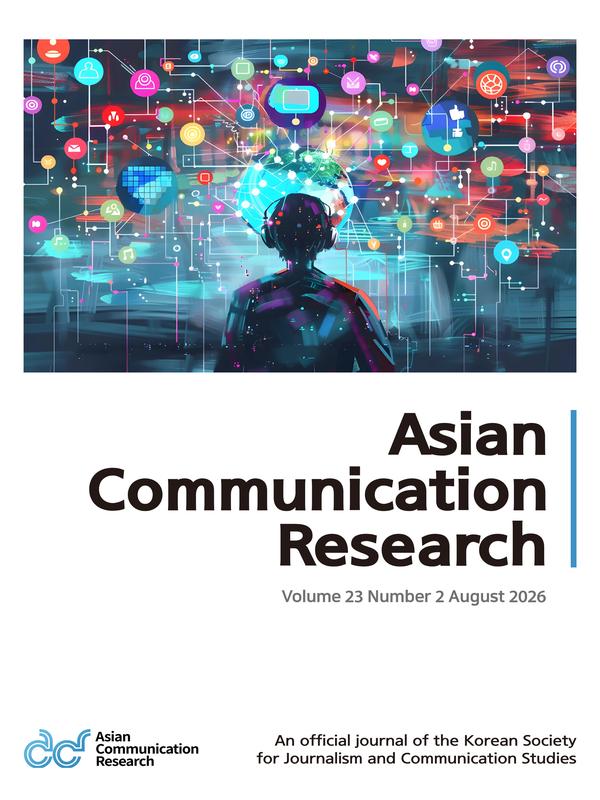
Volume 23(2); August 2026
-
Mapping Inter-Asian Connections through Mother-Daughter Relationships in South Korean Films
Myoung-Sun Song
This paper examines two contemporary Korean films— (2023) and (2019)—through the lens of connections: between mothers and daughters, between lovers, and ultima...
-
Megu Itoh
The villainess character has recently emerged as a transnationally circulating archetype across Korean and Japanese media, particularly within manga, manhwa, we...
-
South Korean V-Tuber Visual Conventions within Korea–Japan Cultural Circuits
Olivier Jiyoun Jung, Sungbin Youk
Virtual YouTubers (V-Tubers) are avatar-based digital content creators whose performances rely heavily on visual design. Although V-Tubers have become increasin...
-
When Paid Intimacy Fails: Target-Specific Accountability in Chinese K-pop Video Call Events
Xingyue Li, Kristin April Kim, Ji Hoon Park
K-pop video call events turn intimate access into a paid encounter involving idols, entertainment companies, sales platforms, and fan organizations. This study ...
-
Embodied Boundary Work: Materializing Identity Across Transnational K-pop Concert Spaces
Sam James, So Yoon Lee
This study posits K-pop fandom as a site of , focusing on the spatial and material dimensions of concertgoing practices. Drawing on comparative ethnographic fie...
-
K-Style Content on Netflix: Assembling ‘Korea’ in the Platform Era
Sarah Keith
This article theorises the term ‘K-style content’ to describe Western produced televisual media that mobilises Korean popular culture as a resource to attract g...
Special Issue: Circuits of K-content: Co-productions, Collaborations, and Connections
Book Review



| Editors’ Pick | |||
|









ISSN: 1738-2084 (Print), 2765-3390 (Online)
Copyright © 2021 Korean Society for Journalism & Communication Studies
Address: 04520,#1409 Korea Press Foundation 124, Sejong-daero, Jung-gu, Seoul, Korea
Tel: 82-2-762-6833, Fax: 82-2-723-8351, Homepage: www.comm.or.kr, E-mail: office@comm.or.kr